IṢẸ́ ỌNÀ
ẸWÀ ÀTI ÌLERA
IṢẸ́ ỌWỌ́
ÀṢÀ ÀTI ÌTÀN
ÌṢERÉ
ÀYÍKÁ
OÚNJẸ ÀTI OHUN MÍMU
REVERSE ENGINEERING
SÁYẸ́ǸSÌ
ERÉ ÌDÁRAYÁ
ÌMỌ̀-Ẹ̀RỌ
ÀWỌN OHUN WÍWỌ̀
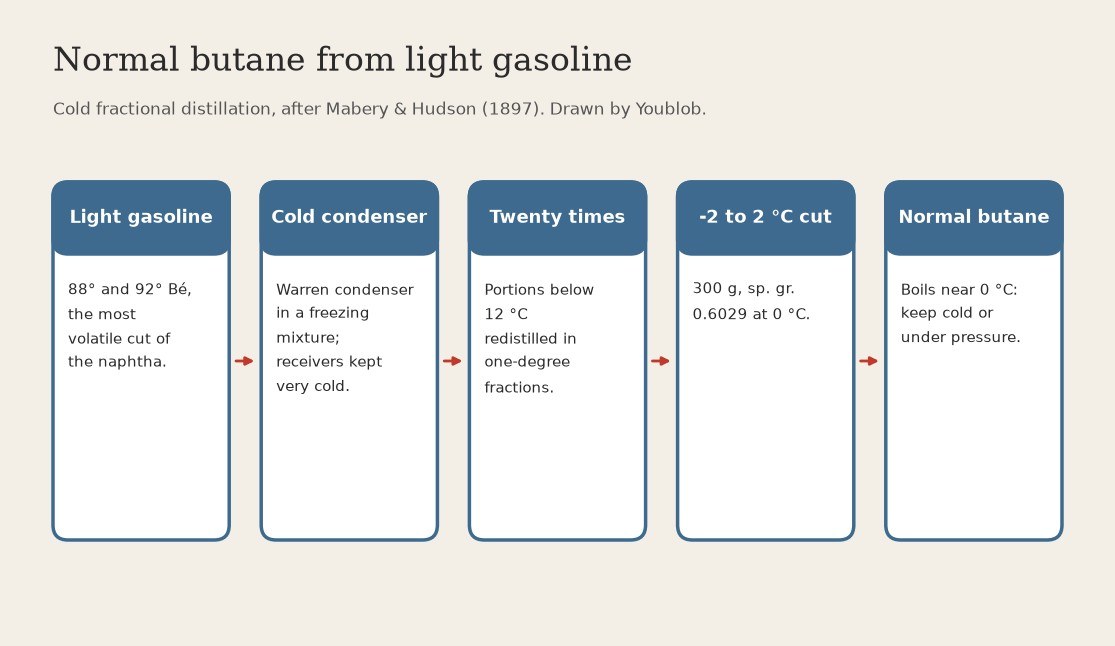


Normal Butane: the 0 °C Cut of the Lightest Gasoline, Distilled Twenty Times in the Cold (Mabery & Hudson 1897)
The lightest gasoline still holds butane, a gas that boils at about 0 °C. Distil it again and again through a condenser packed in a freezing mixture, and the butane gathers as a cut between -2 and 2 °C.
Result: 300 grams within -2 to 2 °C, specific gravity 0.6029 at 0 °C, vapour density 2.07 (2.01 calculated for butane). Very little came over below -10 °C.
Note: Mabery & Hudson named this cut isobutane. By the boiling points in Ipatieff & Pines, US 2,318,226 (normal butane +0.5 °C, isobutane -10.5 °C), a cut at 0 °C is normal butane, and it is built here as such.
Source: Mabery & Hudson, Proc. Amer. Acad. 32 (1897), pp. 101-111. Not given: the freezing mixture, how the butane was stored. Extremely flammable: no flame near. Picture drawn by Youblob.
Ògbóǹtarìgì
3 months
Ìlànà
1
1
Take the lightest gasoline
Take the lightest gasoline
Start from the most volatile gasoline you can get. Mabery & Hudson used 88° and 92° Baumé gasoline, the second distillate of Pennsylvania and Ohio naphtha, collected at the refinery in lots of 45 litres while the air was below 0 °F. 250 litres were worked in all.
Àwọn ohun èlò fún ìgbésẹ̀ yìí:
 Epo bẹ́ńtíróòlù250 lítà
Àwọn irinṣẹ́ tí a nílò:
 Ìgò Gíláàsì Ìsàn
2
2
Distil through a condenser in a freezing mixture
Distil through a condenser in a freezing mixture
Distil from a flask through a Warren condenser filled with a freezing mixture, and keep every receiver very cold to avoid loss. The paper does not give the mixture. Ours: crushed ice and salt.
Àwọn irinṣẹ́ tí a nílò:
Ìgò Gíláàsì Ìsàn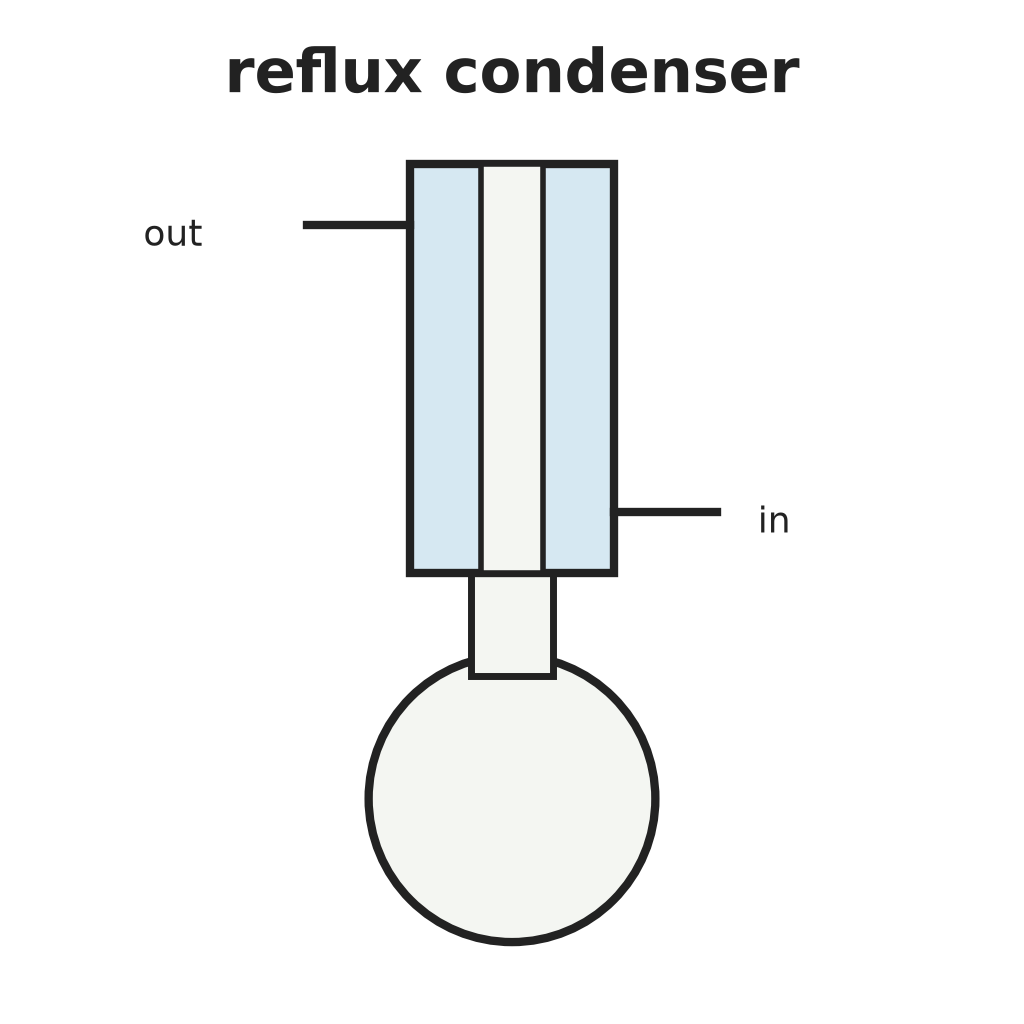 Kọ́ndẹ́nsà Ìpadàbọ̀
 Yìnyín tí a gún
 Iyọ̀
 Ẹ̀rọ Ìwọ̀n Ooru Yàrá Ìwádìí
3
3
Let the lightest portions boil from room heat
Let the lightest portions boil from room heat
The portions from -20 to -10 °C boil from the heat of the surrounding air alone. Regulate them by cooling the still, not by heating it.
Àwọn irinṣẹ́ tí a nílò:
Ìgò Gíláàsì ÌsànYìnyín tí a gúnIyọ̀Ẹ̀rọ Ìwọ̀n Ooru Yàrá Ìwádìí4
4
Redistil everything below 12 °C twenty times
Redistil everything below 12 °C twenty times
Collect in single-degree fractions and distil the portions below 12 °C again, twenty times over. By the twentieth run almost nothing stays between 5 and 20 °C, and the butane gathers between -2 and 2 °C.
Àwọn irinṣẹ́ tí a nílò:
Ìgò Gíláàsì ÌsànKọ́ndẹ́nsà Ìpadàbọ̀Yìnyín tí a gúnIyọ̀Ẹ̀rọ Ìwọ̀n Ooru Yàrá Ìwádìí5
5
Keep the -2 to 2 °C cut
Keep the -2 to 2 °C cut
This is the butane: 300 grams in Mabery & Hudson's run, specific gravity 0.6029 at 0 °C. It boils at about 0 °C, so it must be kept cold or under pressure. Ours: condense it into a pressure gas cylinder.
Àwọn irinṣẹ́ tí a nílò:
 Àgbá gáàsì tí a fi ìfúnpá kúnẸ̀rọ Ìwọ̀n Ooru Yàrá Ìwádìí
Àwọn ohun-èlò
1- 250 lítàÀyè
Ìtọ́nisọ́nà yìí ń ṣe
Blueprint tó jọra
Àwọn blueprint wọ̀nyí pín ìmọ̀ — ọ̀nà, ohun-èlò tàbí ìlànà
CC0 Àgbègbè Gbogbogbò
Blueprint yìí ti jáde lábẹ́ CC0. O lè ṣe àdàkọ, yí padà, pín, àti lò láìsí ìyọ̀ǹda.
Ṣàtìlẹ́yìn Olùṣẹ́dá nípa rírà àwọn ọjà nipasẹ̀ Blueprint wọn Ẹ̀san Olùṣẹ́dá tí àwọn Olùtajà gbé kalẹ̀, tàbí ṣẹ̀dá àtúnṣe tuntun ti Blueprint yìí kí o sì fi sínú Blueprint rẹ gẹ́gẹ́ bí ìsopọ̀ láti pín owó-wíwọlé.