
Notation Beauchamp-Feuillet
Comment écrire une danse sur une feuille de papier ? La musique avait sa portée depuis des siècles. La danse, elle, se transmettait de corps à corps, et disparaissait avec le maître qui la connaissait.
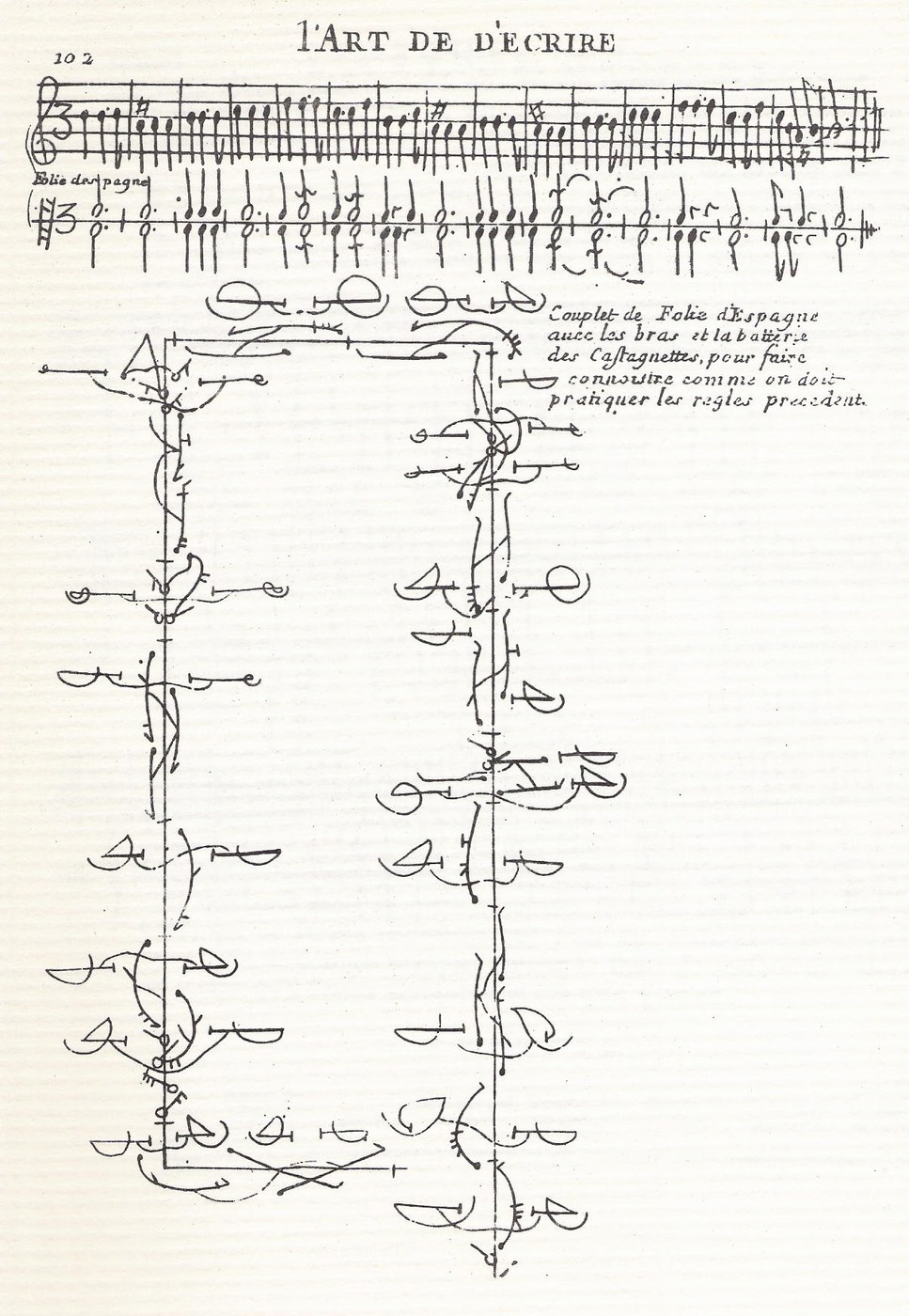
La solution trouvée à la cour de Louis XIV est d'une élégance rare : on ne dessine pas le danseur, on dessine le chemin qu'il parcourt sur le plancher. C'est le tract, une ligne vue d'en haut, comme un plan. Les pas s'accrochent le long de cette ligne, la musique est imprimée en haut de la page, et les barres de mesure traversent le tract — si bien qu'on voit d'un coup d'œil quel pas tombe sur quel temps.
Ce n'est pas un exercice d'archive. Plus de trois cents danses nous sont parvenues uniquement grâce à ce système. Sans lui, nous ne saurions pas comment on dansait en 1700 — nous aurions seulement des tableaux et des mots.
Ìlànà
Préparer la page comme un plan vu d'en haut
Préparer la page comme un plan vu d'en haut
Prenez une feuille en orientation portrait. Toute la page représente le plancher de la salle, vu du dessus. Rien n'est dessiné de profil.
Àwọn ohun èlò fún ìgbésẹ̀ yìí:
 Bébà àwọ̀ omi1 ewé
Àwọn irinṣẹ́ tí a nílò:
 Ìṣù kálámù ìwé ìròyìn (aláìní acid)
Marquer la présence en haut de la page
Marquer la présence en haut de la page
Le haut de la page, c'est le côté du roi — la présence. Écrivez-le en toutes lettres. Toutes les directions de la danse se lisent par rapport à ce point, jamais par rapport au danseur.
Réserver le haut pour la portée musicale
Réserver le haut pour la portée musicale
Réservez une bande en haut de la page et recopiez-y la mélodie sur une portée ordinaire. C'est l'une des vraies inventions du système : le musicien lit sa page habituelle, au-dessus de la danse.
Àwọn irinṣẹ́ tí a nílò:
 Ìdíwọ̀n
Tracer le chemin du danseur
Tracer le chemin du danseur
Dessinez le tract : une ligne continue qui part de la position de départ et suit le déplacement au sol. Droite pour un déplacement droit, courbe pour un contour.
Placer les deux danseurs et leur orientation
Placer les deux danseurs et leur orientation
Marquez la position de départ de chacun et le sens dans lequel il regarde. La figure doit dire tout de suite qui est où, et face à quoi.
Couper le tract par les barres de mesure
Couper le tract par les barres de mesure
Tracez un petit trait en travers du tract à chaque barre de mesure de la musique. C'est ce qui synchronise le pied et la note : on voit exactement où en est le danseur à chaque mesure.
Dessiner le signe de pas contre la ligne
Dessiner le signe de pas contre la ligne
Chaque pas se dessine comme un petit trait perpendiculaire au tract, avec une marque au bout pour le pied. Le côté du trait indique quelle jambe travaille : à droite du tract pour le pied droit, à gauche pour le gauche.
Noter les cinq positions vraies
Noter les cinq positions vraies
Apprenez d'abord les positions des pieds — les cinq positions dites vraies, que Feuillet expose avant tout le reste, puis les positions fausses. Tout le vocabulaire des pas part de là.
Ajouter les six mouvements de jambe
Ajouter les six mouvements de jambe
Six mouvements se greffent sur le signe de pas : plié, relevé, sauté, cabriole, tombé, glissé. Chacun a sa marque, ajoutée sur le trait de la jambe concernée.
Distinguer les quatre familles de pas
Distinguer les quatre familles de pas
Un pas est droit, circulaire, ondoyant ou battu, et le tracé du signe le montre. C'est la même logique qu'une note de musique : la forme du signe porte l'information, pas une légende.
Noter un pas de bourrée complet
Noter un pas de bourrée complet
Écrivez un pas de bourrée : un plié, puis trois transferts de poids le long du tract, répartis sur une mesure. Vérifiez que les trois signes tiennent entre deux barres de mesure.
Enchaîner huit mesures
Enchaîner huit mesures
Continuez le tract sur huit mesures en gardant le même espacement entre les barres. Un tract dont les mesures sont irrégulières se lit mal, même s'il est juste.
Marquer les bras et les mains prises
Marquer les bras et les mains prises
Ajoutez les signes de bras là où ils comptent, et indiquez les moments où les danseurs se prennent et se lâchent la main. Sans cela, une danse à deux devient illisible.
Faire lire la page par quelqu'un d'autre
Faire lire la page par quelqu'un d'autre
Le vrai test : donnez la feuille à une personne qui n'a pas vu la danse et demandez-lui de la parcourir au sol. Ce qu'elle ne retrouve pas, c'est ce que votre notation n'a pas dit.
Histoire et contexte
Histoire et contexte
Une commande royale. Le système a été mis au point dans les années 1680 à la cour de Louis XIV, sur commande du roi, par Pierre Beauchamp. Il n'a pas été publié par lui. C'est Raoul-Auger Feuillet qui le décrit et l'imprime en 1700 dans Chorégraphie, ou l'art de décrire la danse.
Le procès de 1704. Beauchamp attaque Feuillet en justice, affirmant que l'invention est la sienne. Il perd, faute de preuves — il n'avait rien publié. Le jugement est instructif : dans l'histoire des techniques, c'est la publication qui fixe la paternité, pas l'antériorité. Le nom moderne, notation Beauchamp-Feuillet, rend justice aux deux : Feuillet n'est généralement pas tenu pour l'inventeur, mais pour celui qui a documenté, publié et sans doute adapté le système.
Ce qu'elle a sauvé. Plus de trois cents danses nous sont parvenues dans cette notation. C'est de très loin la source principale sur la danse baroque : sans elle, il ne resterait que des descriptions écrites et des images fixes, dont on ne peut pas déduire un enchaînement. Le système reste en usage, sous des formes modifiées, jusque dans les années 1780.
Ses limites, honnêtement. La notation décrit avant tout les pieds. Les bras y sont pauvrement traités, le haut du corps presque pas, et le style — la qualité du mouvement, ce qui distingue un bon danseur d'un danseur exact — échappe complètement au papier. Les reconstitutions actuelles s'appuient donc aussi sur les traités écrits de l'époque, comme celui de Kellom Tomlinson. Une notation dit ce qu'il faut faire ; elle ne dit pas comment cela doit être beau.
Et le mot. Le titre de Feuillet a donné au français, puis à toutes les langues, le mot chorégraphie — qui signifiait littéralement, au départ, l'art d'écrire la danse. Le sens s'est déplacé vers la composition elle-même ; l'écriture, elle, est restée un problème non résolu, et chaque siècle depuis a proposé son propre système.
Àwọn ohun-èlò
1- 1 ewéÀyè
CC0 Àgbègbè Gbogbogbò
Blueprint yìí ti jáde lábẹ́ CC0. O lè ṣe àdàkọ, yí padà, pín, àti lò láìsí ìyọ̀ǹda.
Ṣàtìlẹ́yìn Olùṣẹ́dá nípa rírà àwọn ọjà nipasẹ̀ Blueprint wọn Ẹ̀san Olùṣẹ́dá tí àwọn Olùtajà gbé kalẹ̀, tàbí ṣẹ̀dá àtúnṣe tuntun ti Blueprint yìí kí o sì fi sínú Blueprint rẹ gẹ́gẹ́ bí ìsopọ̀ láti pín owó-wíwọlé.