IṢẸ́ ỌNÀ
ẸWÀ ÀTI ÌLERA
IṢẸ́ ỌWỌ́
ÀṢÀ ÀTI ÌTÀN
ÌṢERÉ
ÀYÍKÁ
OÚNJẸ ÀTI OHUN MÍMU
REVERSE ENGINEERING
SÁYẸ́ǸSÌ
ERÉ ÌDÁRAYÁ
ÌMỌ̀-Ẹ̀RỌ
ÀWỌN OHUN WÍWỌ̀

Ohm's Law at the Bench: Picking the Resistor That Saves the LED
One equation does most of the arithmetic a maker ever needs from electronics, and it is three letters long. What makes it worth a rung of its own is that the three commonest beginner disasters — the LED that dies instantly, the resistor that cooks, the divider that sags under load — are all the same equation applied carelessly.
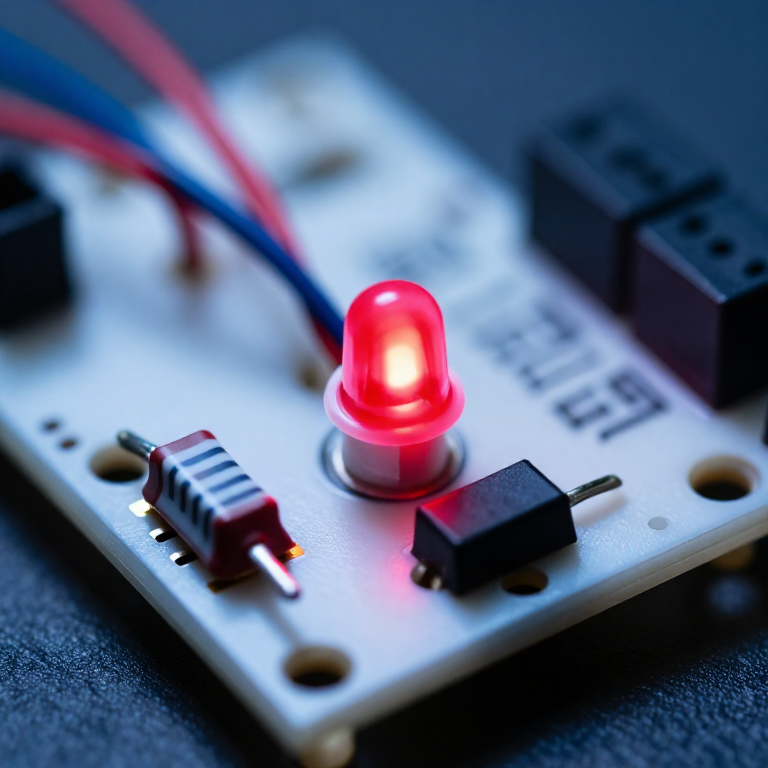
An LED is the sharpest example. It is not a resistor: past its forward voltage the current rises almost without limit, so connecting one directly across a supply destroys it in a fraction of a second. The resistor beside it is not a formality, it is the only thing deciding the current.
Every SIK circuit published here that lights an LED has one, and this is why.
Olùbẹ̀rẹ̀
3 hours
Ìlànà
1
1
Size the resistor for an LED, and see why it is not optional
Size the resistor for an LED, and see why it is not optional
Ń ṣí ìwé Jupyter…
Àwọn ohun èlò fún ìgbésẹ̀ yìí:
 Ìṣù LED1 ẹyọ
 Àkójọ Rẹsístà1 ẹyọ
Àwọn irinṣẹ́ tí a nílò:
 Pátákó Àdánwò
 Ẹ̀rọ Ìṣirò
 Òǹwọ̀n iná mànàmáná onírúurú
2
2
Check the resistor will survive the heat
Check the resistor will survive the heat
Ń ṣí ìwé Jupyter…
Àwọn ohun èlò fún ìgbésẹ̀ yìí:
Àkójọ Rẹsístà1 ẹyọÀwọn irinṣẹ́ tí a nílò:
Ẹ̀rọ ÌṣiròÒǹwọ̀n iná mànàmáná onírúurú3
3
The divider that works until you connect something
The divider that works until you connect something
Ń ṣí ìwé Jupyter…
Àwọn ohun èlò fún ìgbésẹ̀ yìí:
Àkójọ Rẹsístà1 ẹyọÀwọn irinṣẹ́ tí a nílò:
Pátákó ÀdánwòÒǹwọ̀n iná mànàmáná onírúurúẸ̀rọ Ìṣirò4
4
Measure it, and find out what your parts really are
Measure it, and find out what your parts really are
Build the LED and its resistor on a breadboard, then measure: the supply, the voltage across the LED, and the voltage across the resistor. They should add up to the supply.
Then work out the current from the resistor's voltage and its measured resistance, and compare it with what you calculated. The LED's real forward voltage will not be exactly the table value — it varies by part, by colour bin, and with current — which is why the calculation is a starting point and the measurement is the answer.
This also demonstrates Kirchhoff's voltage law without naming it: around any loop, the voltages sum to zero. Once you have seen it on a meter it stops being an abstraction and becomes a tool for finding where a missing volt went.
Àwọn ohun èlò fún ìgbésẹ̀ yìí:
Ìṣù LED1 ẹyọÀkójọ Rẹsístà1 ẹyọÀwọn irinṣẹ́ tí a nílò:
Pátákó ÀdánwòÒǹwọ̀n iná mànàmáná onírúurú Ìpèsè Agbára Tábìlì
Àwọn ohun-èlò
2- 2 ẹyọÀyè
- láti$5.64
Blueprint tó jọra
Àwọn blueprint wọ̀nyí pín ìmọ̀ — ọ̀nà, ohun-èlò tàbí ìlànà

CC0 Àgbègbè Gbogbogbò
Blueprint yìí ti jáde lábẹ́ CC0. O lè ṣe àdàkọ, yí padà, pín, àti lò láìsí ìyọ̀ǹda.
Ṣàtìlẹ́yìn Olùṣẹ́dá nípa rírà àwọn ọjà nipasẹ̀ Blueprint wọn Ẹ̀san Olùṣẹ́dá tí àwọn Olùtajà gbé kalẹ̀, tàbí ṣẹ̀dá àtúnṣe tuntun ti Blueprint yìí kí o sì fi sínú Blueprint rẹ gẹ́gẹ́ bí ìsopọ̀ láti pín owó-wíwọlé.