IṢẸ́ ỌNÀ
ẸWÀ ÀTI ÌLERA
IṢẸ́ ỌWỌ́
ÀṢÀ ÀTI ÌTÀN
ÌṢERÉ
ÀYÍKÁ
OÚNJẸ ÀTI OHUN MÍMU
REVERSE ENGINEERING
SÁYẸ́ǸSÌ
ERÉ ÌDÁRAYÁ
ÌMỌ̀-Ẹ̀RỌ
ÀWỌN OHUN WÍWỌ̀

Orbiting Churn With Rod Rack: The Churn Circles Without Turning, Rods Break the Current
Maxwell moved the whole churn, but not round its own axis.
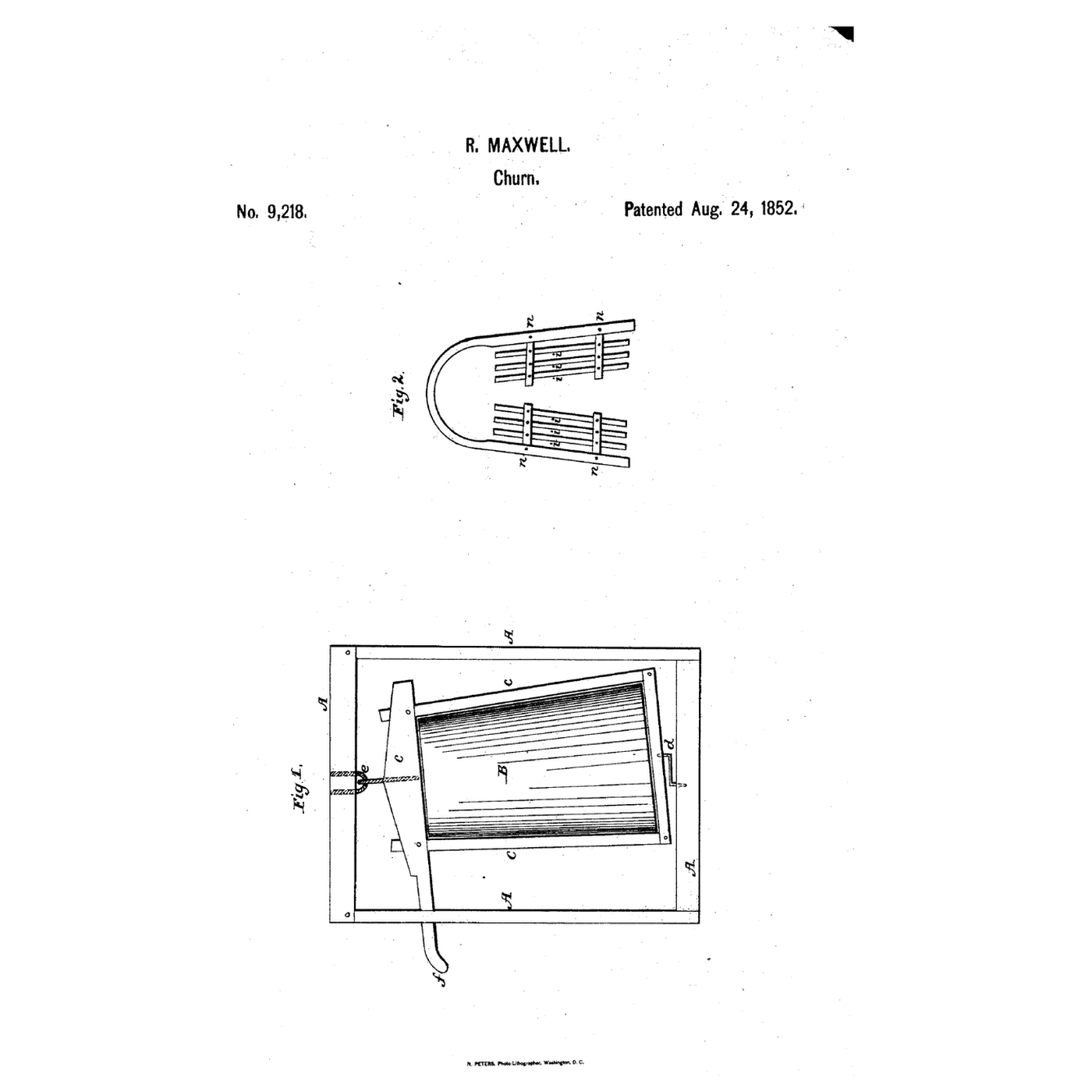
Rufus Maxwell of Lewis County, Virginia, received US 9,218, dated 24 August 1852, for a churn fastened in a frame hung by a hook and staple inside a supporting frame, with a crank connecting the two "so that the center of the bottom of the churn may revolve about a circle, (five or six inches in diameter)." This makes the milk flow round; a rack of parallel rods half an inch apart on a bow of "tough elastic wood" pressing against the sides breaks the current. He claimed forcing the milk through a rack "by revolving the churn in an orbit, without turning it on axis."
This rung works out the bottom's speed, then prints the rod holders and orbit crank, builds the frame and rack, and makes butter.
Àárín
About 4 hours, plus printing
Ìlànà
1
1
The orbit
The orbit
Ń ṣí ìwé Jupyter…
2
2
A churn that moves as a whole, with a grate inside, before it
A churn that moves as a whole, with a grate inside, before it
The embedded blueprint rocks a barrel through a grate. Maxwell circles his churn so the milk flows round through a rack of rods.
3
3
Read US 9,218
Read US 9,218
"This rack consists of a piece of tough elastic wood, bent as represented at Fig. 2, so that it will press against the sides of the churn, thus holding the rack in a stationary position, (with respect to the churn)."
4
4
Print the parts
Print the parts
Print four rod holders (/uploads/blueprints/orbiting-churn-with-rod-rack-rod-holder.stl), the blocks n, and the orbit crank (/uploads/blueprints/orbiting-churn-with-rod-rack-orbit-crank.stl), whose pin is 70 mm off centre for a 5½ in circle. Print in PETG at 0.2 mm layers, 30 % infill, 4 walls; wash before first use.
Àwọn ohun èlò fún ìgbésẹ̀ yìí:
 Okùn PETG1 ẹyọ
Àwọn irinṣẹ́ tí a nílò:
 Ẹ̀rọ ìtẹ̀ 3D oníwàyà (FDM)
5
5
The rack
The rack
Bend a strip of thin steam-bent hardwood or spring steel into a U that springs against the inside of a tapered food-grade bucket. Screw the rod holders to its two legs and push 6 mm hardwood dowels through them, 12–13 mm apart as his, across the bucket.
Àwọn ohun èlò fún ìgbésẹ̀ yìí:
 Ọ̀pá irin orísun1 ẹyọ
 Àwọn dowel igi líle1 ẹyọ
 Ìsúrù igi #8 x 1"1 ẹyọ
 Bàkẹ́ẹ̀tì Lítà 201 ẹyọ
Àwọn irinṣẹ́ tí a nílò:
 Ayùn Ọwọ́
 Ẹ̀rọ Ìlùkòkò Aláìlókùn
 Ìṣù àwọn ohun ìyí skurú
6
6
Frames and crank
Frames and crank
Fasten the bucket in a pine frame and hang that frame from a hook in a larger supporting frame. Mount the orbit crank on a post under the bucket so its pin sits in a socket at the centre of the bucket's bottom, and run the hanging frame's top up through a guide as the handle. Turning the crank carries the bottom round without turning the bucket.
Àwọn ohun èlò fún ìgbésẹ̀ yìí:
 Pákó igi pine1 ẹyọ
 Ọ̀pá Róbótó Irin Rírọ̀1 ẹyọÌsúrù igi #8 x 1"1 ẹyọÀwọn dowel igi líle1 ẹyọ
Àwọn irinṣẹ́ tí a nílò:
Ayùn Ọwọ́Ẹ̀rọ Ìlùkòkò Aláìlókùn Àkójọ Orí ÌlùkòkòÌṣù àwọn ohun ìyí skurú
7
7
The patent drawing
The patent drawing
US 9,218 drawing sheet, public domain (expired patent).
8
8
Orbit and make butter
Orbit and make butter
Let the heavy cream stand until it reaches about 15 °C, checked with the thermometer. Pour in 3 litres. Turn the crank so the bottom circles steadily; time until the butter comes. Pour off the buttermilk, add cold water, churn a little and pour off again until it runs clear; work in a pinch of salt and weigh the butter.
Àwọn ohun èlò fún ìgbésẹ̀ yìí:
 Ọ̀rá wàrà tó nípọn3000 ml
 Iyọ̀ Òkun Rúkèrúdò1 ẹyọ
 Omi1 ẹyọ
Àwọn irinṣẹ́ tí a nílò:
 Ẹ̀rọ ìwọ̀n ooru oníhun tí ó dúró sí inú
 Aago Ìdúró
 Òṣùwọ̀n Díjítà Ilé Ìdáná
 Àwo ìdàpọ̀ ńlá ti irin tí kò ń yá
9
9
A rack that slips, a churn that turns
A rack that slips, a churn that turns
Orbiting churn troubleshooting.
Flow
Loading...
10
10
History and honest limits
History and honest limits
**Rufus Maxwell** of Lewis County, Virginia (the drawing reads Weston), received US 9,218, dated 24 August 1852. Four pins in the bow at n, n carry the rods, bored through them. He claimed forcing the milk through a rack by revolving the churn in an orbit without turning it on its axis, and the bow and rods connected together.
**Honest limits.** A bucket, pine frames and printed parts stand in for his. FDM prints hold food in their layer lines, so wash well and replace when worn. Your times and weights are the result.
Àwọn ohun-èlò
10- 1 ẹyọÀyè
- 1 ẹyọÀyè
- 1 ẹyọÀyè
- 2 ẹyọÀyè
- 1 ẹyọÀyè
- 1 ẹyọÀyè
- Àyè
- 3000 mlÀyè
- 1 ẹyọÀyè
- 1 ẹyọÀyè
Àwọn irinṣẹ́ tó nílò
9- Àyè
- 1 vendor sell this, none ship to you yetÀyè
- Àyè
Ìtọ́nisọ́nà yìí ń ṣe

Blueprint tó jọra
Àwọn blueprint wọ̀nyí pín ìmọ̀ — ọ̀nà, ohun-èlò tàbí ìlànà
Rocking Two-Section Barrel Churn: Cream Falls Through a Grate as the Barrel Tips End Over End
láti ọwọ́ Karen
OÚNJẸ ÀTI OHUN MÍMU
18
0
0
0
0
0
Rotary Stirring Churn: Three Floats That Stop the Cream Merely Going Round
láti ọwọ́ YourGrandma
OÚNJẸ ÀTI OHUN MÍMU
17
0
0
0
0
0

Churning Butter from Cream — The 5,000-Year-Old Fat Separation
láti ọwọ́ TheChef
IṢẸ́ ỌWỌ́
49
0
0
0
0
0
CC0 Àgbègbè Gbogbogbò
Blueprint yìí ti jáde lábẹ́ CC0. O lè ṣe àdàkọ, yí padà, pín, àti lò láìsí ìyọ̀ǹda.
Ṣàtìlẹ́yìn Olùṣẹ́dá nípa rírà àwọn ọjà nipasẹ̀ Blueprint wọn Ẹ̀san Olùṣẹ́dá tí àwọn Olùtajà gbé kalẹ̀, tàbí ṣẹ̀dá àtúnṣe tuntun ti Blueprint yìí kí o sì fi sínú Blueprint rẹ gẹ́gẹ́ bí ìsopọ̀ láti pín owó-wíwọlé.