IṢẸ́ ỌNÀ
ẸWÀ ÀTI ÌLERA
IṢẸ́ ỌWỌ́
ÀṢÀ ÀTI ÌTÀN
ÌṢERÉ
ÀYÍKÁ
OÚNJẸ ÀTI OHUN MÍMU
REVERSE ENGINEERING
SÁYẸ́ǸSÌ
ERÉ ÌDÁRAYÁ
ÌMỌ̀-Ẹ̀RỌ
ÀWỌN OHUN WÍWỌ̀
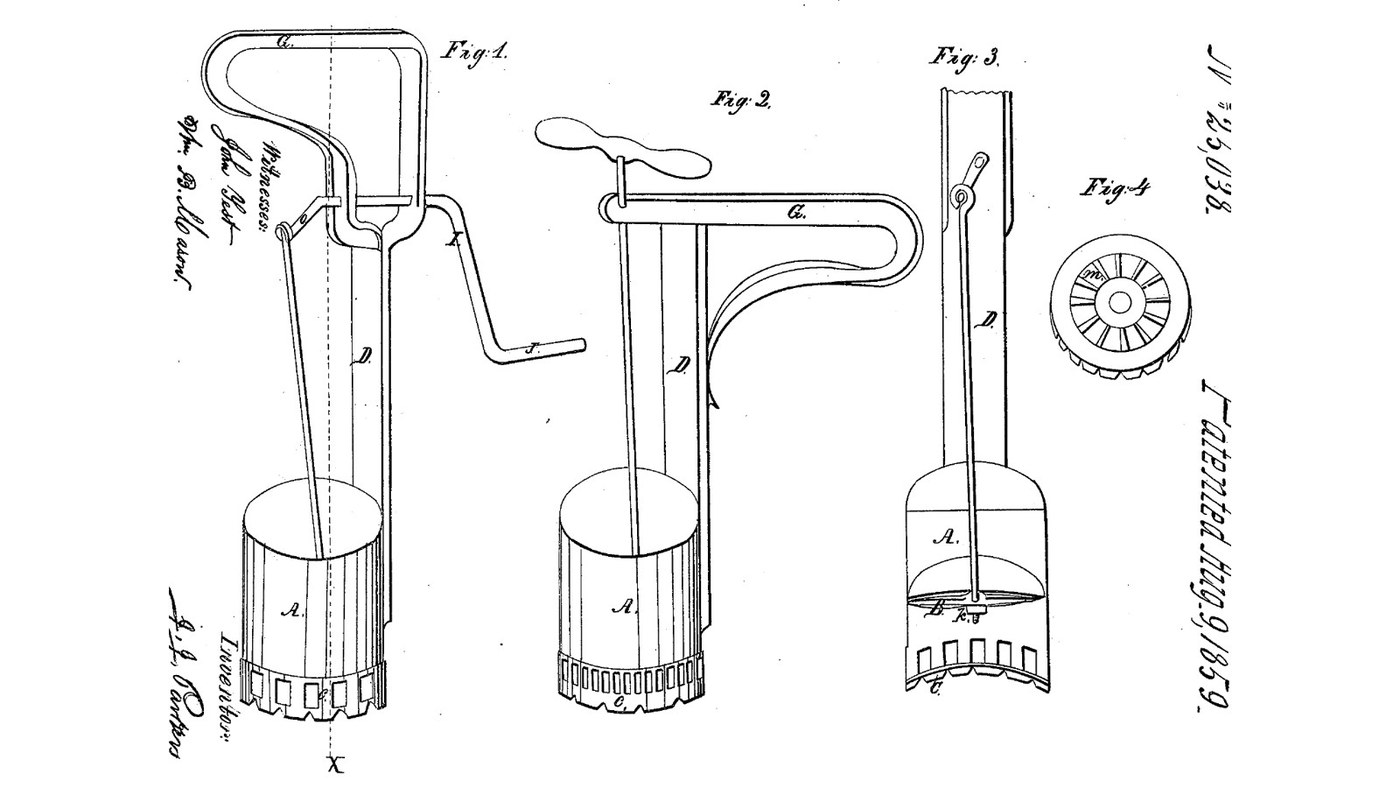

Pump Egg Beater: A Piston Draws the Eggs In and Out Through a Grate
J. J. Parker of Marietta, Ohio, received US 25,038, dated 9 August 1859, for an egg-beater and churn combined. A small tube stands in the eggs. A crank on a post above it works a piston up and down "in the manner of a pump", drawing the eggs in and out through square openings and a grated bottom until they are fine and frothy. A loose band turned over the openings closes them or opens them.
This rung builds his "smaller sized machine" at his own sizes: a tube 1 1/2 inches across and 1 5/8 inches deep, openings 1/4 inch square, a band 1/2 inch wide, bearings 4 inches above the tube, and a crank shaft of No. 7 wire.
Àárín
About 4 hours, plus printing
Ìlànà
1
1
Parker's sizes, worked through
Parker's sizes, worked through
Ń ṣí ìwé Jupyter…
2
2
A plunger in the cream, before it
A plunger in the cream, before it
That churn was worked up and down by hand. Parker's piston is worked by a crank.
3
3
Read US 25,038
Read US 25,038
"The eggs are broken into a vessel, the beater set into them. The piston being moved up and down by means of the crank draws the eggs in and out through the grate bars until they are completely torn in pieces or made perfectly fine and frothy."
4
4
Print the tube A with post D and holder G
Print the tube A with post D and holder G
The tube, 38.1 mm across and 41.3 mm deep, with twelve 6.35 mm square openings at its lower end, the post up its side, the bearing 101.6 mm above the tube's top and the loop handle G. Print it standing, tube down, with supports under the bearing and the handle's top bar. PETG, 0.16 mm layers, 30 % infill, 4 walls.
5
5
Print the band C with its grated bottom M
Print the band C with its grated bottom M
The 12.7 mm band that slips loosely over the tube's lower end, with twelve matching openings, notches in its lower edge and the grate of twelve bars round a hub (Fig. 4). Print it grate down. PETG, 0.16 mm layers, 30 % infill, 4 walls.
6
6
Print the piston halves B
Print the piston halves B
One dished half, 33.7 mm across with a 4 mm crown and a 3.4 mm hole. Print two, crown up. PETG, 0.16 mm layers, 30 % infill, 4 walls.
7
7
Crank shaft from No. 7 wire
Crank shaft from No. 7 wire
Cut about 180 mm of 4.6 mm stainless wire. In the vice bend the wrist and the 7/8 inch crank at one end: a 6.4 mm wrist, then a 22.2 mm arm at right angles, measured centre to centre. Slide the straight end through the bearing from the tube's side, and 25.4 mm on bend the 2 inch crank, 50.8 mm centre to centre, opposite the first, then a 38 mm handle. Push a hardwood dowel, drilled 4.8 mm, on the handle as a grip.
Àwọn ohun èlò fún ìgbésẹ̀ yìí:
 Okùn irin aláìjẹrùn1 ẹyọ
 Àwọn dowel igi líle1 ẹyọ
Àwọn irinṣẹ́ tí a nílò:
 Ìdìmú Tábìlì
 Ẹ̀mú Olórí Yíká
 Ẹ̀mú ìgé okùn oníkọ̀rọ̀
 Àwọn Ìfá (Ìfá Ọwọ́)
 Ẹ̀rọ Ìlùkòkò Aláìlókùn
 Àkójọ Orí Ìlùkòkò
 Kálípà Fáníà
8
8
Piston B on the rod E
Piston B on the rod E
Cut a 35.6 mm disc of 1.5 mm food-grade silicone sheet with a 3 mm hole, for Parker's leather. Cut a 3 mm stainless threaded rod 145 mm long and bend a 5 mm eye at one end with the round-nose pliers. Run two nuts up the other end, locked against each other 109 mm below the eye's middle, then a piston half crown up, the silicone disc, the other half crown down, and nut K. Tighten K until the disc's edge just stands proud of the halves: it should slide in the tube with a light drag.
Àwọn ohun èlò fún ìgbésẹ̀ yìí:
 Ọ̀pá oníṣọ̀kan1 ẹyọ
 Nọ́ọ̀tì Onígun Mẹ́fà3 ẹyọ
 Àwo rọ́bà silicone1 ẹyọ
Àwọn irinṣẹ́ tí a nílò:
 Ìṣẹ́náẸ̀mú Olórí Yíká
 Ayùn Irin
 Kọ́kọ́rọ́ tí a lè ṣàtúnṣeKálípà Fáníà
9
9
Assemble
Assemble
Drop the piston into the tube from the top, hook the rod's eye over the wrist and squeeze the eye closed. Slip the band over the tube's lower end. Turn the handle: the piston runs down to just above the grate, and at the top of the stroke it rises out of the tube and drops back in. Turn the band so its openings line up with the tube's for the most stir, or part over them for less.
Àwọn ohun èlò fún ìgbésẹ̀ yìí:
 Okùn PETG1 ẹyọ
Àwọn irinṣẹ́ tí a nílò:
 Ẹ̀rọ ìtẹ̀ 3D oníwàyà (FDM)Kọ́kọ́rọ́ tí a lè ṣàtúnṣe
10
10
The build in 3D
The build in 3D
FreeCAD model of this build, cut open: the tube with its post, bearing and loop handle, the band and grate, the bent crank shaft and handle, the rod and the piston at the bottom of its stroke. Checked at 24 crank angles.
11
11
Beat eggs
Beat eggs
Break four eggs into a glass bowl. Stand the beater in them on its notched band, hold the loop handle and turn the crank about two turns a second, timing it. Lift it out when the eggs are smooth and frothy. Wash every part in warm soapy water; the piston comes apart at nut K.
Àwọn ohun èlò fún ìgbésẹ̀ yìí:
 Ẹyin4 ẹyọ
Àwọn irinṣẹ́ tí a nílò:
 Àwo gíláàsì
 Aago Ìdúró
12
12
Troubleshooting
Troubleshooting
Pump egg beater troubleshooting.
Flow
Loading...
13
13
History and honest limits
History and honest limits
**J. J. Parker** of Marietta, Ohio, US 25,038, 9 August 1859, "Egg-Beater or Churn". He claimed the tube A in combination with the band C and the grated bottom M. His sizes are kept: the tube, the openings, the band, the bearing height and the crank shaft. We read his "crank seven eighths of an inch long" as centre to centre, so its 1 3/4 inch stroke is longer than his 1 5/8 inch tube is deep and the piston leaves the tube at the top of each stroke. He does not name the wire gauge; 4.6 mm is No. 7 on the Birmingham gauge. Printed PETG stands in for his tin, and silicone for his leather; the rod, the piston's shape and the handle G's outline are ours.
Àwọn ohun-èlò
7- 1 ẹyọÀyè
- 1 ẹyọÀyè
- 1 ẹyọÀyè
- 3 ẹyọÀyè
- 1 ẹyọÀyè
- 1 ẹyọÀyè
- 4 ẹyọÀyè
Àwọn irinṣẹ́ tó nílò
13- Àyè
- 1 vendor sell this, none ship to you yetÀyè
- Àyè
- Àyè
- Àyè
- Àyè
- Àyè
Àwọn fáìlì àpẹrẹ
4Ìtọ́nisọ́nà yìí ń ṣe

Blueprint tó jọra
Àwọn blueprint wọ̀nyí pín ìmọ̀ — ọ̀nà, ohun-èlò tàbí ìlànà
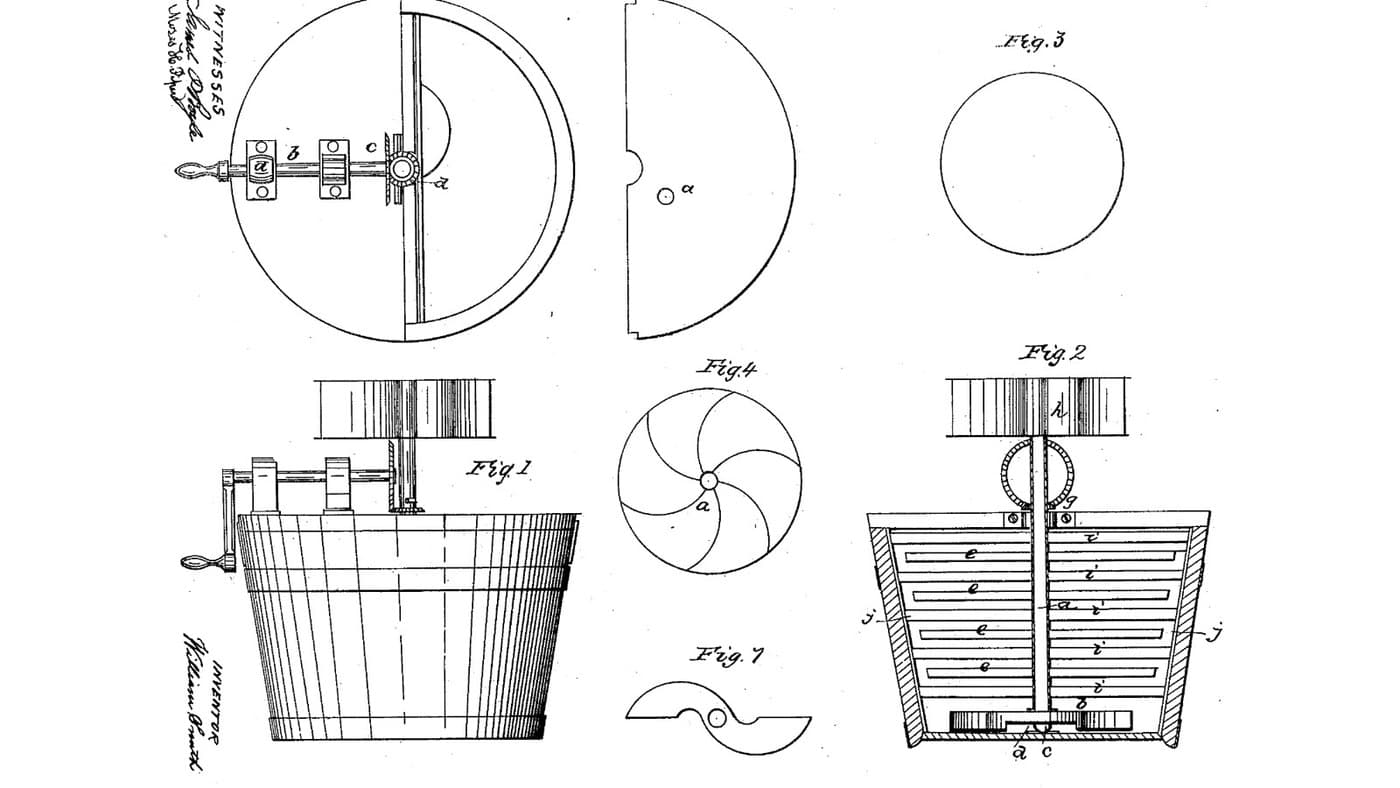
Atmospheric Combination Churn: A Fan Sends Air Down a Hollow Shaft and Out Through the Turning Arm
láti ọwọ́ Buttercup
OÚNJẸ ÀTI OHUN MÍMU
12
0
0
0
0
0
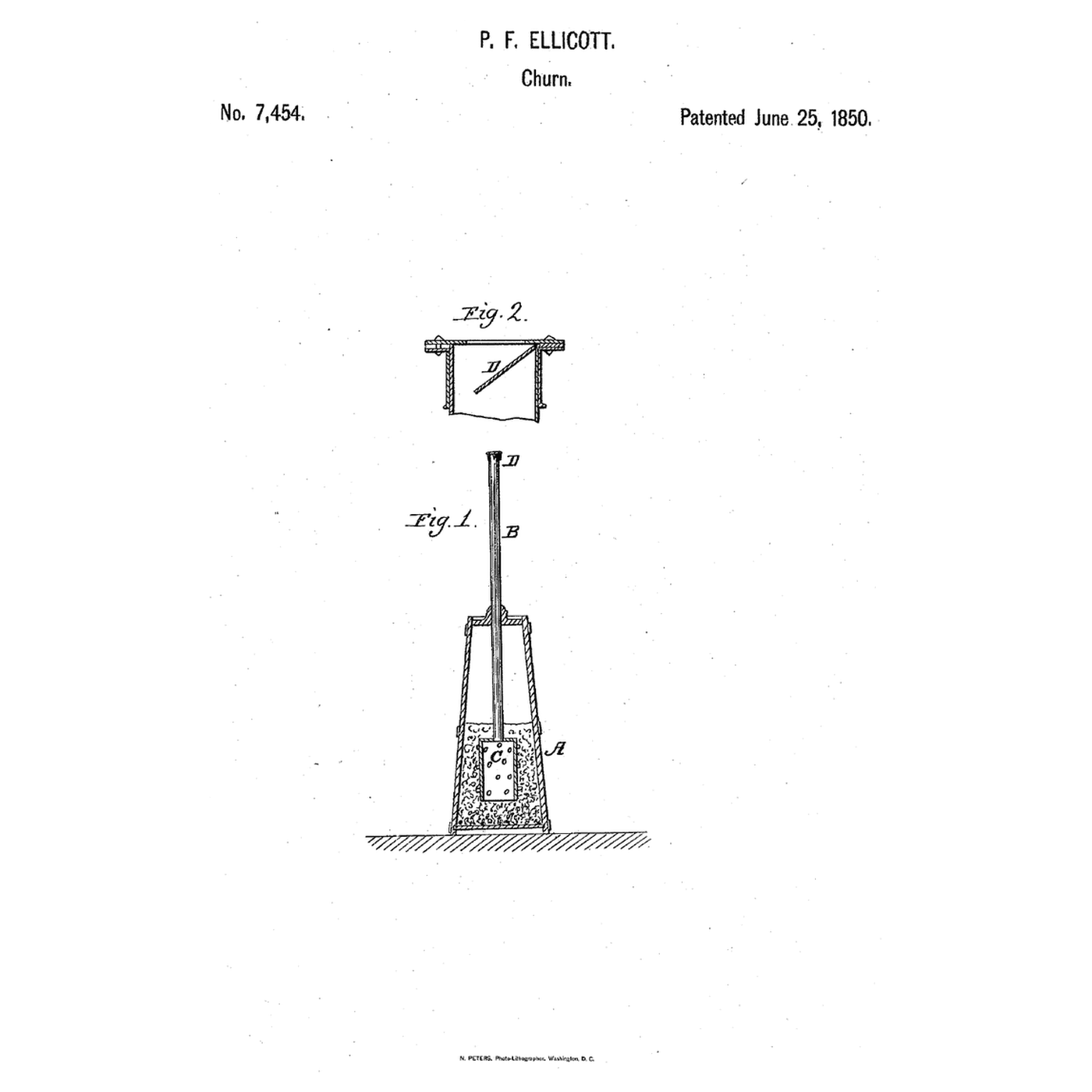
Valved Hollow-Staff Plunger Churn: A Valve at the Top, Air Forced Out at the Foot
láti ọwọ́ TheChef
OÚNJẸ ÀTI OHUN MÍMU
45
0
0
0
0
0
Churning Butter from Cream — The 5,000-Year-Old Fat Separation
láti ọwọ́ TheChef
IṢẸ́ ỌWỌ́
63
0
0
0
0
0
CC0 Àgbègbè Gbogbogbò
Blueprint yìí ti jáde lábẹ́ CC0. O lè ṣe àdàkọ, yí padà, pín, àti lò láìsí ìyọ̀ǹda.
Ṣàtìlẹ́yìn Olùṣẹ́dá nípa rírà àwọn ọjà nipasẹ̀ Blueprint wọn Ẹ̀san Olùṣẹ́dá tí àwọn Olùtajà gbé kalẹ̀, tàbí ṣẹ̀dá àtúnṣe tuntun ti Blueprint yìí kí o sì fi sínú Blueprint rẹ gẹ́gẹ́ bí ìsopọ̀ láti pín owó-wíwọlé.