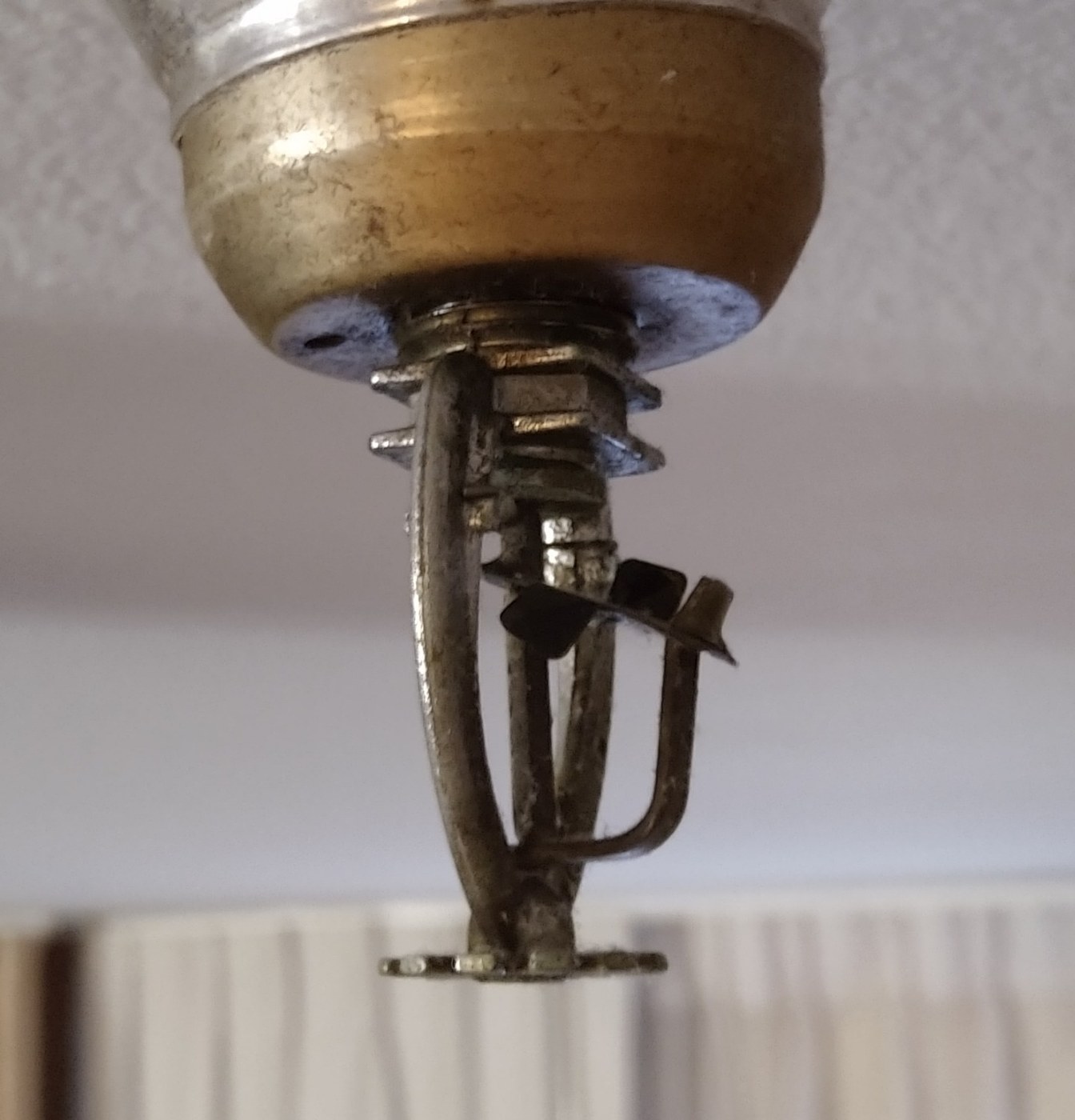


Parmelee Fire Sprinkler
Early factory fire protection was a perforated pipe running along the ceiling with a valve at the end of the building. When a fire broke out, somebody had to notice it, reach the valve, and open it — soaking every floor of the mill in the process.
Parmelee's sprinkler decides for itself, locally. Each head is held shut by a joint of low-melting-point alloy. Heat from a fire directly beneath melts that joint, the head opens, and water falls on that spot alone. No detector, no wiring, no person: the fire operates its own extinguisher.
The elegance is that the sensor, the decision and the valve are one component, and the failure mode is chosen well — a head that fails tends to fail by opening. US Patent 154,076, "Improvement in fire-extinguishers", granted to Henry S. Parmelee of New Haven on 11 August 1874.
Ìlànà
Test with water only, never with fire
Test with water only, never with fire
Trigger heads with a heat gun or hot water, never an open flame, and test the water side at low pressure over a drain. This is a bench model of a life-safety device, not a life-safety device.
Read US 154,076 and find the fusible joint
Read US 154,076 and find the fusible joint
Parmelee claims a valve held shut by fusible material that melts on heating. Sensor and actuator are the same piece of metal — that is the invention.
Model the old system and see why it failed
Model the old system and see why it failed
Draw a perforated pipe with one manual valve. Everything opens at once, wetting stock that was never on fire, and only if someone is there to turn it.
Choose the alloy by its melting point
Choose the alloy by its melting point
Pick a low-melting solder that softens around 70 °C — well above a hot summer ceiling, well below a fire. The melting point IS the trigger temperature.
Àwọn ohun èlò fún ìgbésẹ̀ yìí:
 Wẹ́là tìnì-lédì50 g
Measure the actual melting point before you trust it
Measure the actual melting point before you trust it
Melt a sample on a hotplate with a thermometer in it. Solder specifications vary, and a device whose set point you have not measured has no set point.
Àwọn irinṣẹ́ tí a nílò:
 Ìwọ̀n Ooru Yàrá
Machine a valve body with a seat and a plug
Machine a valve body with a seat and a plug
Make a brass body with an orifice, a plug that seals against it, and a way to hold the plug down. Water pressure should push the plug OFF the seat.
Àwọn ohun èlò fún ìgbésẹ̀ yìí:
 Ohun ìsopọ̀ idẹ2 ẹyọ
Àwọn irinṣẹ́ tí a nílò:
 Ìfá Irin
Let the pressure work in your favour
Let the pressure work in your favour
Arrange the plug so line pressure helps open it once released. The stored energy that will eventually fight the fire is already in the pipe.
Solder a strut to hold the plug closed
Solder a strut to hold the plug closed
Make a small strut or link whose joint is the fusible solder. It carries the plug's load in compression, and it is the only thing keeping the head shut.
Load the joint so it releases decisively
Load the joint so it releases decisively
Preload the strut. As the solder softens it creeps, then lets go all at once — you want a clean release, not a slow weep.
Fit a deflector below the orifice
Fit a deflector below the orifice
Add a slotted plate under the outlet. Without it you get a jet drilling a hole in the floor; the deflector turns it into a spray covering an area.
Plumb several heads onto one pressurised line
Plumb several heads onto one pressurised line
Fit three or four heads along a charged pipe. Each is independent — this is a distributed system with no controller anywhere in it.
Àwọn ohun èlò fún ìgbésẹ̀ yìí:
 Ọ̀pá bàbà3 mítà
Heat ONE head and watch only that one open
Heat ONE head and watch only that one open
Apply heat to a single head. It opens; the others stay shut. This selectivity is the whole advance over the perforated pipe.
Work out the failure modes deliberately
Work out the failure modes deliberately
List what happens if the solder is weak, if it is too strong, if the pipe loses pressure. A weak joint opens spuriously and wets stock; a strong one does nothing in a fire. Only one of those kills people.
Time the response against ceiling height
Time the response against ceiling height
Test at two heights. Hot gas has to reach the head and heat its mass, so response time depends on ceiling height and on how heavy the head is.
Compendium — a valve that senses its own emergency
Compendium — a valve that senses its own emergency
The patent. US 154,076, "Improvement in fire-extinguishers", granted 11 August 1874 to Henry S. Parmelee of New Haven, Connecticut. He was a piano manufacturer protecting his own factory. His was the first practical automatic sprinkler head — earlier systems, including perforated-pipe arrangements used in British textile mills from the 1810s, required a person to open a valve. Frederick Grinnell improved the head substantially from 1881 and it is his name that became attached to the industry.
Sensor, logic and actuator in one part. The fusible link is simultaneously the thermometer, the decision rule and the latch. There is no detection circuit, no controller, no power supply, and nothing to be commissioned or maintained beyond the water. Each head decides independently about its own patch of ceiling, so the system is fully distributed and degrades gracefully — the loss of one head does not affect any other. Modern heads often use a glass bulb of coloured liquid that expands and bursts instead of solder, but the principle is identical and the colour codes the temperature.
The failure mode was chosen, not accepted. The joint is loaded in a way that makes failure tend towards opening rather than jamming shut. A spuriously opened head causes water damage; a head that fails to open causes deaths. When the two failure modes are not equally bad, the design should be biased towards the survivable one — and this is a clean nineteenth-century example of that reasoning, the same logic as the fail-safe air brake and the dead-man's handle.
Why only one head opens. This is the most commonly misunderstood thing about sprinklers, largely because films show every head in a building discharging at once. Each is held shut by its own link, so only heads that actually get hot will open — typically one or two in a real fire. Sprinklered buildings very rarely suffer fire deaths, and the water damage from a couple of heads is trivial next to that from a fire brigade's hoses. Insurers understood the economics immediately, which is why they, rather than regulators, drove adoption for the first several decades.
Àwọn ohun-èlò
3- 50 gÀyè
- 2 ẹyọÀyè
- 3 mítàÀyè
Blueprint tó jọra
Àwọn blueprint wọ̀nyí pín ìmọ̀ — ọ̀nà, ohun-èlò tàbí ìlànà

CC0 Àgbègbè Gbogbogbò
Blueprint yìí ti jáde lábẹ́ CC0. O lè ṣe àdàkọ, yí padà, pín, àti lò láìsí ìyọ̀ǹda.
Ṣàtìlẹ́yìn Olùṣẹ́dá nípa rírà àwọn ọjà nipasẹ̀ Blueprint wọn Ẹ̀san Olùṣẹ́dá tí àwọn Olùtajà gbé kalẹ̀, tàbí ṣẹ̀dá àtúnṣe tuntun ti Blueprint yìí kí o sì fi sínú Blueprint rẹ gẹ́gẹ́ bí ìsopọ̀ láti pín owó-wíwọlé.