IṢẸ́ ỌNÀ
ẸWÀ ÀTI ÌLERA
IṢẸ́ ỌWỌ́
ÀṢÀ ÀTI ÌTÀN
ÌṢERÉ
ÀYÍKÁ
OÚNJẸ ÀTI OHUN MÍMU
REVERSE ENGINEERING
SÁYẸ́ǸSÌ
ERÉ ÌDÁRAYÁ
ÌMỌ̀-Ẹ̀RỌ
ÀWỌN OHUN WÍWỌ̀


Perforated Screen Plate: Clear- or Buhr-Punched Steel Plate (Richards, Ore Dressing, 1903)
The punched steel screens of ore mills: round holes or slots punched through steel plate, either 'clear punched' with a sharp square-edged tool that cuts out a wad, or 'buhr punched' with a thicker tool that tears the metal over a socket in the die.
Clear punching suits holes of 0.03 inch and up; buhr punching suits fine holes of 0.02 inch and less, because a thicker plate can be used. Holes in rows at 60° give 1.154 times the open area of rows at 90°.
Unknown: the plate thickness and hole spacing for a given screen.
Source: R. H. Richards, Ore Dressing vol. I (1903), pp. 167-168. Picture: p. 167 with Figs. 117 and 118.
Àárín
Unknown
Ìlànà
1
1
Choose the holes
Choose the holes
For coarse work use round holes of 0.04 inch (1 mm) and up; for medium work about 0.03 inch (0.75 mm), clear punched. For fine work, 0.02 inch (0.5 mm) and less, buhr punch, so a thicker plate can be used. The smallest practical clear-punched hole is about 0.014 inch (0.35 mm) wide: a hole much narrower than the plate is thick breaks the punch (the extreme Richards found was a slot 54 per cent of the thickness).
Àwọn ohun èlò fún ìgbésẹ̀ yìí:
 Àwo irin1 steel plate
 Ìwọ̀n tí a kò mọ̀1 ẹyọ
Àwọn irinṣẹ́ tí a nílò:
 Ẹ̀rọ ìtẹ̀ ìlu ihò
2
2
Lay out the holes
Lay out the holes
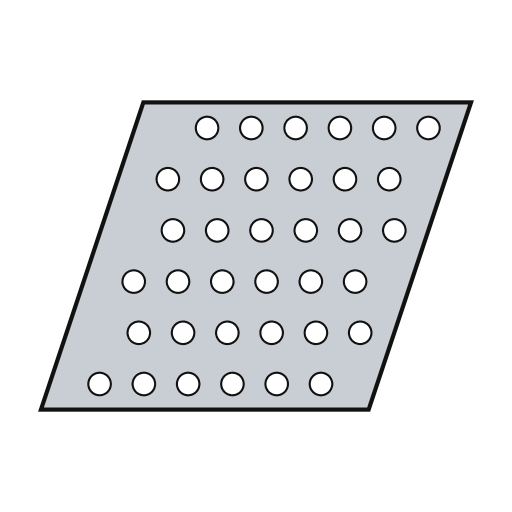
Set round holes in rows at 60° or 90°; with the same hole and spacing, 60° rows give 1.154 times the open area. Punch slots vertical, diagonal or horizontal, in line or staggered; staggering spreads the punching strain.
Àwọn irinṣẹ́ tí a nílò:
Ẹ̀rọ ìtẹ̀ ìlu ihò3
3
Punch the plate
Punch the plate
Clear punching: a tool with a square, sharp edge cuts out a wad exactly the size and shape of the hole. Buhr punching: a thicker tool presses the plate, lying on a socket in the die, just deep enough to tear the metal apart.
Àwọn irinṣẹ́ tí a nílò:
Ẹ̀rọ ìtẹ̀ ìlu ihòÌtọ́nisọ́nà yìí ń ṣe
CC0 Àgbègbè Gbogbogbò
Blueprint yìí ti jáde lábẹ́ CC0. O lè ṣe àdàkọ, yí padà, pín, àti lò láìsí ìyọ̀ǹda.
Ṣàtìlẹ́yìn Olùṣẹ́dá nípa rírà àwọn ọjà nipasẹ̀ Blueprint wọn Ẹ̀san Olùṣẹ́dá tí àwọn Olùtajà gbé kalẹ̀, tàbí ṣẹ̀dá àtúnṣe tuntun ti Blueprint yìí kí o sì fi sínú Blueprint rẹ gẹ́gẹ́ bí ìsopọ̀ láti pín owó-wíwọlé.