IṢẸ́ ỌNÀ
ẸWÀ ÀTI ÌLERA
IṢẸ́ ỌWỌ́
ÀṢÀ ÀTI ÌTÀN
ÌṢERÉ
ÀYÍKÁ
OÚNJẸ ÀTI OHUN MÍMU
REVERSE ENGINEERING
SÁYẸ́ǸSÌ
ERÉ ÌDÁRAYÁ
ÌMỌ̀-Ẹ̀RỌ
ÀWỌN OHUN WÍWỌ̀
Youblob · CC0


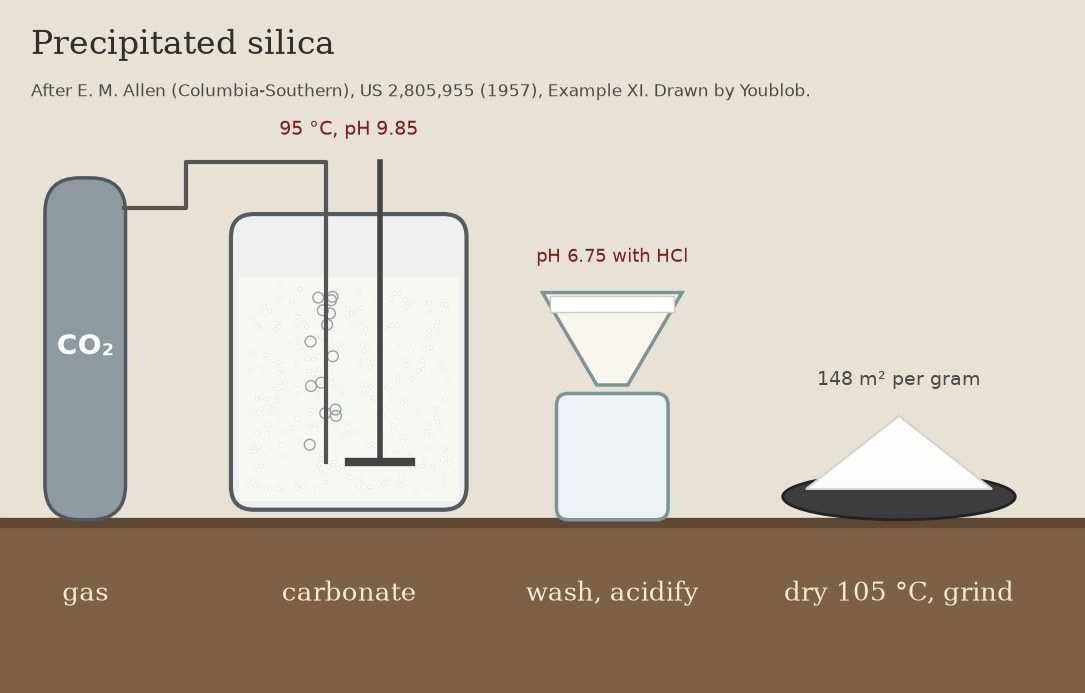
Precipitated Silica: Hot Water Glass Carbonated, Then Acidified to pH 6.75 (Allen 1957)
Bubble carbon dioxide through hot dilute water glass and the silica comes down as an extremely fine white powder rather than a gel. Edward Allen of Columbia-Southern made it this way as a white reinforcing filler for rubber; this follows his Example XI, which gave a powder of 148 m² per gram.
Source: E. M. Allen (Columbia-Southern), US 2,805,955 (1957), Example XI. The percentages are our arithmetic; the filter, mill and indicator are ours. Picture drawn by Youblob.
Àárín
2 days
Ìlànà
1
1
Dilute the water glass
Dilute the water glass
Take 12,850 g of sodium silicate solution holding 976 g Na2O and 3115 g SiO2 (7.6 % and 24.2 %, a silica to soda ratio of 3.19 by weight; our arithmetic). Dilute it with water to 48 litres in a stirred kettle with a heating coil and thermometer, and heat to 95 °C.
Àwọn ohun èlò fún ìgbésẹ̀ yìí:
 Gíláàsì omi (omi sodium silicate)12850 g
 Omi1 as required
Àwọn irinṣẹ́ tí a nílò:
 Ìkòkò ìṣesí ìfúnpá
 Ohun ìrúwé
 Ẹ̀rọ Ìwọ̀n Ooru
 Òǹwọ̀n ìdọ́gba
2
2
Carbonate for an hour
Carbonate for an hour
Bubble in pure carbon dioxide fast enough to add the theoretical amount in about 30 minutes, and keep going at that rate for about 1 hour. The slurry ends at pH 9.85.
Àwọn irinṣẹ́ tí a nílò:
 Gáàsì carbon dioxideÌkòkò ìṣesí ìfúnpáOhun ìrúwéẸ̀rọ Ìwọ̀n Ooru
 Bébà tí ń ṣàfihàn pH
3
3
Filter and wash
Filter and wash
Filter the slurry and wash the cake twice with hot water.
Àwọn ohun èlò fún ìgbésẹ̀ yìí:
Omi1 as requiredÀwọn irinṣẹ́ tí a nílò:
 Funnel Büchner (porcelain)
 Bébà Ìsẹ́
4
4
Acidify to pH 6.75
Acidify to pH 6.75
Stir the cake back into water and bring it to pH 6.75 with 400 ml of 3.5 N hydrochloric acid.
Àwọn ohun èlò fún ìgbésẹ̀ yìí:
Omi1 as requiredÀwọn irinṣẹ́ tí a nílò:
 Hydrochloric acid
 Ohun èlò dígíOhun ìrúwéBébà tí ń ṣàfihàn pH
5
5
Wash out the chloride
Wash out the chloride
Filter again and wash the cake with hot water until it is nearly free of chloride.
Àwọn ohun èlò fún ìgbésẹ̀ yìí:
Omi1 as requiredÀwọn irinṣẹ́ tí a nílò:
Funnel Büchner (porcelain)Bébà Ìsẹ́6
6
Dry at 105 °C and grind
Dry at 105 °C and grind
Dry it at 105 °C in a fan oven and grind it to a fine powder. Allen's had a pH of 8.2, 0.61 % sodium and a surface area of 148 m² per gram.
Àwọn irinṣẹ́ tí a nílò:
 Ààrò ìgbẹ̀
 Odó àti Ọmọ Odó
 Ìgò Gílásì Onídìí
Àwọn irinṣẹ́ tó nílò
13- Àyè
- Àyè
- Àyè
Ìtọ́nisọ́nà yìí ń ṣe
Blueprint tó jọra
Àwọn blueprint wọ̀nyí pín ìmọ̀ — ọ̀nà, ohun-èlò tàbí ìlànà
CC0 Àgbègbè Gbogbogbò
Blueprint yìí ti jáde lábẹ́ CC0. O lè ṣe àdàkọ, yí padà, pín, àti lò láìsí ìyọ̀ǹda.
Ṣàtìlẹ́yìn Olùṣẹ́dá nípa rírà àwọn ọjà nipasẹ̀ Blueprint wọn Ẹ̀san Olùṣẹ́dá tí àwọn Olùtajà gbé kalẹ̀, tàbí ṣẹ̀dá àtúnṣe tuntun ti Blueprint yìí kí o sì fi sínú Blueprint rẹ gẹ́gẹ́ bí ìsopọ̀ láti pín owó-wíwọlé.