IṢẸ́ ỌNÀ
ẸWÀ ÀTI ÌLERA
IṢẸ́ ỌWỌ́
ÀṢÀ ÀTI ÌTÀN
ÌṢERÉ
ÀYÍKÁ
OÚNJẸ ÀTI OHUN MÍMU
REVERSE ENGINEERING
SÁYẸ́ǸSÌ
ERÉ ÌDÁRAYÁ
ÌMỌ̀-Ẹ̀RỌ
ÀWỌN OHUN WÍWỌ̀
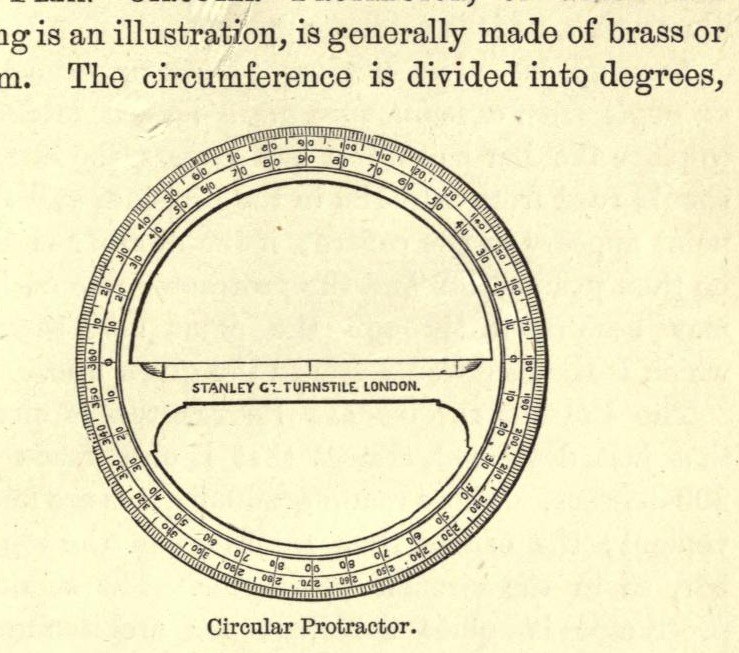


Protractor: Plain Circular Brass Protractor with a Centre Bar (Stanley, 1878)
The draughtsman's circular protractor: a flat brass ring divided all round into degrees and half-degrees, its outer edge bevelled thin so a needle point can feel the divisions, with a bar across the middle whose edge runs exactly through the centre from 0° to 180°. Lay the bar on a line, prick off the angle and draw through the point and the centre.
Result: a protractor for setting off and measuring angles on a drawing.
Source: W. F. Stanley, A Descriptive Treatise on Mathematical Drawing Instruments (1878), pp. 227-228. Unknown: sizes and how the circle is divided. Picture: the book's figure.
Àárín
Unknown
Ìlànà
1
1
Make the ring and bar
Make the ring and bar
Cut a flat ring of brass (electrum also serves) with a bar across the inner space. Make one side of the bar a true straight line through the centre of the ring, and mark the centre with a short line in the middle of the bar; a small semicircle may be cut out of the bar's edge there to make it easier to set over a point. Bevel the outer edge down very thin. Not given: sizes. Ours: brass sheet.
Àwọn ohun èlò fún ìgbésẹ̀ yìí:
 Pẹlẹbẹ Bronse1 ring and bar
Àwọn irinṣẹ́ tí a nílò:
 Ìlàǹkàn irin
 Ẹ̀rọ Ìyí Irin
 Ìwọ̀n tí a kò mọ̀
2
2
Divide it
Divide it
Divide the circumference into degrees, subdivided into half-degrees, so that the bar's edge, carried on, reads 0° and 180°, and number the degrees. Not given: how the circle is divided.
Àwọn irinṣẹ́ tí a nílò:
Ìwọ̀n tí a kò mọ̀3
3
Use it
Use it
To set off an angle from a point on a line, lay the bar so it half covers the line, the line reading 0 to 180, with the point in the centre. Prick off the number of degrees at the bevelled edge with a needle point, lift the protractor away, and draw a line through the mark and the point.
Àwọn irinṣẹ́ tí a nílò:
Ìwọ̀n tí a kò mọ̀Àwọn ohun-èlò
1- 1 ring and barÀyè
Àwọn irinṣẹ́ tó nílò
3- Àyè
Ìtọ́nisọ́nà yìí ń ṣe
CC0 Àgbègbè Gbogbogbò
Blueprint yìí ti jáde lábẹ́ CC0. O lè ṣe àdàkọ, yí padà, pín, àti lò láìsí ìyọ̀ǹda.
Ṣàtìlẹ́yìn Olùṣẹ́dá nípa rírà àwọn ọjà nipasẹ̀ Blueprint wọn Ẹ̀san Olùṣẹ́dá tí àwọn Olùtajà gbé kalẹ̀, tàbí ṣẹ̀dá àtúnṣe tuntun ti Blueprint yìí kí o sì fi sínú Blueprint rẹ gẹ́gẹ́ bí ìsopọ̀ láti pín owó-wíwọlé.