IṢẸ́ ỌNÀ
ẸWÀ ÀTI ÌLERA
IṢẸ́ ỌWỌ́
ÀṢÀ ÀTI ÌTÀN
ÌṢERÉ
ÀYÍKÁ
OÚNJẸ ÀTI OHUN MÍMU
REVERSE ENGINEERING
SÁYẸ́ǸSÌ
ERÉ ÌDÁRAYÁ
ÌMỌ̀-Ẹ̀RỌ
ÀWỌN OHUN WÍWỌ̀
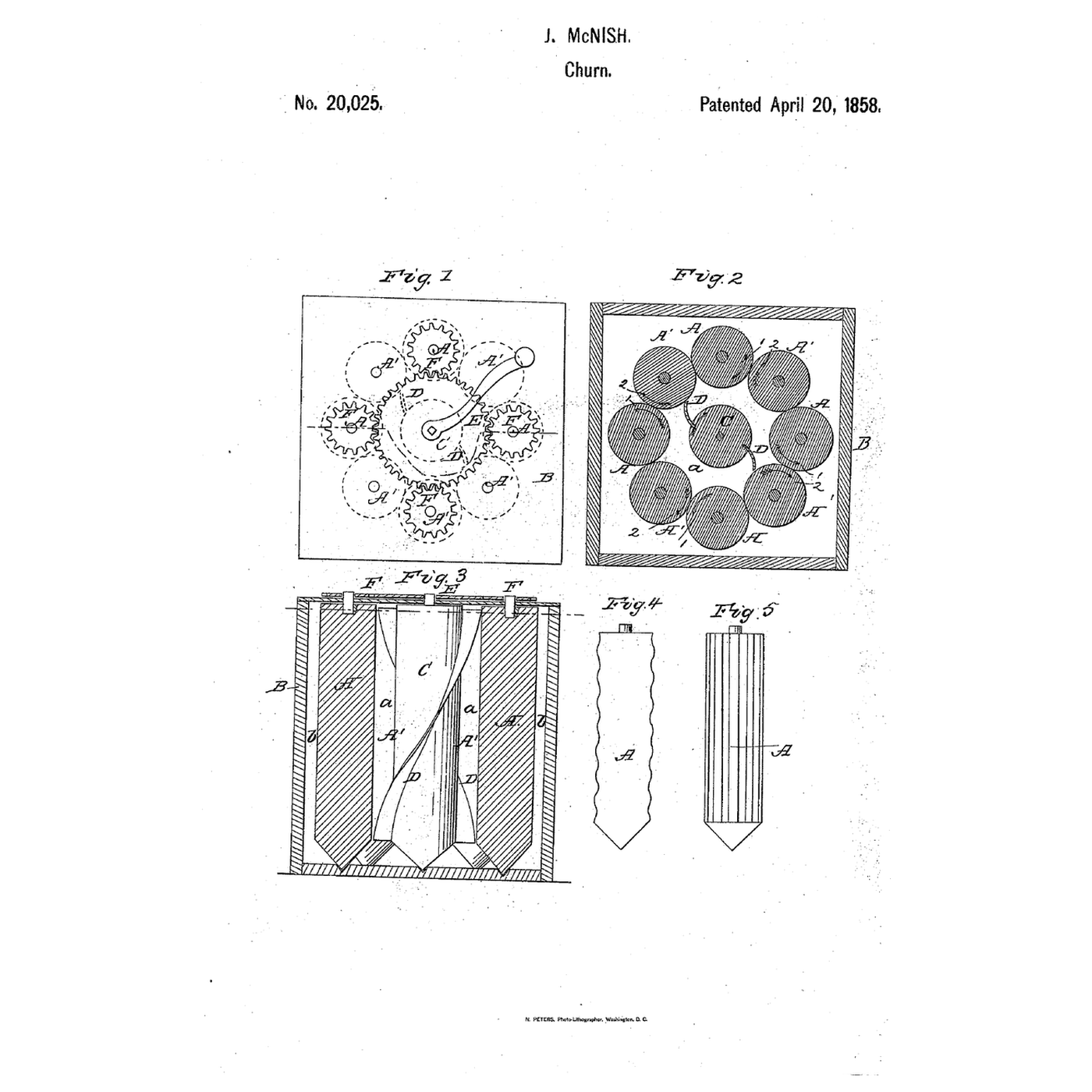


Radial-Roller Spiral-Shaft Churn: A Ring of Cone-Pointed Rollers Turning Both Ways Round a Spiral-Winged Shaft
James MacNish of Berlin, Wisconsin, received US 20,025, dated 20 April 1858, for a churn in which a central shaft with semi-spiral wings turns inside a circle of rollers with cone-shaped lower ends. A spur wheel on the shaft drives every other roller; those turn their neighbours the opposite way by friction, and the cream is squeezed between them.
This rung prints the rollers, the spiral shaft, the spur wheel and the two frames at tabletop scale.
Ilọsíwájú
About 6 hours, plus printing
Ìlànà
1
1
Wheel and rollers
Wheel and rollers
Ń ṣí ìwé Jupyter…
2
2
Churns with turning rollers, before it
Churns with turning rollers, before it
The self-turning churn carried its rollers on the dasher; MacNish stands a whole ring of rollers round the shaft.
3
3
Read US 20,025
Read US 20,025
"By turning the central roller C, rapidly, the cream is dashed by the action of the flanches against the inside of the encircling rollers A, A', which are at the same time set in motion in the direction indicated by the arrows, thus pressing the milk or cream between them as it passes from the inside space a, within the circle of rollers A, A, into the space b, outside of the same."
4
4
Print the parts
Print the parts
Print four driven rollers with their pinions (/uploads/blueprints/radial-roller-spiral-shaft-churn-roller-a.stl), four plain rollers (/uploads/blueprints/radial-roller-spiral-shaft-churn-roller-a-prime.stl), the spiral shaft (/uploads/blueprints/radial-roller-spiral-shaft-churn-spiral-shaft.stl), the spur wheel with its crank arm (/uploads/blueprints/radial-roller-spiral-shaft-churn-spur-wheel.stl), the top frame (/uploads/blueprints/radial-roller-spiral-shaft-churn-top-frame.stl) and the floor plate (/uploads/blueprints/radial-roller-spiral-shaft-churn-floor-plate.stl). Print in PETG at 0.2 mm layers, 30 % infill, 4 walls; wash before first use.
Àwọn ohun èlò fún ìgbésẹ̀ yìí:
 Okùn PETG1 ẹyọ
Àwọn irinṣẹ́ tí a nílò:
 Ẹ̀rọ ìtẹ̀ 3D oníwàyà (FDM)
5
5
Box and floor plate
Box and floor plate
Build an open pine box about 174 mm square inside and 190 mm deep. Glue a 10 mm pine strip along two opposite walls, their tops 177 mm above the floor, for the top frame to rest on. Lay the floor plate in the bottom: its eight conical seats take the rollers' cone points and its centre hole takes the shaft.
Àwọn ohun èlò fún ìgbésẹ̀ yìí:
 Pákó igi pine1 ẹyọ
 Ìdìpọ̀ Igi1 ẹyọ
 Ìsúrù igi #8 x 1"1 ẹyọ
Àwọn irinṣẹ́ tí a nílò:
 Ayùn Ọwọ́
 Ẹ̀rọ Ìlùkòkò Aláìlókùn
 Àkójọ Orí Ìlùkòkò
 Ìṣù àwọn ohun ìyí skurú
 Okùn Ìdíwọ̀n
6
6
Rollers, shaft and wheel
Rollers, shaft and wheel
Stand the spiral shaft in the centre and the eight rollers round it, driven and plain in turn, so each touches its neighbours. Drop the top frame over their journals onto the strips, then fit the spur wheel on the flat at the shaft's top so it meshes with the four pinions.
7
7
The build in 3D
The build in 3D
FreeCAD model of this build: the box, the floor plate, eight rollers with cone points standing in a circle, four of them with pinions, the spiral-winged shaft in the centre, the top frame and the spur wheel with its crank arm.
8
8
Churn
Churn
Pour in 1 litre of heavy cream at about 15 °C, checked with the thermometer, to below the top frame. Turn the crank steadily and time it with the stopwatch: the wings throw the cream outward through the rollers and it returns under them between the cone points. When the butter comes, lift out the frame, the rollers and the shaft, pour off the buttermilk, wash the butter in cold water until it runs clear, work in a pinch of salt and weigh it.
Àwọn ohun èlò fún ìgbésẹ̀ yìí:
 Ọ̀rá wàrà tó nípọn1 l
 Iyọ̀ Òkun Rúkèrúdò1 ẹyọ
 Omi1 ẹyọ
Àwọn irinṣẹ́ tí a nílò:
 Ẹ̀rọ ìwọ̀n ooru oníhun tí ó dúró sí inú
 Aago Ìdúró
 Òṣùwọ̀n Díjítà Ilé Ìdáná
 Àwo ìdàpọ̀ ńlá ti irin tí kò ń yá
9
9
Troubleshooting
Troubleshooting
Radial-roller churn troubleshooting.
Flow
Loading...
10
10
History and honest limits
History and honest limits
**James MacNish** of Berlin, Marquette County, Wisconsin, US 20,025, 20 April 1858; reissued 30 November 1858 as No. 630. The drawing sheet spells the name McNish. He showed smooth rollers as best for churning milk, a corrugated roller for thin cream and a fluted roller for thick cream, and held all the rollers in an iron frame at the top. He claimed the central spiral-winged shaft with the circle of rollers, some turned directly one way and the others indirectly the opposite way. Our sizes, gear counts and printed frames are ours. FDM prints hold food in their layer lines, so wash well and replace when worn.
Àwọn ohun-èlò
7- 1 ẹyọÀyè
- 1 ẹyọÀyè
- 1 ẹyọÀyè
- 1 ẹyọÀyè
- Àyè
- 1 ẹyọÀyè
- 1 ẹyọÀyè
Àwọn irinṣẹ́ tó nílò
10- Àyè
- 1 vendor sell this, none ship to you yetÀyè
- 1 vendor sell this, none ship to you yetÀyè
- Àyè
Àwọn fáìlì àpẹrẹ
1Ìtọ́nisọ́nà yìí ń ṣe

Blueprint tó jọra
Àwọn blueprint wọ̀nyí pín ìmọ̀ — ọ̀nà, ohun-èlò tàbí ìlànà



CC0 Àgbègbè Gbogbogbò
Blueprint yìí ti jáde lábẹ́ CC0. O lè ṣe àdàkọ, yí padà, pín, àti lò láìsí ìyọ̀ǹda.
Ṣàtìlẹ́yìn Olùṣẹ́dá nípa rírà àwọn ọjà nipasẹ̀ Blueprint wọn Ẹ̀san Olùṣẹ́dá tí àwọn Olùtajà gbé kalẹ̀, tàbí ṣẹ̀dá àtúnṣe tuntun ti Blueprint yìí kí o sì fi sínú Blueprint rẹ gẹ́gẹ́ bí ìsopọ̀ láti pín owó-wíwọlé.