IṢẸ́ ỌNÀ
ẸWÀ ÀTI ÌLERA
IṢẸ́ ỌWỌ́
ÀṢÀ ÀTI ÌTÀN
ÌṢERÉ
ÀYÍKÁ
OÚNJẸ ÀTI OHUN MÍMU
REVERSE ENGINEERING
SÁYẸ́ǸSÌ
ERÉ ÌDÁRAYÁ
ÌMỌ̀-Ẹ̀RỌ
ÀWỌN OHUN WÍWỌ̀
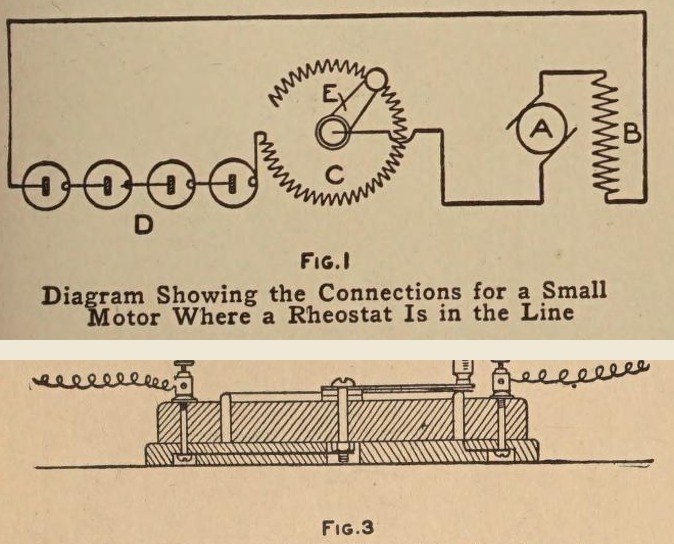


Rheostat: a Small Ring Rheostat for Toy Motors (Boy Mechanic, 1915)
A small variable resistor to set the speed of a toy motor: resistance wire wound on a fibre strip bent into a ring, set in a groove in a hardwood base, with a brass arm that slides round the bared top of the winding.
Wired in series with the motor, it works like a valve in a water pipe.
Source: The Boy Mechanic, Book 2 (1915), pp. 393-394. Unknown: wire alloy. Picture: Figs. 1 and 3 of the book.
Àárín
Unknown
Ìlànà
1
1
Wind the resistance strip
Wind the resistance strip
Smooth a strip of thin fibre about 1/16 in thick, 1/2 in wide and 10 in long. Wind it with No. 22 cotton-covered resistance wire, close turns from 1/4 in from one end to 1/4 in from the other, securing the ends through small drilled holes and leaving 3 to 4 in free. Bend the strip into a ring round a round object, winding outward, and note its inside and outside diameters.
Àwọn ohun èlò fún ìgbésẹ̀ yìí:
 Ohun èlò tí a kò mọ̀1 fibre strip
 Wáyà ìdènà fàdákà Jámánì1 No. 22
Àwọn irinṣẹ́ tí a nílò:
 Ìlù ọwọ́
2
2
Make the base
Make the base
Round the corners and top edges of a seasoned hardwood block 1/2 x 4 1/2 x 4 1/2 in, mark the ring's two diameters from the centre, and saw out the circles so the ring fits between them. Screw this onto a second board 1/4 x 4 3/4 x 4 3/4 in from below with countersunk screws. Drill a hole for one wire end, fit two back-connected binding posts in the corners, and cut grooves underneath for the leads; one post goes to the winding, the other to the centre bolt.
Àwọn ohun èlò fún ìgbésẹ̀ yìí:
 Pátákó Igi Líle2 1/2 and 1/4 in
 Ìṣó igi1 ẹyọ
 Òpó ìsopọ̀2 ẹyọ
Àwọn irinṣẹ́ tí a nílò:
 Kọ́mpàsì olójú méjì
 Ayùn ẹlẹ́yìn irinÌlù ọwọ́
 Ìlọ̀sí olójú pẹlẹbẹ
3
3
Make and mount the arm
Make and mount the arm
Cut the arm from 1/16 in sheet brass, 2 in long, 1/2 in wide at one end and 1/4 in at the other. Under the narrow end solder thin spring brass to bear on the ring; fit a small handle on top. Mount it on a 1/8 in brass bolt about 1 in long through the centre, with washers under it, the base hole countersunk underneath 1/2 in wide and 1/4 in deep. Solder a short brass strip to the nut, set in a recess, and lock with a second nut or a spring washer.
Àwọn ohun èlò fún ìgbésẹ̀ yìí:
 Pẹlẹbẹ Bronse1 arm, spring
 Irin tí a kò mọ̀1 1/8 in brass bolt
 Wáṣà Pẹrẹsẹ3 ẹyọ
 Spring Washer1 ẹyọ
 Wẹ́là tìnì-lédì1 ẹyọ
Àwọn irinṣẹ́ tí a nílò:
 Ìlàǹkàn irinÌlù ọwọ́
 Irin Sọ́ldà Oníná Mànàmáná
4
4
Bare the track and finish
Bare the track and finish
Set the ring in its groove. Sand the insulation off the top edge of the winding so the spring contact touches the wire. Give the wood a coat of shellac.
Àwọn ohun èlò fún ìgbésẹ̀ yìí:
 Fánníṣì sẹ́làkì1 ẹyọ
Àwọn irinṣẹ́ tí a nílò:
 Bébà Ìfá
 Àwọn ìfọ̀wọ́ kékeré
Àwọn ohun-èlò
11- 1 fibre stripÀyè
- 1 No. 22Àyè
- 2 1/2 and 1/4 inÀyè
- 1 ẹyọÀyè
- Àyè
- 1 arm, springÀyè
- 1 1/8 in brass boltÀyè
- 3 ẹyọÀyè
- 1 ẹyọÀyè
- 1 ẹyọÀyè
- 1 ẹyọÀyè
Àwọn irinṣẹ́ tó nílò
8- Àyè
- Àyè
- Àyè
Ìtọ́nisọ́nà yìí ń ṣe
CC0 Àgbègbè Gbogbogbò
Blueprint yìí ti jáde lábẹ́ CC0. O lè ṣe àdàkọ, yí padà, pín, àti lò láìsí ìyọ̀ǹda.
Ṣàtìlẹ́yìn Olùṣẹ́dá nípa rírà àwọn ọjà nipasẹ̀ Blueprint wọn Ẹ̀san Olùṣẹ́dá tí àwọn Olùtajà gbé kalẹ̀, tàbí ṣẹ̀dá àtúnṣe tuntun ti Blueprint yìí kí o sì fi sínú Blueprint rẹ gẹ́gẹ́ bí ìsopọ̀ láti pín owó-wíwọlé.