IṢẸ́ ỌNÀ
ẸWÀ ÀTI ÌLERA
IṢẸ́ ỌWỌ́
ÀṢÀ ÀTI ÌTÀN
ÌṢERÉ
ÀYÍKÁ
OÚNJẸ ÀTI OHUN MÍMU
REVERSE ENGINEERING
SÁYẸ́ǸSÌ
ERÉ ÌDÁRAYÁ
ÌMỌ̀-Ẹ̀RỌ
ÀWỌN OHUN WÍWỌ̀
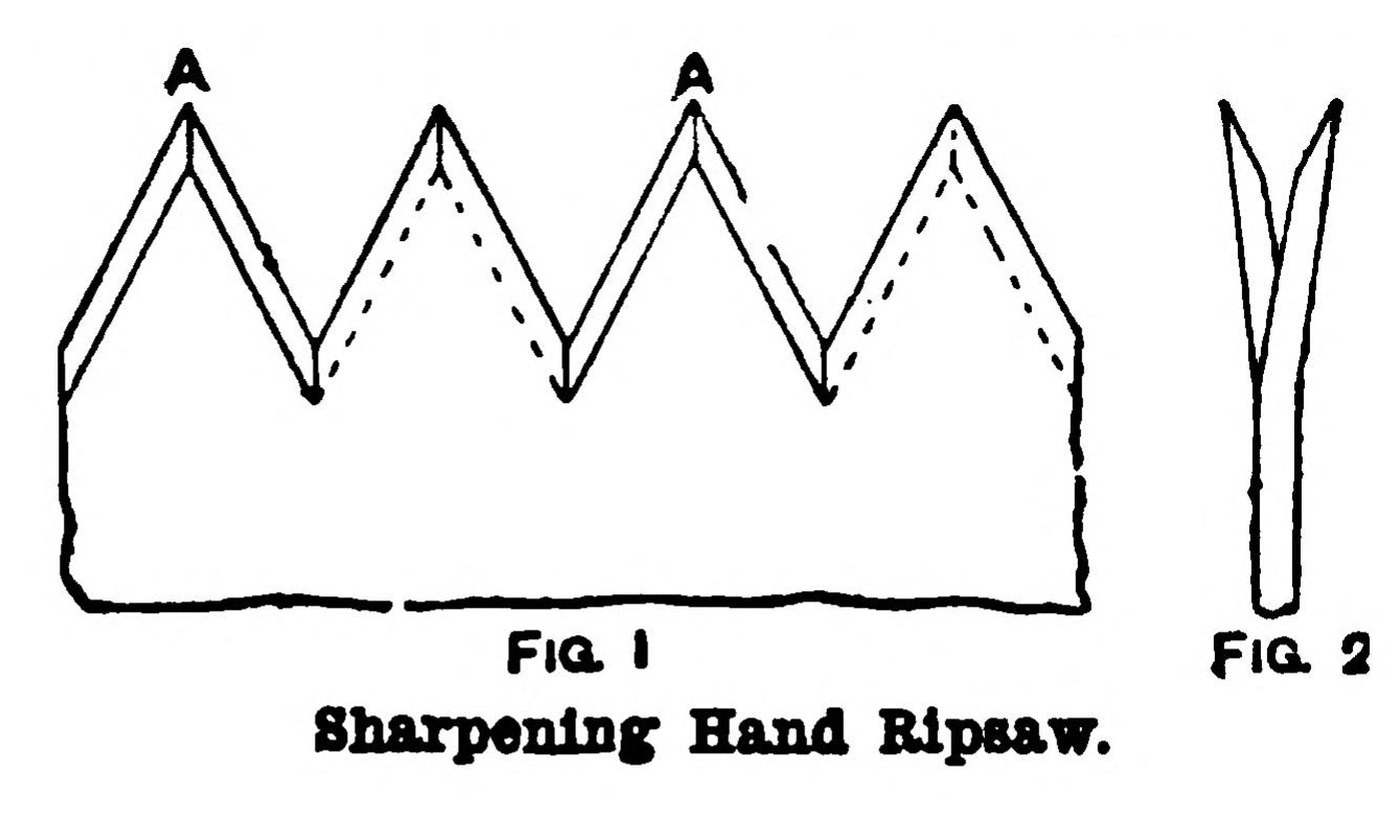


Rip Saw: Diamond-Pointed Teeth Bevelled from One Face (Cassell's Cyclopaedia, 1904)
A less common way to sharpen a hand rip saw, given in Cassell's Cyclopaedia of Mechanics (1904) as one that "answers well in actual practice". Both edges of each tooth are bevelled from the same face, so every tooth comes to a long point like a diamond-pointed wood chisel with a left and a right cutting edge, the teeth alternating from side to side of the blade. Set as usual, with the flat side of each pointed tooth turned outward. Teeth a little longer than an equilateral triangle, with a longer side slope, cut much more sweetly.
Tooth size, bevel angle and amount of set are not given; those are unknown here.
Source: P. N. Hasluck (ed.), Cassell's Cyclopaedia of Mechanics vol. V (1904), p. 122. Picture: its figs. 1 and 2.
Àárín
An hour
Ìlànà
1
1
Read Cassell's
Read Cassell's
"... both edges of each tooth are bevelled from the same face, to form a long point at A (Fig. 1). In this way each successive tooth resembles a diamond-pointed wood chisel having a left and right cutting edge ..."
2
2
Clamp the saw
Clamp the saw
Clamp the hand saw in the vice with its teeth just above the jaws.
Àwọn ohun èlò fún ìgbésẹ̀ yìí:
 Ayùn gbẹ́nàgbẹ́nà1 hand saw
Àwọn irinṣẹ́ tí a nílò:
 Ìdìmú Tábìlì
3
3
File the long points
File the long points
File alternate teeth from one side of the blade, bevelling BOTH edges of each tooth from that same face so the tooth ends in a long point (A in Fig. 1). Turn the saw and file the other teeth the same way from the other face. Make the teeth slightly longer than an equilateral triangle and the side slope a little longer than usual, for a keener edge. The bevel angle and tooth size are not given (unknown).
Àwọn irinṣẹ́ tí a nílò:
 Àyí eyín ayùn
 Ìwọ̀n tí a kò mọ̀
4
4
Set the teeth
Set the teeth
Give the usual set: turn the flat side of each pointed tooth outward, alternately left and right (Fig. 2), the same amount on each side. The amount is not given (unknown).
Àwọn irinṣẹ́ tí a nílò:
 Ohun èlò ìtẹ́ eyín ayùnÌwọ̀n tí a kò mọ̀
5
5
History and honest limits
History and honest limits
Cassell's notes this method was "not generally adopted"; the usual rip saw has upright fronts filed with a small bevel (p. 73, the other Rip Saw blueprint).
Tooth size, bevel angle and amount of set are not given; the saw is a hand saw refiled for ripping.
Àwọn ohun-èlò
1- 1 hand sawÀyè
Àwọn irinṣẹ́ tó nílò
4- Àyè
Ìtọ́nisọ́nà yìí ń ṣe

CC0 Àgbègbè Gbogbogbò
Blueprint yìí ti jáde lábẹ́ CC0. O lè ṣe àdàkọ, yí padà, pín, àti lò láìsí ìyọ̀ǹda.
Ṣàtìlẹ́yìn Olùṣẹ́dá nípa rírà àwọn ọjà nipasẹ̀ Blueprint wọn Ẹ̀san Olùṣẹ́dá tí àwọn Olùtajà gbé kalẹ̀, tàbí ṣẹ̀dá àtúnṣe tuntun ti Blueprint yìí kí o sì fi sínú Blueprint rẹ gẹ́gẹ́ bí ìsopọ̀ láti pín owó-wíwọlé.