IṢẸ́ ỌNÀ
ẸWÀ ÀTI ÌLERA
IṢẸ́ ỌWỌ́
ÀṢÀ ÀTI ÌTÀN
ÌṢERÉ
ÀYÍKÁ
OÚNJẸ ÀTI OHUN MÍMU
REVERSE ENGINEERING
SÁYẸ́ǸSÌ
ERÉ ÌDÁRAYÁ
ÌMỌ̀-Ẹ̀RỌ
ÀWỌN OHUN WÍWỌ̀
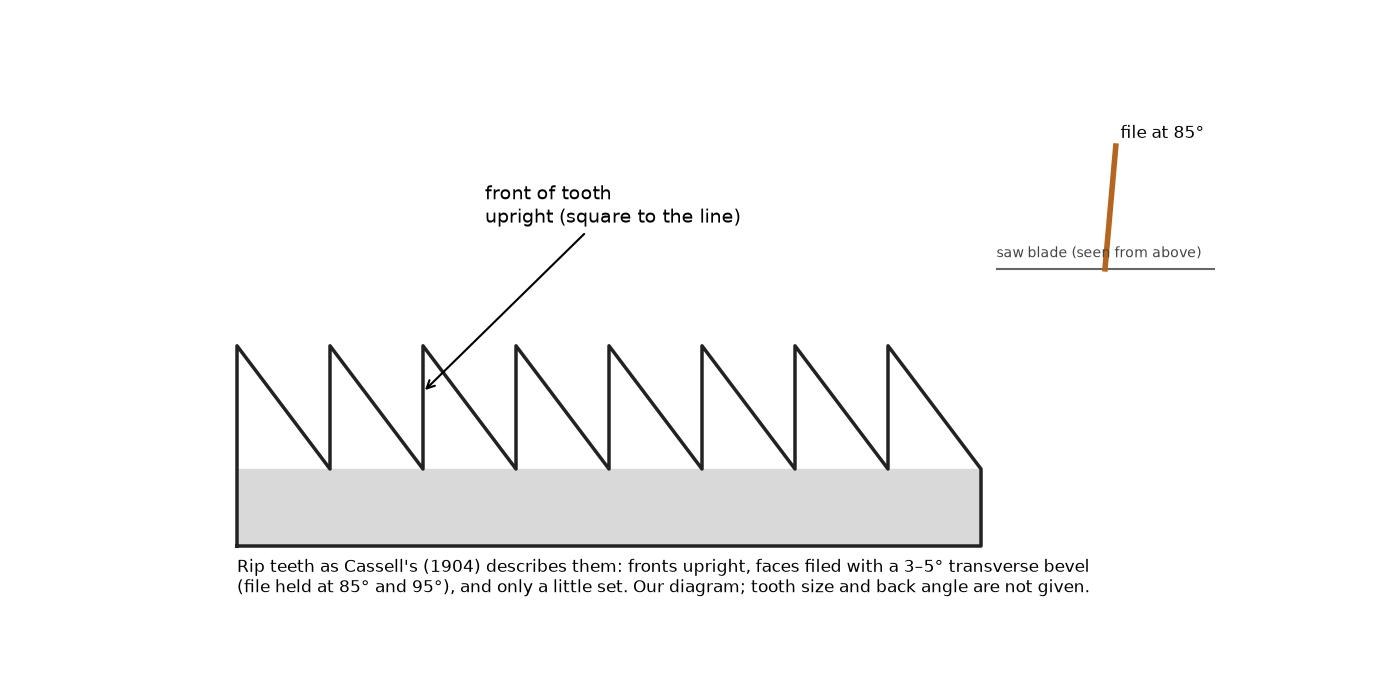


Rip Saw: a Hand Saw Filed with Upright Teeth and Little Set (Cassell's Cyclopaedia, 1904)
A rip saw cuts along the grain, so its teeth work like a row of small chisels, not like the knife points of a cross-cut saw. Cassell's Cyclopaedia of Mechanics (1904) says how to file one: the fronts of the teeth perfectly upright, the faces given a transverse bevel of only 3 to 5 degrees (the file held at 85 and 95 degrees), and only a little set, less than a cross-cut saw needs.
It gives no tooth size, back angle or amount of set; those are unknown here.
Source: P. N. Hasluck (ed.), Cassell's Cyclopaedia of Mechanics vol. V (1904), p. 73, Setting Saw Teeth. Picture: our diagram.
Àárín
An hour
Ìlànà
1
1
Read Cassell's
Read Cassell's
"The teeth in a rip saw should be so filed that their fronts will be perfectly upright. A transverse bevel of from 3° to 5° should be given to the faces of the teeth."
2
2
Clamp the saw
Clamp the saw
Clamp the hand saw in the vice with its teeth just above the jaws, so the blade cannot chatter under the file.
Àwọn ohun èlò fún ìgbésẹ̀ yìí:
 Ayùn gbẹ́nàgbẹ́nà1 hand saw
Àwọn irinṣẹ́ tí a nílò:
 Ìdìmú Tábìlì
3
3
File the teeth upright
File the teeth upright
File each tooth so its front stands perfectly upright to the line of the teeth. Hold the file at 85° to the blade for one side and 95° for the other, to give the faces a transverse bevel of about 5°; 3° is the least. File alternate teeth from one side, then turn the saw and file the others. Tooth size and the slope of the backs are not given (unknown).
Àwọn irinṣẹ́ tí a nílò:
 Àyí eyín ayùn
 Ìwọ̀n tí a kò mọ̀
4
4
Set lightly and evenly
Set lightly and evenly
Set the teeth alternately left and right with the saw set, the same amount on each side. A properly ground ripping saw needs only a little set, less than a cross-cut saw; how much depends on the timber, the thickness of the blade and how it is ground (not given, unknown).
Àwọn irinṣẹ́ tí a nílò:
 Ohun èlò ìtẹ́ eyín ayùnÌwọ̀n tí a kò mọ̀
5
5
History and honest limits
History and honest limits
On the same page Cassell's gives the other hand saws: a cross-cut saw's fronts recline about 10° and need a keener edge, a tenon saw is filed much like a hand saw with less bevel, and a panel saw, used both ripping and cross-cutting, like a mitre saw.
Tooth size, back angle and amount of set are not given; the saw is a hand saw refiled for ripping.
Àwọn ohun-èlò
1- 1 hand sawÀyè
Àwọn irinṣẹ́ tó nílò
4- Àyè
Ìtọ́nisọ́nà yìí ń ṣe

CC0 Àgbègbè Gbogbogbò
Blueprint yìí ti jáde lábẹ́ CC0. O lè ṣe àdàkọ, yí padà, pín, àti lò láìsí ìyọ̀ǹda.
Ṣàtìlẹ́yìn Olùṣẹ́dá nípa rírà àwọn ọjà nipasẹ̀ Blueprint wọn Ẹ̀san Olùṣẹ́dá tí àwọn Olùtajà gbé kalẹ̀, tàbí ṣẹ̀dá àtúnṣe tuntun ti Blueprint yìí kí o sì fi sínú Blueprint rẹ gẹ́gẹ́ bí ìsopọ̀ láti pín owó-wíwọlé.