IṢẸ́ ỌNÀ
ẸWÀ ÀTI ÌLERA
IṢẸ́ ỌWỌ́
ÀṢÀ ÀTI ÌTÀN
ÌṢERÉ
ÀYÍKÁ
OÚNJẸ ÀTI OHUN MÍMU
REVERSE ENGINEERING
SÁYẸ́ǸSÌ
ERÉ ÌDÁRAYÁ
ÌMỌ̀-Ẹ̀RỌ
ÀWỌN OHUN WÍWỌ̀
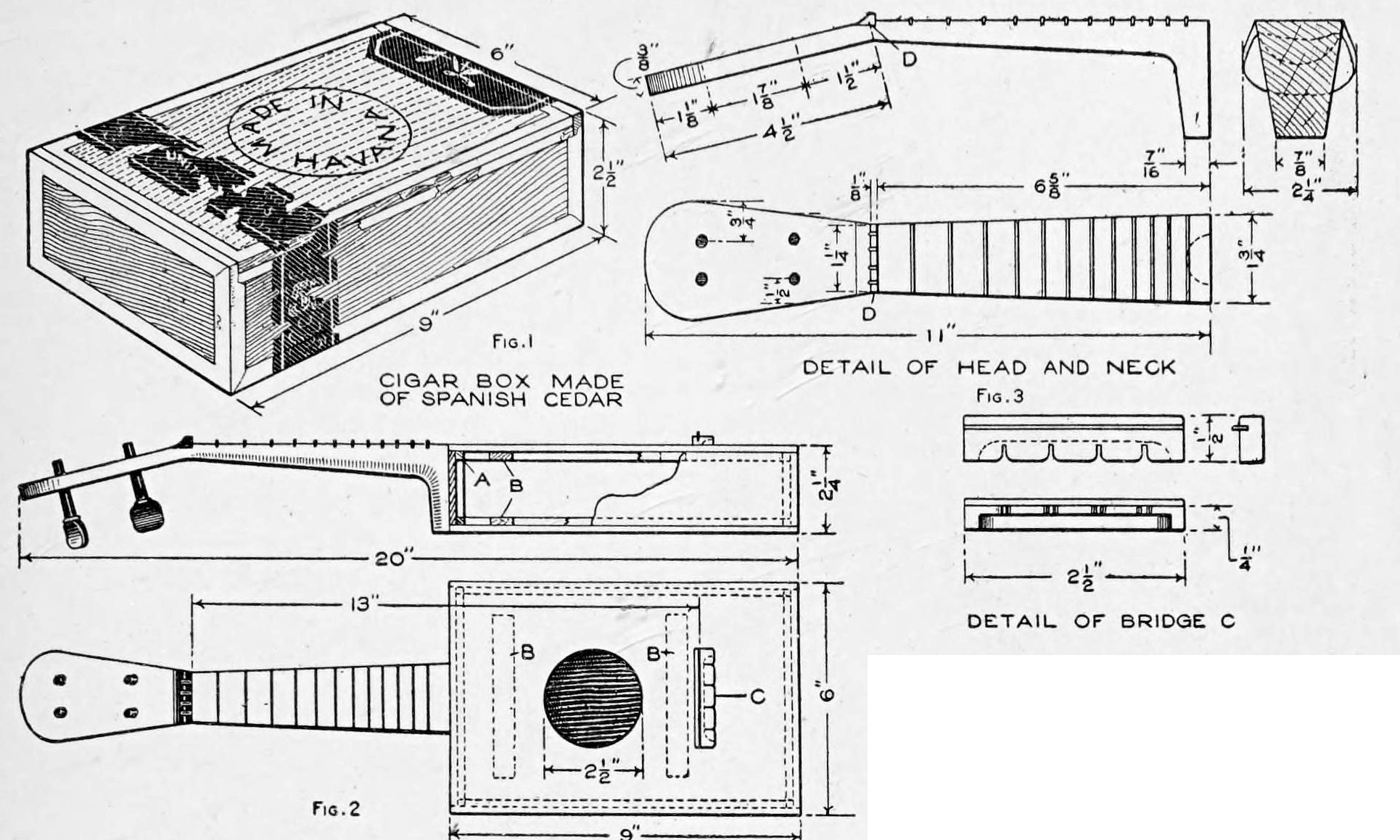


Cigar-Box Hawaiian Ukulele: Spanish-Cedar Body, 11 in Neck and Frets by the Rule of Eighteen (Boy Mechanic, 1919)
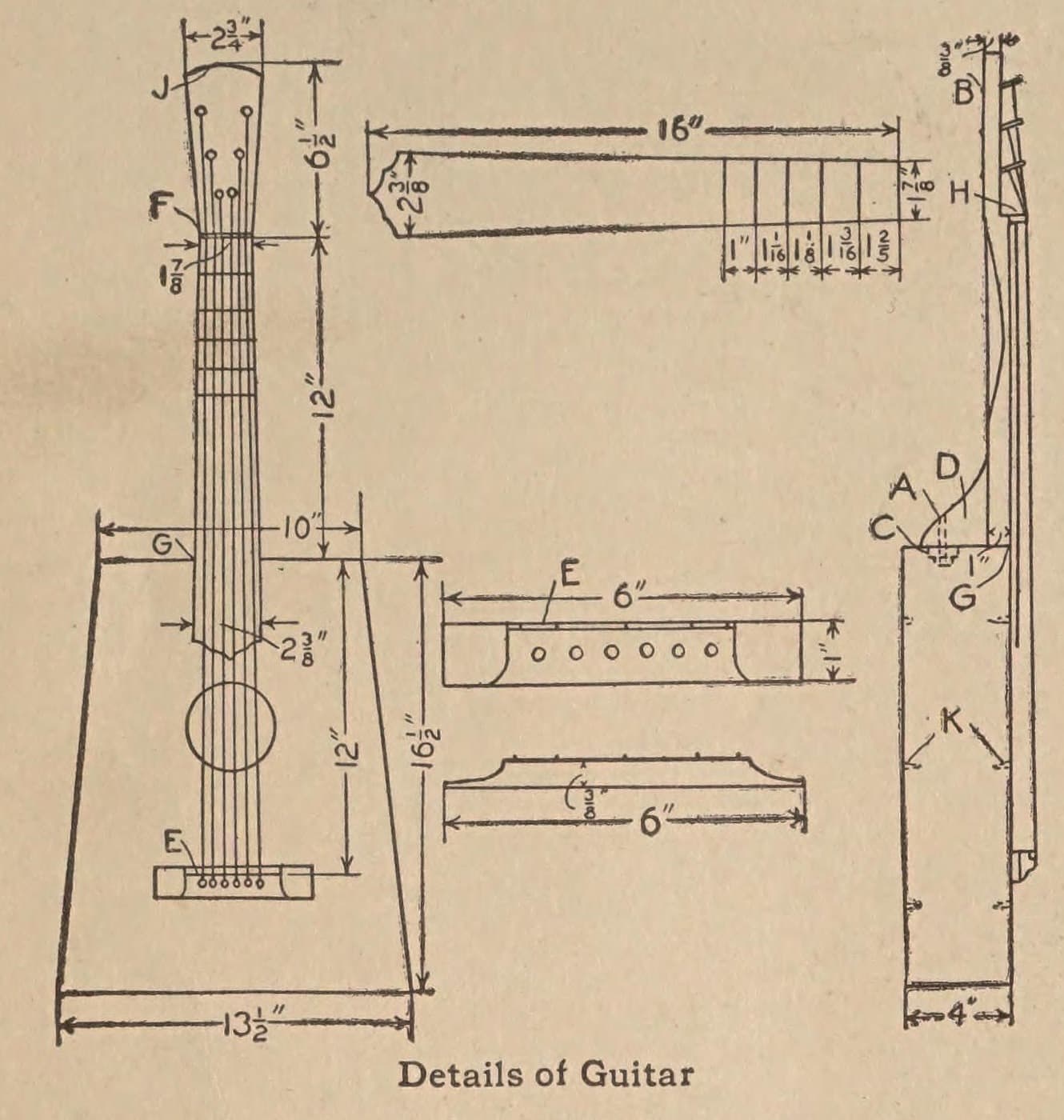
S. H. Samuels's ukulele from The Boy Mechanic, Book 3 (1919), made for 30 cents: a Spanish-cedar cigar box rebuilt as a 9 x 6 in body with a 2-1/2 in sound hole, an 11 in cedar or mahogany neck, a notched hardwood bridge, and aluminium frets set by the old rule of 1/18 on a 13 in string length.
Àárín
About 2 days
Ìlànà
1
1
Fret table
Fret table
Ń ṣí ìwé Jupyter…
2
2
Read The Boy Mechanic, Book 3
Read The Boy Mechanic, Book 3
"The size of this instrument makes it especially suited to the cigar-box type of body construction."
3
3
Rebuild the box as the body
Rebuild the box as the body
Take a good Spanish-cedar cigar box about 2-1/2 by 6 by 9 in, soak off the paper without marring the wood, take it apart and trim edges with too many or broken nail holes. Fit the parts so top and bottom rest against the sides and ends, the ends between the sides (Fig. 2; drawn 9 by 6 by 2-1/4 in). Cut a 2-1/2 in hole in the top 3-3/4 in from the neck end. Make corner strips A 1/4 in square and strips B 1/4 by 5/8 by 4-1/2 in for under the top and on the bottom.
Àwọn ohun èlò fún ìgbésẹ̀ yìí:
 Pákó igi sídà1 ẹyọ
Àwọn irinṣẹ́ tí a nílò:
 Ayùn Kópìngì
 Ọ̀bẹ awọ
 Ohun èlò ìfárí igi (pìlánì)
 Kọ́mpasi
 Ìdíwọ̀n
4
4
Make the neck, nut and bridge
Make the neck, nut and bridge
Cut the neck from Spanish cedar or mahogany, 11 in long, best in one piece (or with the peg extension and the wide body end glued on and doweled): head 4-1/2 in, fingerboard 6-5/8 in from the 1/8 in nut, 1-1/4 in wide at the nut and 1-3/4 in at the body, heel 7/16 in, section 7/8 by 2-1/4 in as drawn (Fig. 3). Make the nut D of mahogany or walnut with the grain lengthwise, notched for the strings as spaced. Make the bridge C of hard wood, 2-1/2 in long and 1/2 in high, hollowed under the notched edge, with a metal string contact.
Àwọn ohun èlò fún ìgbésẹ̀ yìí:
 Pátákó Igi Líle1 ẹyọ
 Òpó Igi Dòwẹ̀lì1 ẹyọ
 Lẹ̀mọ́ ẹranko1 ẹyọ
 Ọ̀pá idẹ pẹrẹsẹ1 ẹyọ
Àwọn irinṣẹ́ tí a nílò:
 Ayùn Ọwọ́Ayùn KópìngìỌ̀bẹ awọ
 Àwọn Ìfá (Ìfá Ọwọ́)
 Ìlù ọwọ́
5
5
Fret the fingerboard
Fret the fingerboard
Measure the string length from the bridge contact to the nut (13 in here). Set the first fret 1/18 of that distance from the nut, the second 1/18 of the distance from the first fret to the bridge, and so on (notebook). Cut grooves 1/8 in deep and drive in frets of aluminium (or brass) 1/16 by 3/16 in, tight enough to need no fastening.
Àwọn ohun èlò fún ìgbésẹ̀ yìí:
Ọ̀pá idẹ pẹrẹsẹ1 ẹyọÀwọn irinṣẹ́ tí a nílò:
Ayùn Ọwọ́ Ayùn IrinÀwọn Ìfá (Ìfá Ọwọ́)Ìdíwọ̀n
 Gègé
 Òòlù
6
6
Assemble and finish
Assemble and finish
Glue the body's end to the neck with animal glue, reinforced by screws, its upper edge parallel with the fingerboard and the fingerboard flush with the top. Glue the body (without the top) to that end; when dry, glue in the strips, bridge and finally the top. Clean, sandpaper, stain and shellac or varnish. Fit tuning pegs (bought or made) and a set of strings.
Àwọn ohun èlò fún ìgbésẹ̀ yìí:
Lẹ̀mọ́ ẹranko1 ẹyọ Ìṣó igi1 ẹyọ
 Bébà Ìfá1 ẹyọ
 Fánníṣì sẹ́làkì1 ẹyọ
 Ẹ̀kù Ìtúnṣe Okùn4 ẹyọ
 Ukulele Strings1 ẹyọ
Àwọn irinṣẹ́ tí a nílò:
 Ìdìmú oní-ọ̀pá
 Ìlọ̀sí olójú pẹlẹbẹ
 Búrọ́ọ̀ṣì fífẹ̀
7
7
Troubleshooting
Troubleshooting
Ukulele troubleshooting.
Flow
Loading...
8
8
History and honest limits
History and honest limits
From "A Homemade Hawaiian Ukulele" by S. H. Samuels, in **The Boy Mechanic, Book 3**, Popular Mechanics, 1919 (Project Gutenberg 71856; checked on the archive.org scan boymechanic0003unse, pp. 358-359). He gives the box as about 2-1/2 in deep; his drawing shows 2-1/4 in. He names no stain and no string type. The fret table, its equal-temperament comparison and the metric figures are ours.
Àwọn ohun-èlò
10- 1 ẹyọÀyè
- 1 ẹyọÀyè
- 1 ẹyọÀyè
- 1 ẹyọÀyè
- 1 ẹyọÀyè
- 1 ẹyọÀyè
- 1 ẹyọÀyè
- 1 ẹyọÀyè
- 4 ẹyọÀyè
- 1 ẹyọÀyè
Àwọn irinṣẹ́ tó nílò
14- Àyè
- Àyè
- Àyè
- Àyè
- Àyè
- Àyè
- Àyè
- 1 vendor sell this, none ship to you yetÀyè
- Àyè
Ìtọ́nisọ́nà yìí ń ṣe

Blueprint tó jọra
Àwọn blueprint wọ̀nyí pín ìmọ̀ — ọ̀nà, ohun-èlò tàbí ìlànà
CC0 Àgbègbè Gbogbogbò
Blueprint yìí ti jáde lábẹ́ CC0. O lè ṣe àdàkọ, yí padà, pín, àti lò láìsí ìyọ̀ǹda.
Ṣàtìlẹ́yìn Olùṣẹ́dá nípa rírà àwọn ọjà nipasẹ̀ Blueprint wọn Ẹ̀san Olùṣẹ́dá tí àwọn Olùtajà gbé kalẹ̀, tàbí ṣẹ̀dá àtúnṣe tuntun ti Blueprint yìí kí o sì fi sínú Blueprint rẹ gẹ́gẹ́ bí ìsopọ̀ láti pín owó-wíwọlé.