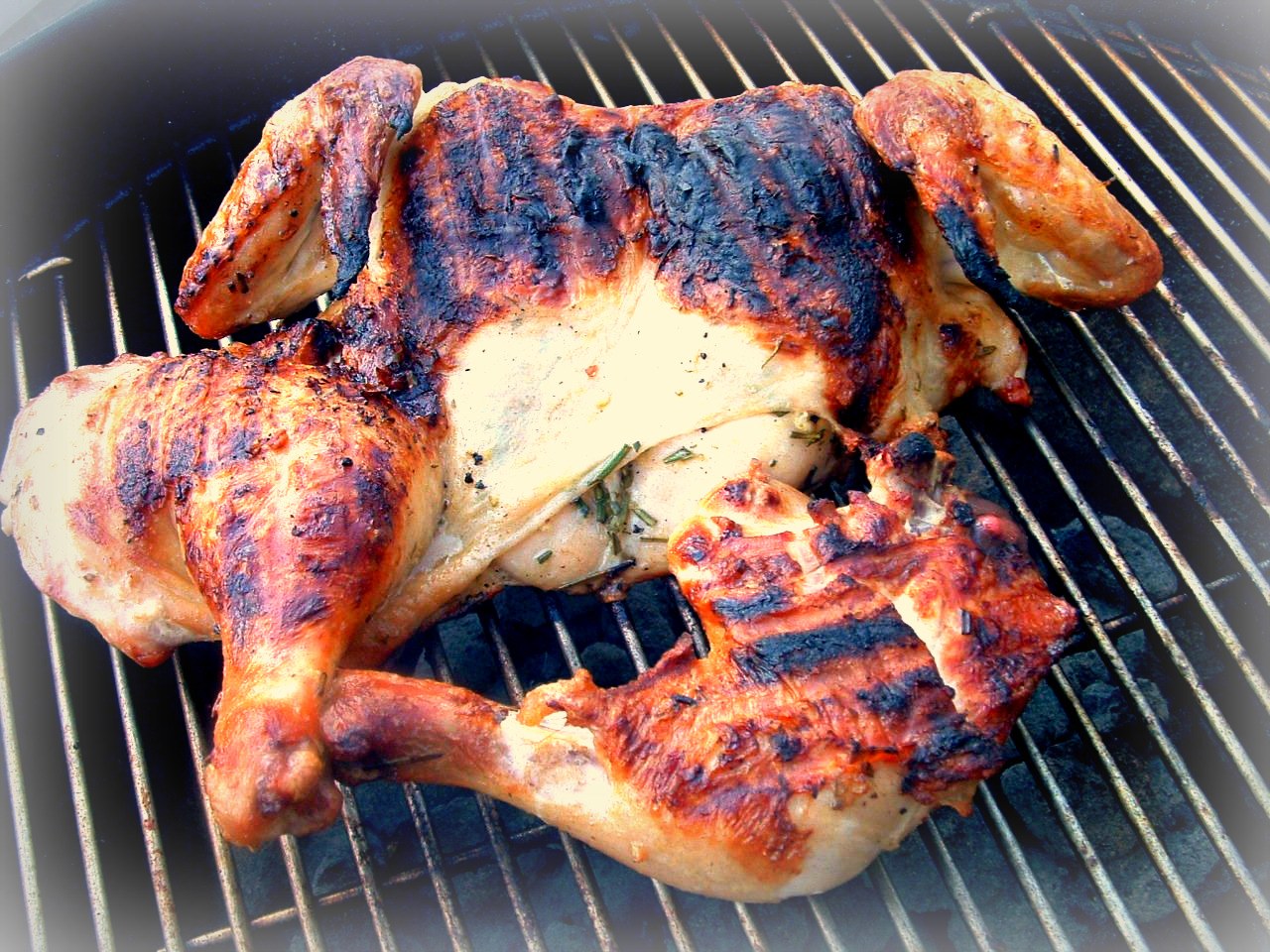


Spatchcock Roast Chicken
A whole chicken is an awkward object to cook. The breast is lean and dries out above about 65 °C; the thigh is full of connective tissue and is only really good once it has been held well past that. Roast the bird whole and the two are at different depths, shielded by each other, with a cold cavity in the middle — so by the time the thigh is right, the breast is chalk.
Spatchcocking removes the geometry problem instead of trying to cook around it. Cut out the backbone, press the bird flat, and it becomes a slab of roughly even thickness with everything facing the heat. The legs, splayed outwards, sit at the hot edges of the tray. The breast, in the middle, is the coolest part of the pan.
Two things follow immediately. It cooks in roughly half the time — about 45-55 minutes at 200-220 °C instead of an hour and a half — and it cooks evenly, which is the part that actually matters.
One number is not negotiable. Poultry is safe at 74 °C (165 °F), measured in the thickest part of the thigh, not touching bone. That is the USDA figure and this blueprint does not soften it.
Do it once with a thermometer and you will not roast a whole bird again.
Ìlànà
Set up so nothing else gets contaminated
Set up so nothing else gets contaminated
Clear the board and sink first. Put the bird on a dedicated board, keep a bin bag open, and have soap at the sink.
Do not wash the chicken. Rinsing does not remove bacteria and it aerosolises them across the sink and worktop; cooking is what makes it safe.
Wash hands, board, shears and anything the raw bird touched before you handle anything else.
Àwọn ohun èlò fún ìgbésẹ̀ yìí:
 Adìẹ1 ẹyọ
Àwọn irinṣẹ́ tí a nílò:
 Igi maple fún pákó ìgé
Cut out the backbone
Cut out the backbone
Put the bird breast-down, tail towards you. With strong shears, cut up one side of the backbone from tail to neck, then up the other side. Remove the backbone and keep it for stock.
Cut close and parallel to the bone.
Shears, not a knife. You are cutting through rib bones, and a knife slips off them in a way that puts your other hand at risk.
Àwọn irinṣẹ́ tí a nílò:
 Àkójọ ohun èlò ìtọ́jú adìẹ
Flatten it and check it stays flat
Flatten it and check it stays flat
Turn the bird breast-up and press firmly down on the breastbone with the heel of your hand until you feel it give and the bird lies flat.
Tuck the wing tips behind the shoulders. Splay the legs outwards.
Measure the thickness at the breast and at the thigh.
Those two figures are the point of the whole technique — the closer they are, the more evenly it will cook.
Àwọn irinṣẹ́ tí a nílò:
 Okùn Ìdíwọ̀n
Dry-brine and leave it uncovered
Dry-brine and leave it uncovered
Salt the bird all over at roughly 1 % of its weight — about 15 g for a 1.5 kg bird. Add pepper and any dry seasoning.
Leave it uncovered on a rack in the fridge for 4-24 hours.
Salt draws moisture out, dissolves in it, and is reabsorbed carrying seasoning inward, while the uncovered surface dries.
A dry skin is what crisps. A wet skin steams, and no oven temperature fixes it.
Àwọn ohun èlò fún ìgbésẹ̀ yìí:
 Ìdìpọ̀ ìjẹ̀ àti ìparí ẹyẹ1 ohun èlò
Àwọn irinṣẹ́ tí a nílò:
 Òṣùwọ̀n Díjítà Ilé Ìdáná
Roast hot, and measure the right place
Roast hot, and measure the right place
Roast skin-up at 200-220 °C for 45-55 minutes for a 1.5-2 kg bird.
Probe the thickest part of the thigh, not touching bone, and separately the thickest part of the breast.
Take it out when the thigh reaches 74 °C.
Colour is not doneness and time is not doneness. A bird can be beautifully browned and unsafe, and the only honest test is a thermometer in the slowest-heating muscle.
Àwọn irinṣẹ́ tí a nílò:
 Àwo ìdáná ìléru
 Ẹ̀rọ Ìwọ̀n Ooru Kíákíá
Rest it, then prove the technique worked
Rest it, then prove the technique worked
Rest 10-15 minutes before carving. Record the breast and thigh temperatures at the moment you pulled it out.
Expect a gap of only a few degrees.
If you can, roast a whole un-spatchcocked bird another day and take the same two readings.
Expect a much larger gap — breast well overcooked by the time the thigh is safe. That difference is the entire argument, in two numbers.
Àwọn irinṣẹ́ tí a nílò:
Ẹ̀rọ Ìwọ̀n Ooru Kíákíá Ìwé Ìkọ̀wé Pápá Fún Gbogbo Ojú Ọjọ́
History & Context
History & Context
The word is older than the fashion. "Spatchcock" is attested in Ireland in the late eighteenth century, and the usual explanation is a contraction of dispatch cock — a bird killed, split and thrown straight on the fire for an unexpected guest. It was a speed technique for cooks with no oven, and "butterflying" is the same operation under a plainer name. Flattening a bird over coals is far older and near-universal: pollo alla diavola in Italy, tabaka in Georgia pressed under a weighted pan, galinha ao murro in Portugal, grilled chicken over charcoal across South and Southeast Asia. Everywhere people cooked birds over a fire rather than in a box, they worked out that flat cooks better.
Why 74 °C, and why it is more nuanced than it sounds. Pathogen reduction is a function of temperature and time — the same kill can be achieved at a lower temperature held for longer, which is the basis of sous-vide poultry and of published time-temperature tables. 74 °C is the single-point figure because it is instantaneous and needs no timing, which makes it the right advice for a domestic kitchen. This blueprint uses it and does not offer the alternatives, because a time-temperature table used carelessly is worse than a simple rule used correctly.
Breast and thigh genuinely want different things. Breast is lean fast-twitch muscle and its proteins tighten and squeeze out water as temperature climbs, so it is best just past the safe point. Thigh is worked muscle full of collagen, which only converts to gelatin appreciably above roughly 70 °C and given time — which is why a thigh at 80 °C is succulent while a breast at 80 °C is dry. Spatchcocking does not abolish the conflict; it just stops the geometry from making it worse.
The skin is a separate problem with a separate solution. Crisp skin needs the surface water gone before browning can begin, because evaporation holds the surface near 100 °C and the Maillard reactions that brown and flavour it run properly well above that. Hence the uncovered fridge rest, hence the high oven, and hence the reason a bird straight from a wet package never browns properly however long you leave it.
Honest limits. The backbone is genuinely tough to cut and poultry shears matter — this is the one step where the right tool is a safety issue, not a convenience. A very large bird flattens badly and cooks unevenly anyway. Fat renders onto a hot tray and can smoke; a rack and a little water in the pan controls it. And raw poultry is a real cross-contamination risk: the board, the shears, the sink and your hands are the actual hazard in this recipe, not the oven.
Àwọn irinṣẹ́ tó nílò
7- 1 vendor sell this, none ship to you yetÀyè
Àwọn Ohun Èlò Ìtọ́nisọ́nà Tí A So Pọ̀


Ìtọ́nisọ́nà yìí ń ṣe

Blueprint tó jọra
Àwọn blueprint wọ̀nyí pín ìmọ̀ — ọ̀nà, ohun-èlò tàbí ìlànà
CC0 Àgbègbè Gbogbogbò
Blueprint yìí ti jáde lábẹ́ CC0. O lè ṣe àdàkọ, yí padà, pín, àti lò láìsí ìyọ̀ǹda.
Ṣàtìlẹ́yìn Olùṣẹ́dá nípa rírà àwọn ọjà nipasẹ̀ Blueprint wọn Ẹ̀san Olùṣẹ́dá tí àwọn Olùtajà gbé kalẹ̀, tàbí ṣẹ̀dá àtúnṣe tuntun ti Blueprint yìí kí o sì fi sínú Blueprint rẹ gẹ́gẹ́ bí ìsopọ̀ láti pín owó-wíwọlé.