IṢẸ́ ỌNÀ
ẸWÀ ÀTI ÌLERA
IṢẸ́ ỌWỌ́
ÀṢÀ ÀTI ÌTÀN
ÌṢERÉ
ÀYÍKÁ
OÚNJẸ ÀTI OHUN MÍMU
REVERSE ENGINEERING
SÁYẸ́ǸSÌ
ERÉ ÌDÁRAYÁ
ÌMỌ̀-Ẹ̀RỌ
ÀWỌN OHUN WÍWỌ̀


Skis: Ash or Hickory Planks Shaped to an 8 ft Pattern, Steam-Bent Tips and a Running Groove (Boy Mechanic, 1919)
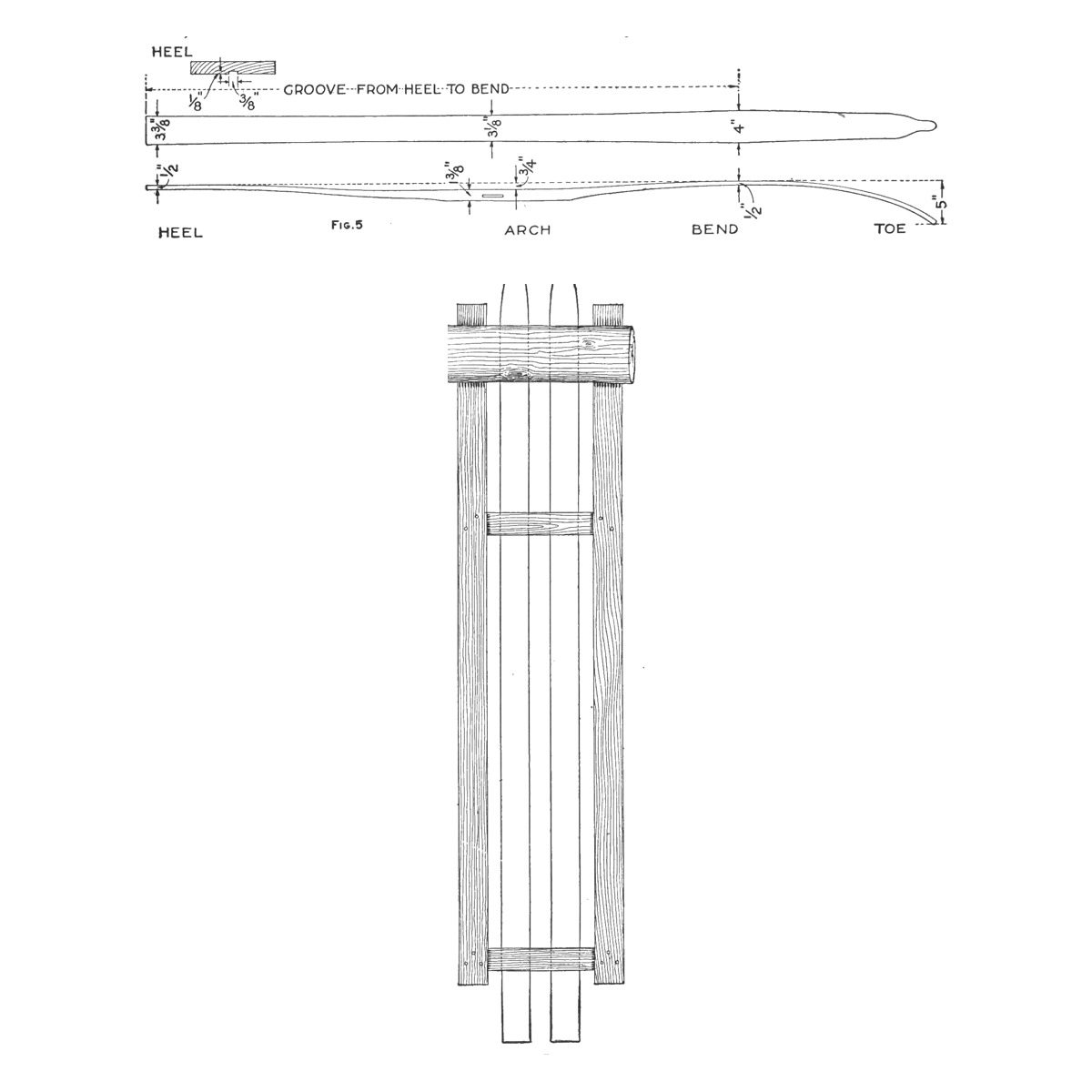
Stillman Taylor's skis from The Boy Mechanic, Book 3 (1919): "far easier than snowshoe construction, since each runner is made from a single piece of plank". Ash or hickory is cut to his 8 ft pattern, thinned from the top only, the tips steamed to a 6 in bend, a centre groove cut, and the skis oiled and waxed.
Àárín
About 1 week
Ìlànà
1
1
Fig. 5 in centimetres, and the wax
Fig. 5 in centimetres, and the wax
Ń ṣí ìwé Jupyter…
2
2
Read The Boy Mechanic, Book 3
Read The Boy Mechanic, Book 3
"Either hickory or ash will give satisfaction, because both are heavy woods, as well as strong and flexible." For a man of good height, 7 to 8 ft is the right length.
3
3
Get and choose the wood
Get and choose the wood
Get two ash or hickory planks about 9 ft long and 2 in thick, from the outside of the lower trunk, with the grain running as in his Fig. 6, A/D (in ash choose open, widely spaced grain). Or split a sound, straight tree about 10 in across and clear of knots for 10 ft: axe a straight groove about 1 in deep along each side and drive small wood wedges along it; hew only enough off the outside to make the flat running surface.
Àwọn ohun èlò fún ìgbésẹ̀ yìí:
 Pátákó Igi Líle2 ẹyọ
Àwọn irinṣẹ́ tí a nílò:
 Ayùn Ọwọ́
 Okùn Ìdíwọ̀n
4
4
Lay out and saw
Lay out and saw
Make a paper pattern from his Fig. 5 (8 ft ski): 3-3/8 in wide at the heel, 3-1/8 in at the foot, 4 in at the bend, rounding to the toe. Trace it on the plank and saw out; on green wood make the width about 1/4 in greater for shrinkage.
Àwọn ohun èlò fún ìgbésẹ̀ yìí:
Pátákó Igi Líle1 ẹyọÀwọn irinṣẹ́ tí a nílò:
 GègéAyùn Ọwọ́Okùn Ìdíwọ̀n
5
5
Plane to thickness
Plane to thickness
Plane the running surface perfectly smooth, grain straight from point to heel. Work the thickness down from the top side only, never the bottom: about 1/2 in at the heel, 3/4 in at the foot and 1/2 in at the bend.
Àwọn irinṣẹ́ tí a nílò:
 Ohun èlò ìfárí igi (pìlánì)
 Ayùn onídìmú méjì
6
6
Steam the tip
Steam the tip
Lay the ski over a wash boiler of boiling water and soak the tip by mopping it with the water on a cloth tied to a stick. Bend gradually over many treatments to a good 6 in bend (it finishes near 5 in, as the wood straightens a little as it dries). Hold it in a rough frame over a short log, or lash or cleat the tips to the bench, as in his Fig. 7. The arch under the foot is easily put in, and easily straightened when cold if overdone.
Àwọn irinṣẹ́ tí a nílò:
 Ìkòkò Ńlá
 Mọ́ọ̀pù
 Ìdìmú oní-ọ̀pá
7
7
Binding hole, balance and groove
Binding hole, balance and groove
Put in the hole for the foot binding. If the wood was left long, trim the heel so the ski balances when lifted by the toe straps (he sees no advantage in weighting a light heel with lead). Cut a groove in the exact centre of the running surface, about 1/8 in deep and 3/8 to 1/2 in wide, from the heel to the start of the bend, with a grooving plane or a small gouge.
Àwọn ohun èlò fún ìgbésẹ̀ yìí:
 Okùn Awọ2 ẹyọ
Àwọn irinṣẹ́ tí a nílò:
 Ìlù ọwọ́
 Àwọn ìgbẹ́ igi
 Ìṣẹ́gún OnígunAyùn Ọwọ́
8
8
Finish and wax
Finish and wax
Sandpaper top and bottom and rub down with linseed oil with a little paraffin or beeswax in it; oil and wax the running surface (spar varnish on the tops if you want gloss). For a hard wax, melt 10 oz of beeswax with 5 oz of rosin, stir in 1 oz of turpentine and pour into small boxes. Rub it on and go over it with a hot flatiron; too much wax makes climbing hard.
Àwọn ohun èlò fún ìgbésẹ̀ yìí:
 Bébà Ìfá1 ẹyọ
 Òróró Ọ̀gbọ̀1 ẹyọ
 Ìdí parafíìnì1 ẹyọ
 Ìdí Oyin1 ẹyọ
 Ọ̀dà igi paini1 ẹyọ
 Tọ́pẹ́ńtáìnì1 ẹyọ
Àwọn irinṣẹ́ tí a nílò:
Ìkòkò Ńlá Irin ayọ́ aṣọ olójú pẹlẹbẹ
 Búrọ́ọ̀ṣì fífẹ̀
9
9
Troubleshooting
Troubleshooting
Ski troubleshooting.
Flow
Loading...
10
10
History and honest limits
History and honest limits
From "How to Make Skis" by Stillman Taylor, in **The Boy Mechanic, Book 3**, Popular Mechanics, 1919 (Project Gutenberg 71856; checked on the archive.org scan boymechanic0003unse, pp. 27-30). His text gives the groove as 3/8 to 1/2 in wide; Fig. 5 shows 3/8 in. He does not describe the binding. The tools and metric figures are ours.
Àwọn ohun-èlò
8- 2 ẹyọÀyè
- 2 ẹyọÀyè
- 1 ẹyọÀyè
- 1 ẹyọÀyè
- 1 ẹyọÀyè
- 1 ẹyọÀyè
- 1 ẹyọÀyè
- 1 ẹyọÀyè
Àwọn irinṣẹ́ tó nílò
13- Àyè
- 1 vendor sell this, none ship to you yetÀyè
- 1 vendor sell this, none ship to you yetÀyè
- Àyè
- Àyè
- Àyè
Ìtọ́nisọ́nà yìí ń ṣe
Blueprint tó jọra
Àwọn blueprint wọ̀nyí pín ìmọ̀ — ọ̀nà, ohun-èlò tàbí ìlànà
CC0 Àgbègbè Gbogbogbò
Blueprint yìí ti jáde lábẹ́ CC0. O lè ṣe àdàkọ, yí padà, pín, àti lò láìsí ìyọ̀ǹda.
Ṣàtìlẹ́yìn Olùṣẹ́dá nípa rírà àwọn ọjà nipasẹ̀ Blueprint wọn Ẹ̀san Olùṣẹ́dá tí àwọn Olùtajà gbé kalẹ̀, tàbí ṣẹ̀dá àtúnṣe tuntun ti Blueprint yìí kí o sì fi sínú Blueprint rẹ gẹ́gẹ́ bí ìsopọ̀ láti pín owó-wíwọlé.