IṢẸ́ ỌNÀ
ẸWÀ ÀTI ÌLERA
IṢẸ́ ỌWỌ́
ÀṢÀ ÀTI ÌTÀN
ÌṢERÉ
ÀYÍKÁ
OÚNJẸ ÀTI OHUN MÍMU
REVERSE ENGINEERING
SÁYẸ́ǸSÌ
ERÉ ÌDÁRAYÁ
ÌMỌ̀-Ẹ̀RỌ
ÀWỌN OHUN WÍWỌ̀
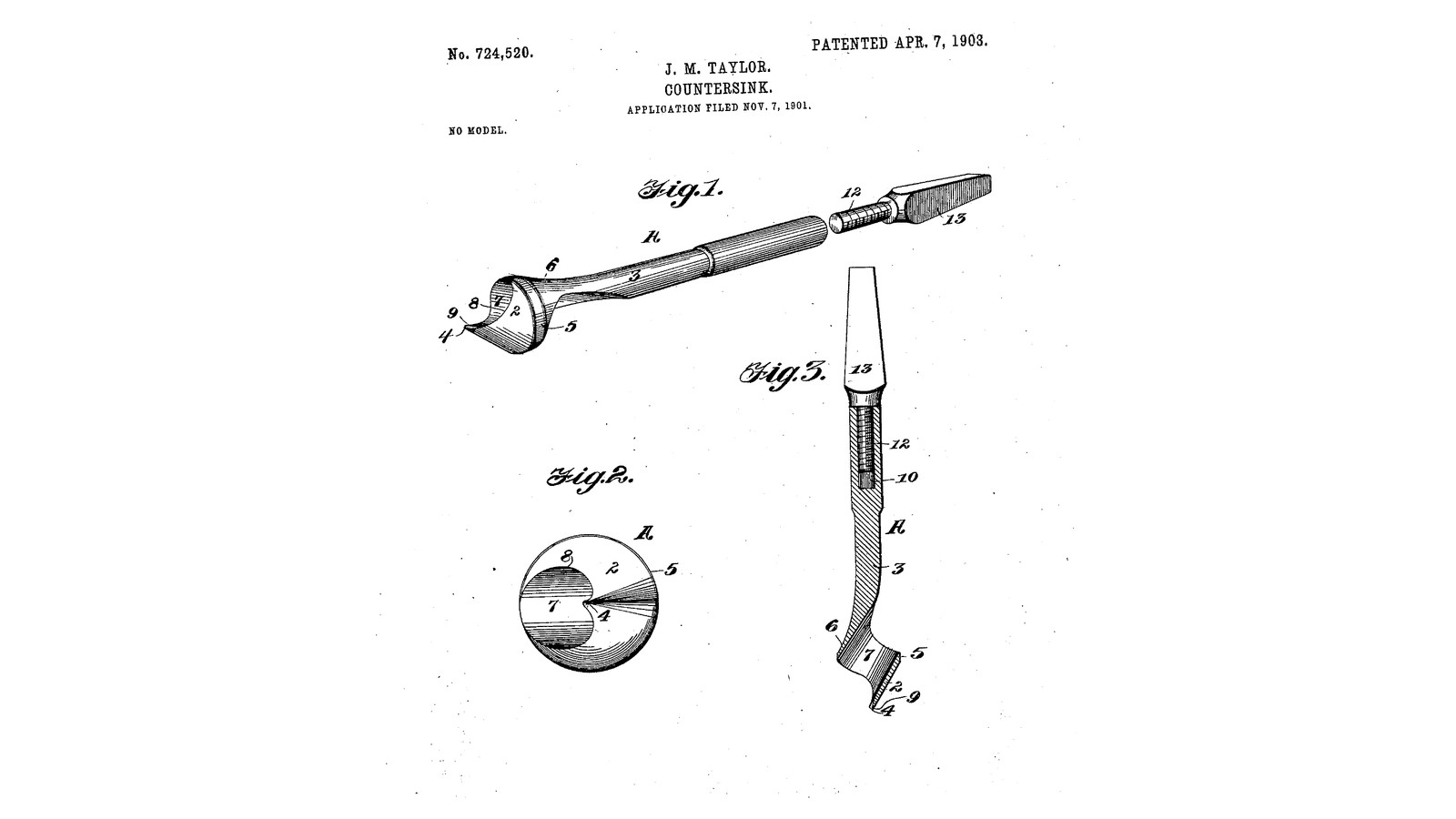


Cross-Hole Countersinks: A Slanting Hole Through the Cone Makes One Spiral Shearing Lip (Taylor, 1903)
John M. Taylor of Hartford, Connecticut, received US 724,520, dated 7 April 1903, for a countersink that shears wood smoothly. Its conical head has a hole drilled through it at a slant that crosses the axis and reaches the point. One edge of that hole is the cutting lip, a spiral curve from the point out to the rim, and the chips go straight out through the hole to the back. A short band behind the cone guides it.
We turn a set of three from tool steel and harden them. The patent gives no sizes; every size here is ours.
Àárín
About 1 day
Ìlànà
1
1
Where the slanting hole must go
Where the slanting hole must go
Ń ṣí ìwé Jupyter…
2
2
Read US 724,520
Read US 724,520
"One of the outer edges of the wall of the opening forms a cutting-lip 8, which is of spiral formation, whereby it is effective to make a shear cut, and terminates in a shoulder 9, forming an entering or cutting point 4 at the apex of the conical head 2."
3
3
Turn the blanks
Turn the blanks
From octagonal tool steel big enough for each head, turn three blanks: a 90 degree cone 2 to a sharp point, 12, 16 and 20 mm across at its base; a band 5 2 mm long at that diameter as the guide; a truncated cone 6 down to an 8 mm shank 50 mm long. File three flats on each shank's end for the chuck. Heat each to a cherry red and let it cool slowly in the air, to soften it for drilling.
Àwọn ohun èlò fún ìgbésẹ̀ yìí:
 Ọ̀pá onígun mẹ́jọ irin irinṣẹ́2 ẹyọ
Àwọn irinṣẹ́ tí a nílò:
 Ẹ̀rọ Ìyí Irin
 Ìmú ẹ̀rọ ìyípo oníka mẹ́ta
 Ohun ìgé ẹ̀rọ ìyí
 Ọ̀bẹ ìgékúrò lórí ẹ̀rọ ìyí
 Ẹ̀rọ Ìwọ̀n Igun
 Òṣùwọ̀n Kálípà Díjítà Ìnṣì 6
 Àkójọ Ìfá
 Ilé Iná Alágbẹ̀dẹ
 Ẹmú Alágbẹ̀dẹ
 Gíláàsì ààbò
4
4
Drill the slanting opening 7
Drill the slanting opening 7
Hold a blank in the machine vice tilted so the drill meets the cone's side at 35 degrees to the tool's axis, aimed to cross the axis just behind the point (the notebook gives how far). Drill through with a drill 0.45 of the head across: 5.5, 7 and 9 mm, so the hole breaks out through the point on one side and out of the back cone on the other. Open the back of the hole a little larger, so it tapers towards the shank.
Àwọn irinṣẹ́ tí a nílò:
 Ẹ̀rọ Ìlùkòkò Onídúró
 Ìdìmú Ẹ̀rọẸ̀rọ Ìwọ̀n Igun
 Àkójọ Orí ÌlùkòkòÒṣùwọ̀n Kálípà Díjítà Ìnṣì 6
5
5
File the lip 8
File the lip 8
With a round needle file, clean the hole's edge on the side that leads as the countersink turns, leaving it sharp from the point to the band: that is the spiral cutting lip. File a little relief on the cone just behind it, and leave the shoulder 9 at the point.
Àwọn irinṣẹ́ tí a nílò:
 Àkójọ Ìfá KékeréÌdìmú Ẹ̀rọ
 Ẹ̀rọ ìfá orí tábìlì
6
6
Harden and temper
Harden and temper
Heat each head to a cherry red, until a magnet no longer sticks, and quench it point first in water, moving it about. Rub it bright with a stone, heat the shank gently 20 mm behind the head, and quench again as soon as a light straw colour reaches the cutting lip.
Àwọn irinṣẹ́ tí a nílò:
Ilé Iná Alágbẹ̀dẹẸmú Alágbẹ̀dẹ Magnẹ́ẹ̀tì Kékeré
 Àpótí ìtutù
 Omi
 Òkúta Ìpọ́n
 Ìbọ̀wọ́ wẹ́lídìnGíláàsì ààbò
7
7
Hone and test
Hone and test
Hone the lip lightly with the stone. Drill a few screw holes in hardwood and countersink them in the drill: the cone should cut a smooth bell without chatter and the chips should come out of the hole at the back.
Àwọn irinṣẹ́ tí a nílò:
Òkúta Ìpọ́n Ẹ̀rọ Ìlùkòkò AláìlókùnÀkójọ Orí Ìlùkòkò
 Pátákó Igi LíleGíláàsì ààbò
8
8
Troubleshooting
Troubleshooting
Countersink troubleshooting.
Flow
Loading...
9
9
History and honest limits
History and honest limits
**John M. Taylor** of Hartford, Connecticut, US 724,520, dated 7 April 1903, filed 7 November 1901. He claimed "a countersink having a cone-shaped head provided with an opening crossing diagonally to the axis within the length of the tool and intersecting the apex of the cone, said opening having a curved edge forming a cutting-lip", and a two-part shank for brace or chuck. We make one-piece shanks for a chuck. He gives no sizes, angle or steel; our 90 degree cones, sizes and the house hardening are ours.
Àwọn ohun-èlò
1- Àyè
Àwọn irinṣẹ́ tó nílò
22- Àyè
- Àyè
- Àyè
- Àyè
- Àyè
- Àyè
- 1 vendor sell this, none ship to you yetÀyè
Ìtọ́nisọ́nà yìí ń ṣe

Blueprint tó jọra
Àwọn blueprint wọ̀nyí pín ìmọ̀ — ọ̀nà, ohun-èlò tàbí ìlànà
CC0 Àgbègbè Gbogbogbò
Blueprint yìí ti jáde lábẹ́ CC0. O lè ṣe àdàkọ, yí padà, pín, àti lò láìsí ìyọ̀ǹda.
Ṣàtìlẹ́yìn Olùṣẹ́dá nípa rírà àwọn ọjà nipasẹ̀ Blueprint wọn Ẹ̀san Olùṣẹ́dá tí àwọn Olùtajà gbé kalẹ̀, tàbí ṣẹ̀dá àtúnṣe tuntun ti Blueprint yìí kí o sì fi sínú Blueprint rẹ gẹ́gẹ́ bí ìsopọ̀ láti pín owó-wíwọlé.