IṢẸ́ ỌNÀ
ẸWÀ ÀTI ÌLERA
IṢẸ́ ỌWỌ́
ÀṢÀ ÀTI ÌTÀN
ÌṢERÉ
ÀYÍKÁ
OÚNJẸ ÀTI OHUN MÍMU
REVERSE ENGINEERING
SÁYẸ́ǸSÌ
ERÉ ÌDÁRAYÁ
ÌMỌ̀-Ẹ̀RỌ
ÀWỌN OHUN WÍWỌ̀
Léwu


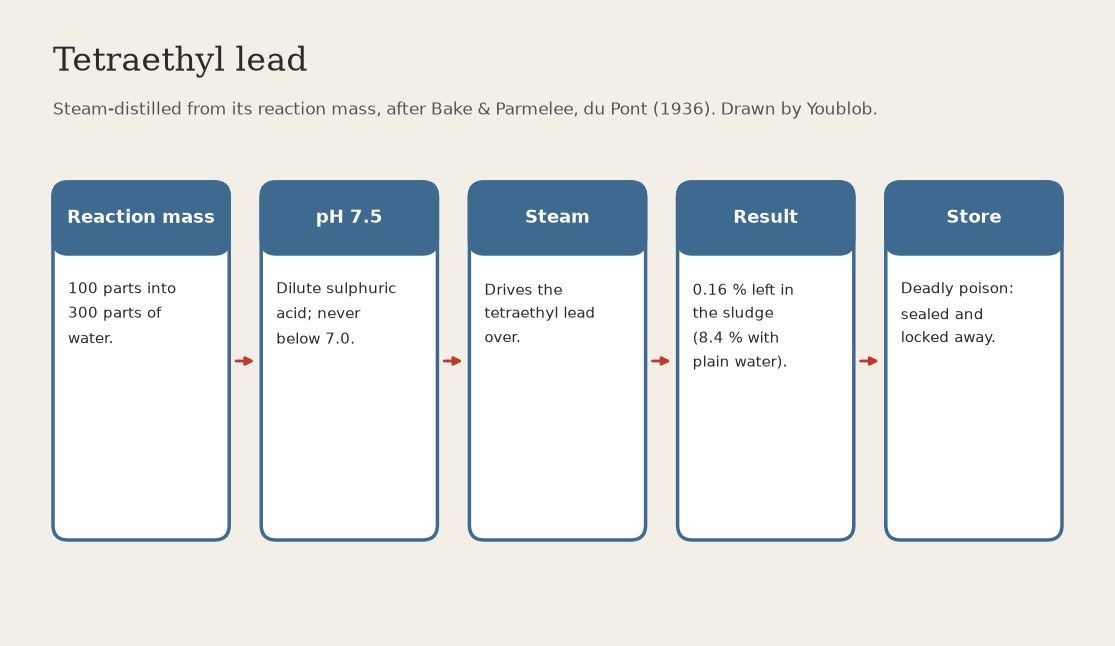
Tetraethyl Lead: Steam-Distilled from the Reaction Mass in Water Brought to pH 7.5 with Dilute Sulphuric Acid (Bake & Parmelee, du Pont, US 2,038,703)
The tetraethyl lead in the reaction mass clings to fine lead particles, in a mass like wet sand that cannot be filtered or poured off. It is driven out with steam. Du Pont found that making the water slightly less alkaline, to pH 7.5, lets almost all of it come over.
Result (Ex. 3): only 0.16 % of tetraethyl lead left in the lead sludge, against 8.4 % with plain water.
Variable: what goes in the water. Plain water 8.4 % left; 0.2 part Turkey red oil 3.2 %; sulphuric acid to pH 9.3 0.35 %; acetic acid to pH 7.5 0.17 %; ammonium sulphate 0.19 %. Do not go below pH 7.0 (claims).
Source: Bake & Parmelee, US 2,038,703 (1936). Not given: how the tetraethyl lead is parted from the condensed water. Danger: tetraethyl lead is a deadly poison, absorbed through skin and from its vapour. Picture drawn by Youblob.
Ògbóǹtarìgì
1 day
Àkóónú tó léwu
Blueprint yii ni awọn ilana ti o lewu. Wọle ki o mu akoonu ti o lewu ṣiṣẹ ninu awọn eto akaunti rẹ lati wo awọn itọnisọna igbesẹ-nipasẹ-igbesẹ.
WọléÌtọ́nisọ́nà yìí ń ṣe
Blueprint tó jọra
Àwọn blueprint wọ̀nyí pín ìmọ̀ — ọ̀nà, ohun-èlò tàbí ìlànà

CC0 Àgbègbè Gbogbogbò
Blueprint yìí ti jáde lábẹ́ CC0. O lè ṣe àdàkọ, yí padà, pín, àti lò láìsí ìyọ̀ǹda.
Ṣàtìlẹ́yìn Olùṣẹ́dá nípa rírà àwọn ọjà nipasẹ̀ Blueprint wọn Ẹ̀san Olùṣẹ́dá tí àwọn Olùtajà gbé kalẹ̀, tàbí ṣẹ̀dá àtúnṣe tuntun ti Blueprint yìí kí o sì fi sínú Blueprint rẹ gẹ́gẹ́ bí ìsopọ̀ láti pín owó-wíwọlé.