IṢẸ́ ỌNÀ
ẸWÀ ÀTI ÌLERA
IṢẸ́ ỌWỌ́
ÀṢÀ ÀTI ÌTÀN
ÌṢERÉ
ÀYÍKÁ
OÚNJẸ ÀTI OHUN MÍMU
REVERSE ENGINEERING
SÁYẸ́ǸSÌ
ERÉ ÌDÁRAYÁ
ÌMỌ̀-Ẹ̀RỌ
ÀWỌN OHUN WÍWỌ̀
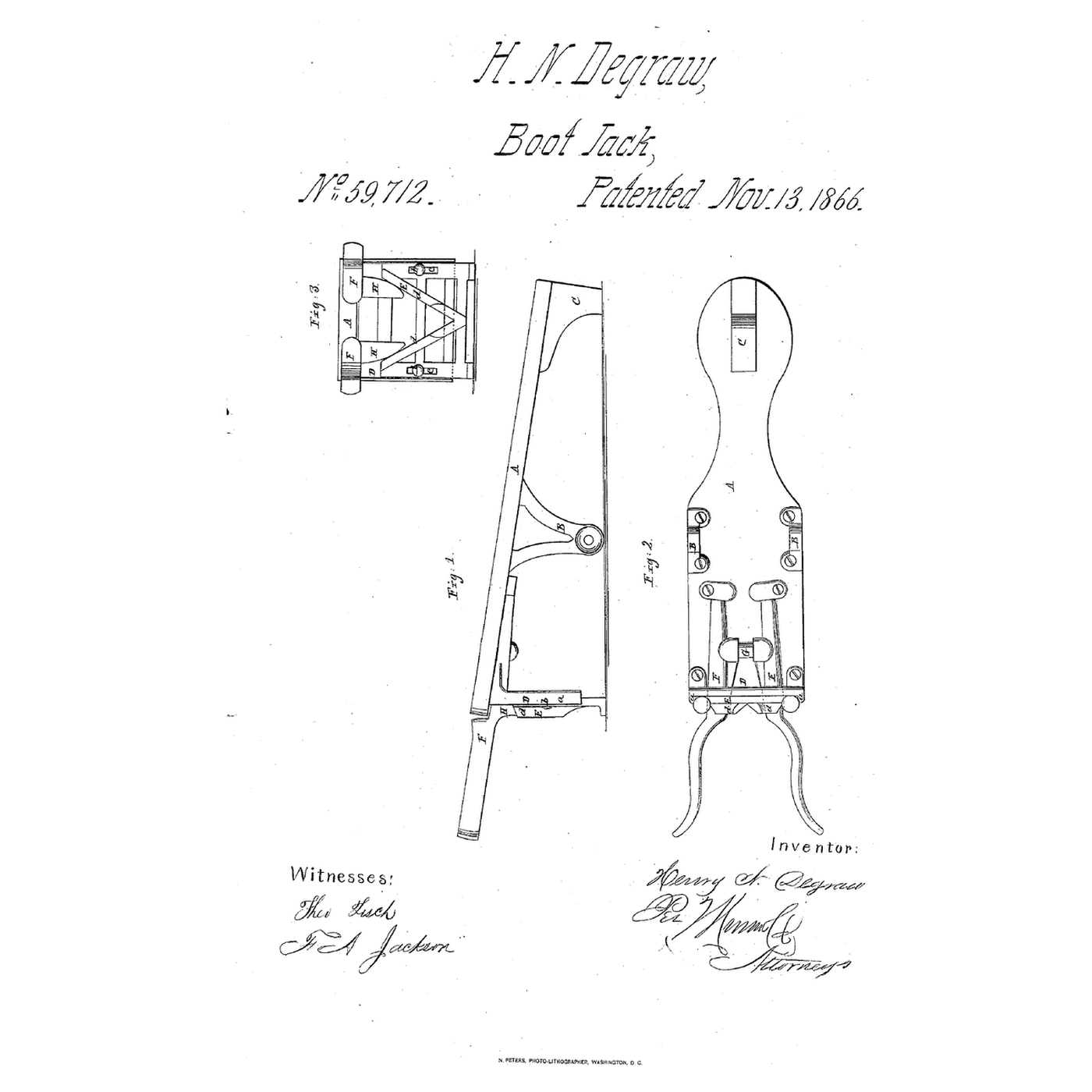


The Boot-Jack: Jaws That Close When You Stand on It
Tall, tight boots are hard to pull off alone. A boot-jack holds the heel of one boot while the other foot stands on it.
Henry N. DeGraw of Newburg, New York, assignor to himself and Henry Wright, received US 59,712, dated 13 November 1866, for a boot-jack whose pivoted jaws "may by the pressure of one foot on the foot-piece be made to grasp the heel of the boot on the other foot, so that said foot may be readily withdrawn therefrom." Pendants on the jaws bear on inclined bars; an india-rubber spring spreads them again when the foot lifts.
This rung works out the squeeze the wedge gives and the pull friction can hold, then builds a wooden model with elastic-band springs.
Olùbẹ̀rẹ̀
About 2 hours
Ìlànà
1
1
Wedge squeeze and friction grip
Wedge squeeze and friction grip
Ń ṣí ìwé Jupyter…
2
2
A small push, a large squeeze
A small push, a large squeeze
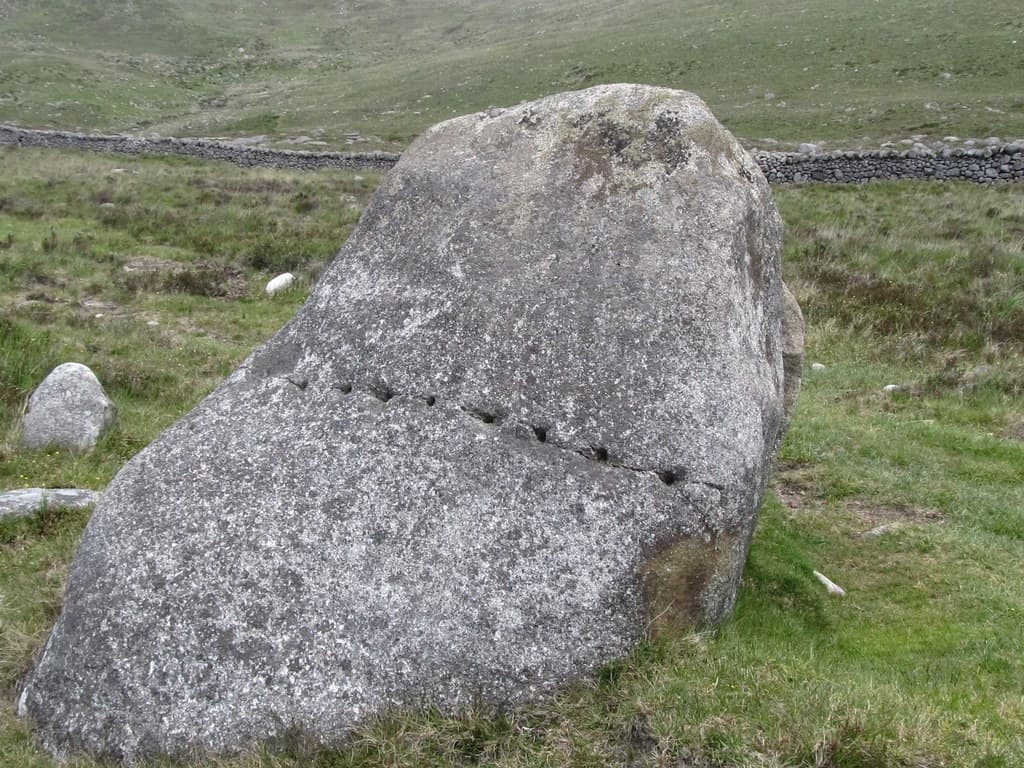
The jack's inclined bars are wedges. The embedded blueprint splits stone with feathers and wedges on the same principle.
3
3
Read US 59,712
Read US 59,712
"This invention relates to a new and improved boot-jack of that class which are provided with movable or pivoted jaws; and it consists in a novel and improved manner of applying the jaws to the foot-piece and arranging certain parts therewith, whereby the jaws may by the pressure of one foot on the foot-piece be made to grasp the heel of the boot on the other foot, so that said foot may be readily withdrawn therefrom."
"The device is used by placing the heel of the boot from which the foot is to be withdrawn between the outer curved parts of the jaws F F, and placing the other foot on the foot-piece A, and pressing upon the latter in a downward and forward direction, so as to force down the frame D and the foot or toe end of the foot piece A, and in consequence of the pendants H of the jaws bearing against the oblique or inclined bars d d of the frame E, the two jaws F F will be pressed toward each other and made to grasp firmly the heel of the boot, so that the foot can be readily drawn from it. On taking the foot from the foot-piece the spring G will distend the jaws F F".
4
4
Build a gripping jack
Build a gripping jack
Cut a pine board about 35 cm long as the foot-piece and screw a short block under its middle so the toe end rises. From plywood cut two curved jaws that meet around a heel; pivot each on a screw under the toe end. Glue two strips in a V under the front, so pressing the board down pushes the jaws' tails along the strips and closes the jaws. Stretch elastic bands between the jaws to spread them.
Try it with a boot: heel in the jaws, other foot on the board. Then hang a bag of known weight from a boot held in the jaws while someone stands on it, adding weight until it slips.
Àwọn ohun èlò fún ìgbésẹ̀ yìí:
 Pákó igi pine1 ẹyọ
 Àwo igi tí a lẹ̀ pọ̀1 ẹyọ
 Okùn rọ́bà4 ẹyọ
 Ìṣó igi1 ẹyọ
Àwọn irinṣẹ́ tí a nílò:
 Ayùn Kópìngì
 Ẹ̀rọ Ìlùkòkò Aláìlókùn
 Àkójọ Orí Ìlùkòkò
 Ìṣù àwọn ohun ìyí skurú
 Pákó ìbọ́ bàtà gígùn
5
5
A boot-jack that slips or will not let go
A boot-jack that slips or will not let go
Boot-jack troubleshooting.
Flow
Loading...
6
6
History and honest limits
History and honest limits
**Henry N. DeGraw** of Newburg, New York, assignor to himself and Henry Wright, received US 59,712, dated 13 November 1866 (no filing date is printed on patents of that period). He notes "quite a large number having been recently manufactured and sold."
**Honest limits.** The patent gives no angles or forces. Body mass, the share pressed forward, bar angles, friction and the pull a boot needs are examples.
Àwọn ohun-èlò
4- 1 ẹyọÀyè
- 1 ẹyọÀyè
- Okùn rọ́bàìdá 10%4 ẹyọÀyè
- 1 ẹyọÀyè
Àwọn irinṣẹ́ tó nílò
5- Àyè
- 1 vendor sell this, none ship to you yetÀyè
Blueprint tó jọra
Àwọn blueprint wọ̀nyí pín ìmọ̀ — ọ̀nà, ohun-èlò tàbí ìlànà


CC0 Àgbègbè Gbogbogbò
Blueprint yìí ti jáde lábẹ́ CC0. O lè ṣe àdàkọ, yí padà, pín, àti lò láìsí ìyọ̀ǹda.
Ṣàtìlẹ́yìn Olùṣẹ́dá nípa rírà àwọn ọjà nipasẹ̀ Blueprint wọn Ẹ̀san Olùṣẹ́dá tí àwọn Olùtajà gbé kalẹ̀, tàbí ṣẹ̀dá àtúnṣe tuntun ti Blueprint yìí kí o sì fi sínú Blueprint rẹ gẹ́gẹ́ bí ìsopọ̀ láti pín owó-wíwọlé.