IṢẸ́ ỌNÀ
ẸWÀ ÀTI ÌLERA
IṢẸ́ ỌWỌ́
ÀṢÀ ÀTI ÌTÀN
ÌṢERÉ
ÀYÍKÁ
OÚNJẸ ÀTI OHUN MÍMU
REVERSE ENGINEERING
SÁYẸ́ǸSÌ
ERÉ ÌDÁRAYÁ
ÌMỌ̀-Ẹ̀RỌ
ÀWỌN OHUN WÍWỌ̀



The Clapboard Gauge: One Man, Straight Siding, Even in the Wind
Siding put on with compasses and set-nails takes two men, mars the boards with nail holes, and lets each course drift a little from the last.
Stephen Inman of Rockford, Illinois, received US 33,199, dated 3 September 1861, for a combined siding hook and gauge "so arranged as to combine in one and to answer the purpose of a square, siding-hook, chalk-line, compasses, and set-nails used in siding up buildings". Its lip catches under the course already nailed, a cross-piece squares it to the board, an adjustable slider sets the exposure, and springs hold the next board in place, so "only one is required, for the springs N keep the siding in place."
This rung works out how much straighter a gauge keeps the courses, then builds two gauges from hardwood and lays strips on a mock wall.
Àárín
About 4 hours
Ìlànà
1
1
Course error, measured against gauged
Course error, measured against gauged
Ń ṣí ìwé Jupyter…
2
2
Square to the board
Square to the board
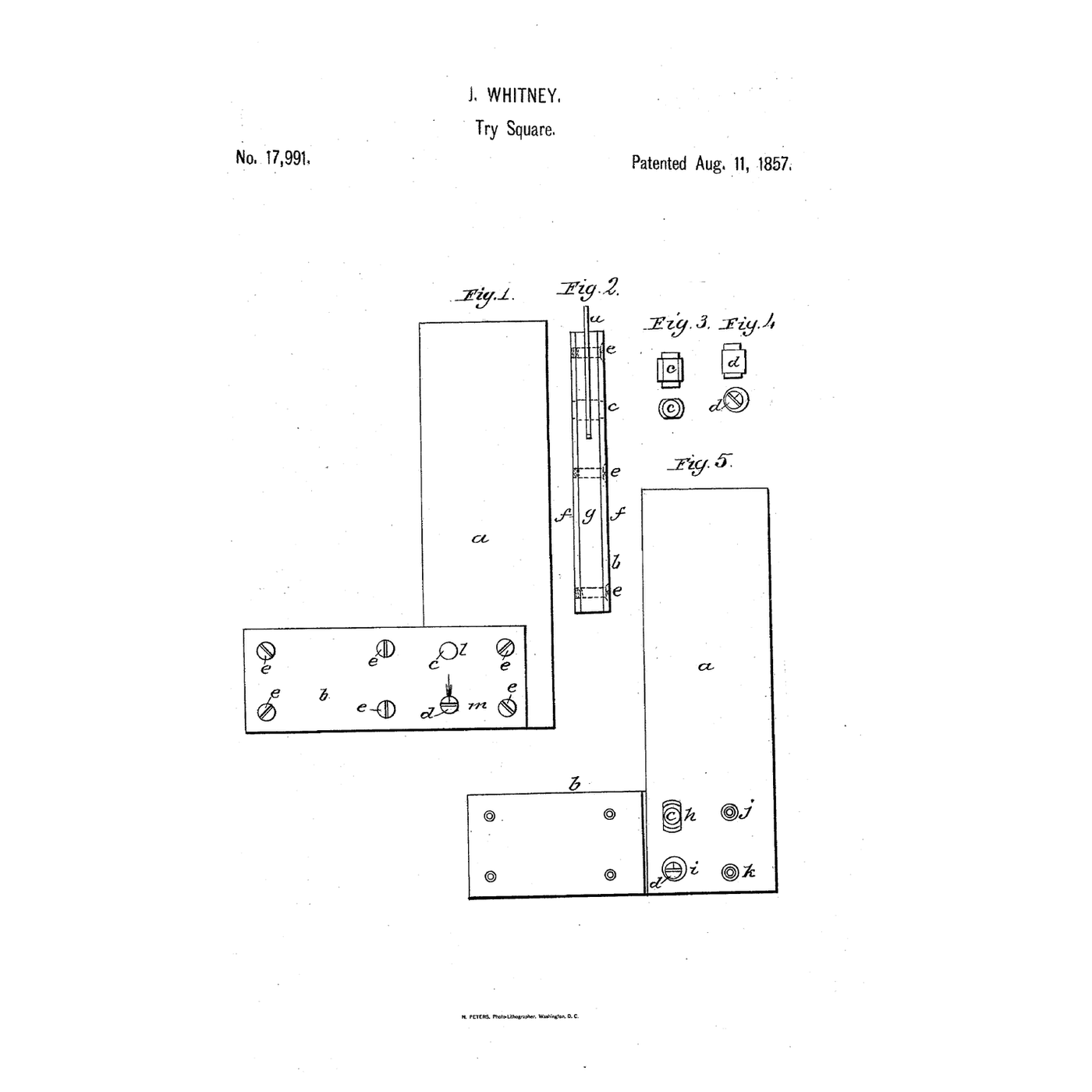
The embedded blueprint trues a try square. Inman's cross-piece does the square's job on the wall, bringing the gauge at right angles to the siding.
3
3
Read US 33,199
Read US 33,199
"In Fig. 1, E is a shank, to the upper part of which is secured the wedge or lip F, that is forced up between two pieces of siding to hold the hook in place. On the outside of this shank is secured by means of the thumb-screw J the slider or standard H, that forms a rest K on the top and terminates in the piece L, to which is jointed the gage M."
"In the way siding is usually put on, compasses have to be used to measure the distance and then set-nails driven in, which consumes much time and mars the siding with the holes after the nails are withdrawn, and does not insure as much accuracy of measurement as where two or more of these hooks are used, if they are adjusted and placed in the siding just alike."
4
4
Build two gauges and side a mock wall
Build two gauges and side a mock wall
**Shank and lip.** For each gauge, saw a shank 30 × 3 cm from hardwood board and glue a thin wedge-shaped lip across its top face to slip up under the bottom edge of a board. Screw a cross-piece across the shank just below the lip so it bears against the face of the course below and squares the gauge.
**Slider.** Saw a slider 12 × 3 cm, cut a slot 6 cm long down it with the coping saw, and hold it on the shank with a bolt and nut through the slot, so it can be set to the exposure. Screw a block across its top as the rest the next board sits on.
**Spring.** Screw a curved strip of spring steel to the slider so it presses the new board against the wall.
**Test.** Screw a plywood sheet upright as the wall and cut strips 10 cm wide from pine board as siding. Nail the first strip level. Set both gauges to 7 cm exposure, hook them under it, rest the next strip on them, and nail it. Repeat for eight courses. Side a second sheet by marking each course with the ruler and pencil. Measure each course's exposure with the caliper on both walls and compare the spread.
Àwọn ohun èlò fún ìgbésẹ̀ yìí:
 Pátákó Igi Líle1 ẹyọ
 Àwo igi tí a lẹ̀ pọ̀1 ẹyọ
 Pákó igi pine2 ẹyọ
 Ọ̀pá irin orísun1 ẹyọ
 Àkójọ bọ́ọ̀lù onígun mẹ́fà1 ẹyọ
 Nọ́ọ̀tì Onígun Mẹ́fà2 ẹyọ
 Ìṣó igi12 ẹyọ
 Ìdìpọ̀ Igi5 ml
 Ìṣó40 ẹyọ
Àwọn irinṣẹ́ tí a nílò:
 Ayùn Ọwọ́
 Ayùn Kópìngì
 Ẹ̀rọ Ìlùkòkò Aláìlókùn
 Àkójọ Orí Ìlùkòkò
 Ìṣù àwọn ohun ìyí skurú
 Kọ́kọ́rọ́ tí a lè ṣàtúnṣe
 Òòlù
Òòlù Igun-òsùwọ̀n tí ó dúró
 Ìdíwọ̀n
 Òṣùwọ̀n Kálípà Díjítà Ìnṣì 6
 Gègé
Gègé5
5
Siding that runs out of level, slips or gaps
Siding that runs out of level, slips or gaps
Clapboard gauge troubleshooting.
Flow
Loading...
6
6
History and honest limits
History and honest limits
**Stephen Inman** of Rockford, Winnebago County, Illinois, received US 33,199, dated 3 September 1861. His slider was adjusted by ratchets and a hand-screw, the gauge was jointed so it could be lifted when a board had to be scribed round a window, and he did not claim the metal siding hook itself, only the cross-piece combined with the gauge.
**Honest limits.** Hardwood, a slotted slider and a spring-steel strip stand in for his hook, ratchet slider and springs, and a plywood mock wall for a building. The notebook's per-course errors are examples, not measurements. Your caliper readings are the result.
Àwọn ohun-èlò
9- 1 ẹyọÀyè
- 1 ẹyọÀyè
- 2 ẹyọÀyè
- 1 ẹyọÀyè
- Àyè
- 2 ẹyọÀyè
- 12 ẹyọÀyè
- 5 mlÀyè
- 40 ẹyọÀyè
Àwọn irinṣẹ́ tó nílò
11- Àyè
- Àyè
- 1 vendor sell this, none ship to you yetÀyè
- Àyè
- Àyè
- 1 vendor sell this, none ship to you yetÀyè
Blueprint tó jọra
Àwọn blueprint wọ̀nyí pín ìmọ̀ — ọ̀nà, ohun-èlò tàbí ìlànà


CC0 Àgbègbè Gbogbogbò
Blueprint yìí ti jáde lábẹ́ CC0. O lè ṣe àdàkọ, yí padà, pín, àti lò láìsí ìyọ̀ǹda.
Ṣàtìlẹ́yìn Olùṣẹ́dá nípa rírà àwọn ọjà nipasẹ̀ Blueprint wọn Ẹ̀san Olùṣẹ́dá tí àwọn Olùtajà gbé kalẹ̀, tàbí ṣẹ̀dá àtúnṣe tuntun ti Blueprint yìí kí o sì fi sínú Blueprint rẹ gẹ́gẹ́ bí ìsopọ̀ láti pín owó-wíwọlé.