IṢẸ́ ỌNÀ
ẸWÀ ÀTI ÌLERA
IṢẸ́ ỌWỌ́
ÀṢÀ ÀTI ÌTÀN
ÌṢERÉ
ÀYÍKÁ
OÚNJẸ ÀTI OHUN MÍMU
REVERSE ENGINEERING
SÁYẸ́ǸSÌ
ERÉ ÌDÁRAYÁ
ÌMỌ̀-Ẹ̀RỌ
ÀWỌN OHUN WÍWỌ̀
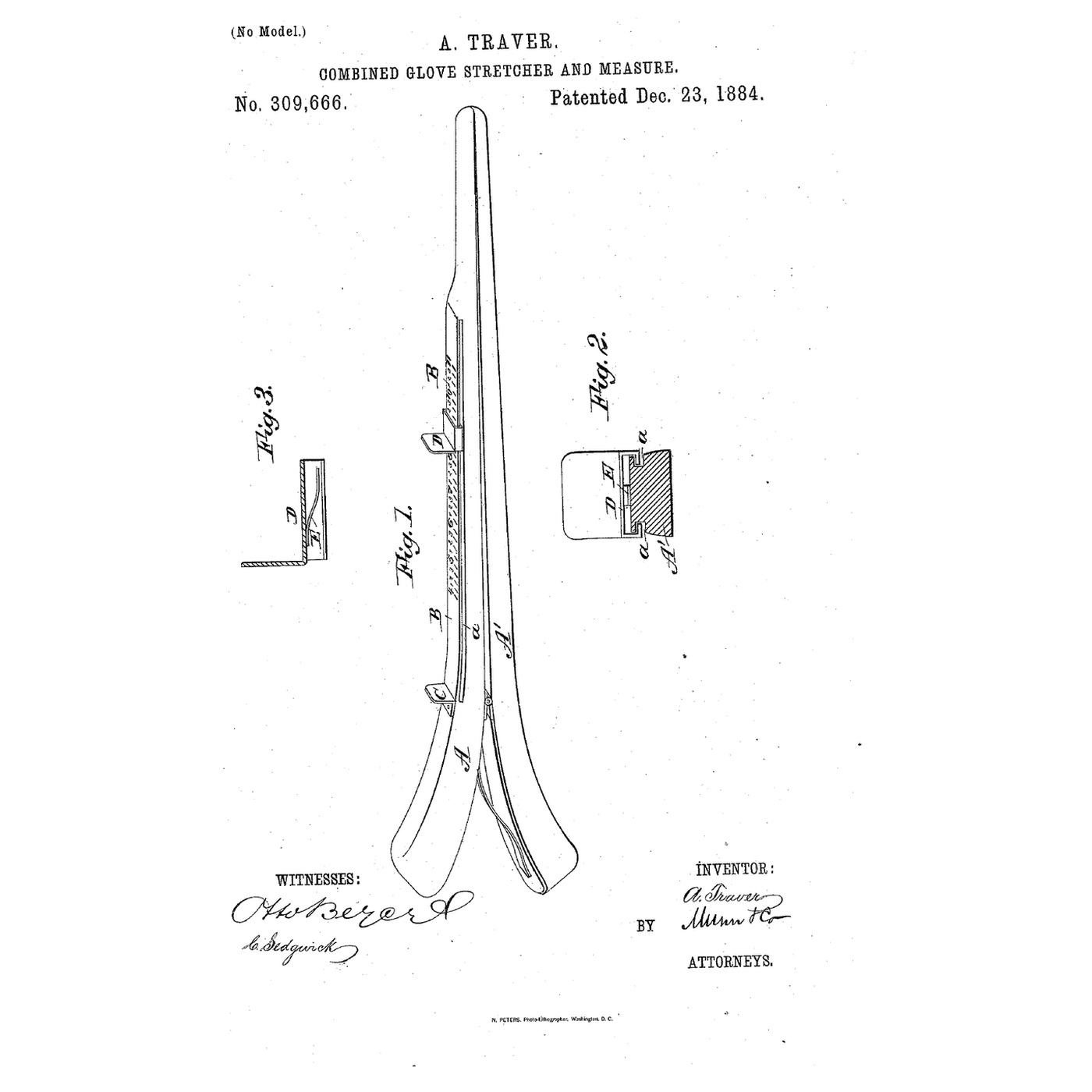


The Clip-Measure Glove Stretcher: A Rigid Width Scale on the Lever
A glove measure of cloth or leather is passed round the hand and pulled snug, and how snug depends on who pulls it.
Augustus Traver of New York received US 309,666, dated 23 December 1884, for a glove stretcher with "a measure for measuring the width of the hand across the knuckles" fixed on one of its levers: a fixed clip and a sliding clip held by a spring strip. "One side of the hand at the knuckles is placed against the clip C, and the other clip, D, is pressed firmly against the other side of the hand. The number at the inner side of the clip D shows the glove-number for the hand." He noted that a stretcher with a flexible loop in its handle already existed.
This rung works out what a width measure misses, then builds two pivoted levers with a fixed and a sliding clip and compares width and loop readings on several hands.
Àárín
About 3 hours
Ìlànà
1
1
Width against round-the-hand
Width against round-the-hand
Ń ṣí ìwé Jupyter…
2
2
Measuring by clipping
Measuring by clipping
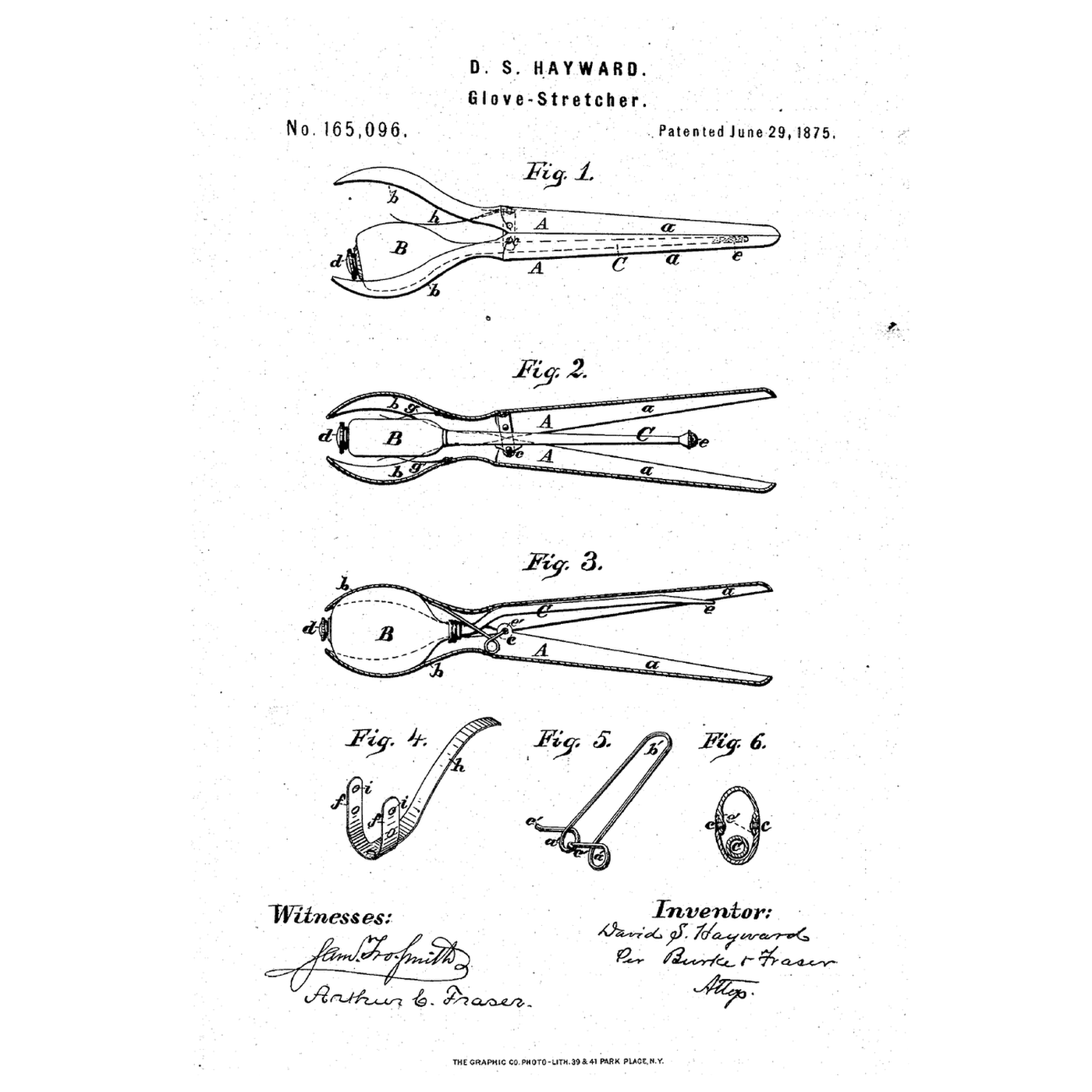
The embedded blueprint transfers a size between two points without reading a scale. Traver's clips take the hand's width the same way and read it off a fixed scale.
3
3
Read US 309,666
Read US 309,666
"The usual glove-measures have been made of flexible material only, and were adapted to be passed around the hand at the knuckles". "My improved measure is formed on a rigid object."
"A spring-strip, E, is secured to the under side of the clip D, to hold it in any desired position on the lever A. The scale or measure B, secured on the outer surface of the lever A, is subdivided, so that it shows the various numbers of gloves for corresponding widths of hands."
4
4
Build the measure and compare two methods
Build the measure and compare two methods
**Levers.** Saw two levers 25 × 2.5 cm from hardwood board and pivot them together near one end with a bolt, washer and nut, like the two arms of a glove stretcher.
**Fixed clip.** Cut a strip of aluminium sheet 5 × 2 cm, bend 1 cm up square, and screw it near the lever's pivot end so the bent lip stands up.
**Sliding clip.** Cut a strip 8 × 2 cm, bend its long edges down round the lever so it slides along it, and bend 1 cm up square as its lip. Glue a strip of spring steel under it so it grips the lever where it is set.
**Scale.** Glue a ruler along the lever's face with its zero at the fixed clip's lip.
**Test.** For five people, close the clips on the hand across the knuckles and read the width; then wrap the tape measure round the knuckles and read the loop. Measure each hand's thickness with the caliper. Plot loop against width and compare the spread with the notebook.
Àwọn ohun èlò fún ìgbésẹ̀ yìí:
 Pátákó Igi Líle1 ẹyọ
 Àwo aluminiọ̀mù1 ẹyọ
 Ọ̀pá irin orísun1 ẹyọ
 Àkójọ bọ́ọ̀lù onígun mẹ́fà1 ẹyọ
 Nọ́ọ̀tì Onígun Mẹ́fà1 ẹyọ
 Wáṣà Pẹrẹsẹ2 ẹyọ
 Ìṣó igi2 ẹyọ
 Lẹ̀mọ́ Ìfarakanra5 ml
Àwọn irinṣẹ́ tí a nílò:
 Ayùn Ọwọ́
 Ìlàǹkàn irin
 Ẹmú Ẹnu Pẹrẹsẹ
 Ìdìmú Tábìlì
 Ẹ̀rọ Ìlùkòkò Aláìlókùn
 Àkójọ Orí Ìlùkòkò
 Ìṣù àwọn ohun ìyí skurú
 Ìdíwọ̀n
 Okùn Ìdíwọ̀n
 Òṣùwọ̀n Kálípà Díjítà Ìnṣì 6
 Gègé
Gègé5
5
A measure that slips, sticks or disagrees with the tape
A measure that slips, sticks or disagrees with the tape
Clip-measure glove stretcher troubleshooting.
Flow
Loading...
6
6
History and honest limits
History and honest limits
**Augustus Traver** of New York filed US 309,666 on 7 January 1884; it is dated 23 December 1884. His sliding clip ran in grooves in the lever's sides, and he disclaimed both the loop-measure stretcher and a shoemaker's measure with a stationary and a sliding block on a graduated bar.
**Honest limits.** Hardwood levers, bent aluminium clips and a steel ruler stand in for his parts, and no historical glove-number scale is given: widths are read in millimetres. The notebook treats the hand as an ellipse; its sizes are examples. Your readings are the result.
Àwọn ohun-èlò
8- 1 ẹyọÀyè
- 1 ẹyọÀyè
- 1 ẹyọÀyè
- Àyè
- 1 ẹyọÀyè
- 2 ẹyọÀyè
- 2 ẹyọÀyè
- Àyè
Àwọn irinṣẹ́ tó nílò
11- Àyè
- Àyè
- Àyè
- 1 vendor sell this, none ship to you yetÀyè
- Àyè
- 1 vendor sell this, none ship to you yetÀyè
- 1 vendor sell this, none ship to you yetÀyè
Blueprint tó jọra
Àwọn blueprint wọ̀nyí pín ìmọ̀ — ọ̀nà, ohun-èlò tàbí ìlànà


CC0 Àgbègbè Gbogbogbò
Blueprint yìí ti jáde lábẹ́ CC0. O lè ṣe àdàkọ, yí padà, pín, àti lò láìsí ìyọ̀ǹda.
Ṣàtìlẹ́yìn Olùṣẹ́dá nípa rírà àwọn ọjà nipasẹ̀ Blueprint wọn Ẹ̀san Olùṣẹ́dá tí àwọn Olùtajà gbé kalẹ̀, tàbí ṣẹ̀dá àtúnṣe tuntun ti Blueprint yìí kí o sì fi sínú Blueprint rẹ gẹ́gẹ́ bí ìsopọ̀ láti pín owó-wíwọlé.