IṢẸ́ ỌNÀ
ẸWÀ ÀTI ÌLERA
IṢẸ́ ỌWỌ́
ÀṢÀ ÀTI ÌTÀN
ÌṢERÉ
ÀYÍKÁ
OÚNJẸ ÀTI OHUN MÍMU
REVERSE ENGINEERING
SÁYẸ́ǸSÌ
ERÉ ÌDÁRAYÁ
ÌMỌ̀-Ẹ̀RỌ
ÀWỌN OHUN WÍWỌ̀
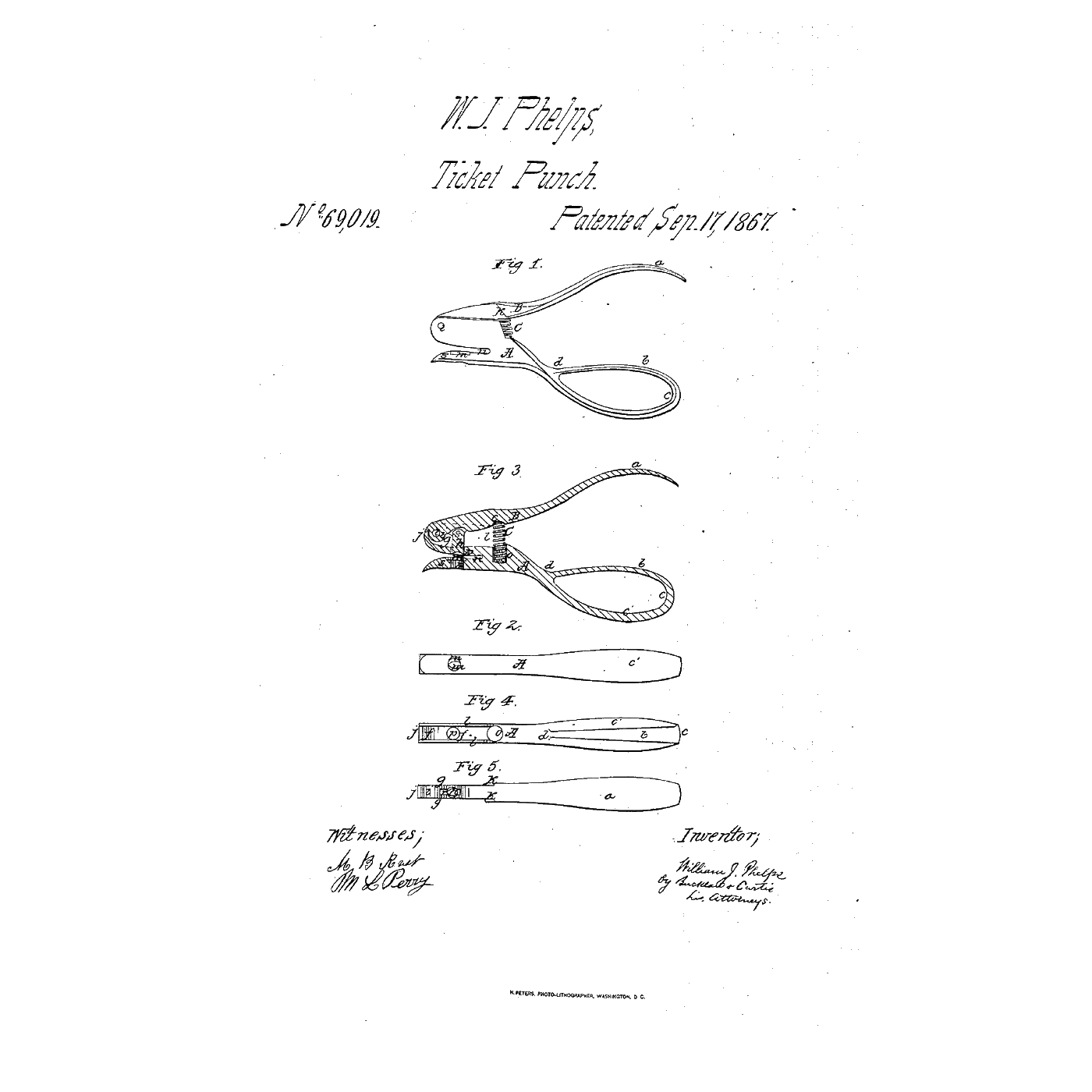

The Die-Spindle Ticket Punch: A Shaped Die on a Pivot, a Slot for the Ticket
Every conductor on a railway line cancelled tickets with a punch of his own shape, and a punch whose die rode loosely in its lever cut ragged holes.
William J. Phelps of Springfield, Massachusetts, received US 69,019, dated 17 September 1867, for "attaching to one of the levers of a ticket-punch a die-spindle, which is pivoted to the lever, and operates as a plunger in reference to a female die seated in the other lever of the punch, the latter lever being slotted for the reception of the ticket to be punched." The spindle's lower end is cut to any shape, "the case that different persons employed in cancelling tickets upon the same route have punches of different configuration"; a spiral spring keeps the levers apart and a finger loop hangs the punch from the finger.
This rung works out the force to punch a ticket, then files the levers from flat bar with a pivoted spindle, a hardened die plate and a shaped cutting end, and punches card with it.
Ilọsíwájú
About 6 hours
Ìlànà
1
1
Punching force
Punching force
Ń ṣí ìwé Jupyter…
2
2
A ticket punch a week before it
A ticket punch a week before it
The embedded blueprint is a ticket punch patented a week earlier. Phelps pivots the cutting spindle to one lever so it enters its die in line.
3
3
Read US 69,019
Read US 69,019
"A slot, n, is cut in the lower side of A, of sufficient width to receive a ticket or strip of pasteboard, the outer end of the slot being made flaring, so as to facilitate the insertion of the ticket which is to be punched. The die-spindle h passes through an opening, p, formed in that part of A above the slot n, the shape of the inner surface of p being made to correspond with the shape of the die-spindle, so as to act as an accurate guide for the latter as it is moved to and from the female die m."
"The contour of the female die is made to correspond exactly with that of the male die, and the edges of both are carefully formed, so as to make a sharp and clean cut when the male die is made to enter the female die."
4
4
Make the punch and cancel tickets
Make the punch and cancel tickets
**Levers.** Cut two 16 cm levers from 20 × 5 mm mild steel flat bar, shaped as Phelps's: A with a finger loop bent from its end and a slot n sawn across its jaw with a flared mouth, B slimmer beyond its shoulders. Drill both for a pivot pin.
**Guide and die.** Drill A's jaw above the slot for the spindle as the guide p, and set a small hardened steel plate m below the slot, drilled with the female die and relieved underneath so the chips fall out.
**Spindle.** File a 5 mm steel rod's lower end to your chosen shape, a star or letter, and file the female die to match it exactly. Pin the spindle's upper end between two ears on lever B so it swings into the guide.
**Spring.** Put a compression spring between the levers behind the pivot to hold them open.
**Test.** Slide card into the slot and squeeze. Look at the hole's edges through a magnifier, and punch a hundred holes to see whether they stay clean.
Àwọn ohun èlò fún ìgbésẹ̀ yìí:
 Ọ̀pá Pẹrẹsẹ Irin Pẹ́lẹ́0.35 mítà
 Ọ̀pá Róbótó Irin Rírọ̀0.1 mítà
 Pẹpẹ irin rírọ̀1 ẹyọ
 Àkójọpọ̀ orísun ìtẹ̀mọ́lẹ̀1 ẹyọ
 Àwọn pop rivet2 ẹyọ
 Bébà Líle1 ẹyọ
Àwọn irinṣẹ́ tí a nílò:
 Ayùn Irin
 Àwọn Ìfá (Ìfá Ọwọ́)
 Àkójọ Ìfá Kékeré
 Ìdìmú Tábìlì
 Ẹ̀rọ Ìlùkòkò Aláìlókùn
 Àkójọ Orí Ìlùkòkò
 Ọ̀pá Iná Pùróféènì
 Òòlù
Òòlù Òṣùwọ̀n Kálípà Díjítà Ìnṣì 6
 Ìbọ̀wọ́ Iṣẹ́ Awọ
 Gílásì Ààbò Tí Ó Mọ́
5
5
A punch that tears, jams or misses its die
A punch that tears, jams or misses its die
Die-spindle ticket punch troubleshooting.
Flow
Loading...
6
6
History and honest limits
History and honest limits
**William J. Phelps** of Springfield, Hampden County, Massachusetts, received US 69,019, dated 17 September 1867. His lever B was curved at a and thinned from the shoulders K K to fit a recess f f′ in lever A, the ears g g received the spindle, a steel die plate m was set into a brass lever, and a spring C in recesses o and e held the levers apart. He did not claim the ticket slot or the levers' arrangement apart from the die-spindle, but the lever B with the pivoted spindle, the slotted lever, guide and female die, with the spring.
**Honest limits.** Filed flat bar and a hardened rod stand in for his cast levers. The notebook uses a simple shear formula; its strength, thickness and shapes are examples. Your cancelled tickets are the result.
Àwọn ohun-èlò
6- 0.35 mítàÀyè
- 0.1 mítàÀyè
- 1 ẹyọÀyè
- Àyè
- 2 ẹyọÀyè
- 1 ẹyọÀyè
Àwọn irinṣẹ́ tó nílò
11- Àyè
- Àyè
- 1 vendor sell this, none ship to you yetÀyè
- Àyè
Blueprint tó jọra
Àwọn blueprint wọ̀nyí pín ìmọ̀ — ọ̀nà, ohun-èlò tàbí ìlànà

The Cushioned Ticket Punch: A Spring That Strips the Ticket and Rings That Carry the Joint
láti ọwọ́ Martin
Àwọn Irinṣẹ́ Iṣẹ́ Bébà
24
0
0
0
0
0

Blanking: The Punch, the Die, and the Gap Between Them
láti ọwọ́ Forge
Iṣẹ́ Irin
28
0
0
0
0
0
Punching and Drifting: A Hole Without Removing Metal
láti ọwọ́ Forge
Iṣẹ́ Irin
22
0
0
0
0
0
CC0 Àgbègbè Gbogbogbò
Blueprint yìí ti jáde lábẹ́ CC0. O lè ṣe àdàkọ, yí padà, pín, àti lò láìsí ìyọ̀ǹda.
Ṣàtìlẹ́yìn Olùṣẹ́dá nípa rírà àwọn ọjà nipasẹ̀ Blueprint wọn Ẹ̀san Olùṣẹ́dá tí àwọn Olùtajà gbé kalẹ̀, tàbí ṣẹ̀dá àtúnṣe tuntun ti Blueprint yìí kí o sì fi sínú Blueprint rẹ gẹ́gẹ́ bí ìsopọ̀ láti pín owó-wíwọlé.