IṢẸ́ ỌNÀ
ẸWÀ ÀTI ÌLERA
IṢẸ́ ỌWỌ́
ÀṢÀ ÀTI ÌTÀN
ÌṢERÉ
ÀYÍKÁ
OÚNJẸ ÀTI OHUN MÍMU
REVERSE ENGINEERING
SÁYẸ́ǸSÌ
ERÉ ÌDÁRAYÁ
ÌMỌ̀-Ẹ̀RỌ
ÀWỌN OHUN WÍWỌ̀
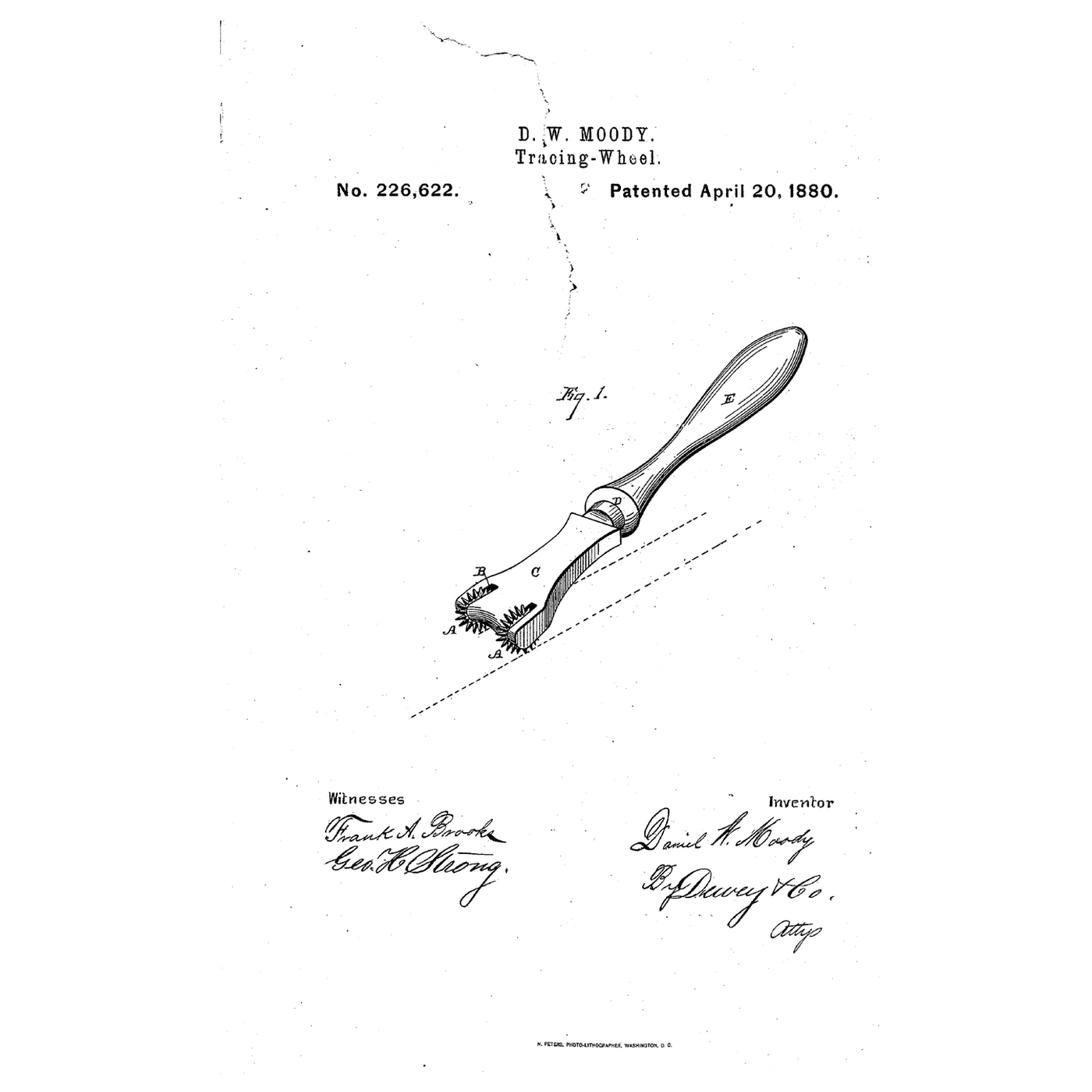


The Double Tracing Wheel: The Pattern Line and the Cutting Line at Once
A paper pattern gives the sewing line, but the cloth must be cut wider to leave a seam allowance. Marking that second line by eye makes it uneven, and measuring it at every point is slow.
Daniel W. Moody of San Francisco received US 226,622, dated 20 April 1880 (filed 19 January 1880), for a tracing wheel with "two parallel toothed or star wheels", so that "when one of the wheels is made to traverse the desired pattern the other will form a line upon which the goods are to be cut, so as to give the necessary width for the seam".
This rung works out how much cloth a seam allowance adds to a panel, then marks and cuts a piece with a double line.
Olùbẹ̀rẹ̀
About 2 hours
Ìlànà
1
1
Cloth added by the allowance
Cloth added by the allowance
Ń ṣí ìwé Jupyter…
2
2
What the second line is for
What the second line is for
The embedded blueprint explains the seam allowance itself. Moody's second wheel marks it.
3
3
Read US 226,622
Read US 226,622
"When a pattern has been traced by this wheel it is necessary to mark out a line for cutting, which must be at such a distance from the pattern-line as will insure sufficient material to form the seam. This is either done in an irregular manner, without measurement, or sometimes by careful measurements at frequent intervals and marking to indicate the points and guide the cutter."
"The distance between the wheels might be made adjustable, if desired; but I have found that in practice a fixed distance of about five-eighths of an inch will give the proper width for all seams."
4
4
Trace a pattern and its cutting line
Trace a pattern and its cutting line
Draw a simple pattern piece on kraft paper and cut it out. Pin it to the cloth over a sheet of carbon paper, carbon side down.
Run the tracing wheel round the paper's edge to transfer the sewing line. Then mark a second line 16 mm (5/8 inch) outside it: with a double wheel in one pass, or with the single wheel guided along the ruler.
Cut on the outer line and sew on the inner one. Measure the finished allowance at several points with the tape measure and see how even it is. Compare the cloth used with the notebook.
Àwọn ohun èlò fún ìgbésẹ̀ yìí:
 Aṣọ òwú (fúyẹ́)1 ẹyọ
 Ìdì ìwé kraft (aláwọ̀ dúdú-pupa)1 ẹyọ
 Bébà carbon1 ẹyọ
 Pìn ìránṣọ10 ẹyọ
Àwọn irinṣẹ́ tí a nílò:
 Kẹ̀kẹ́ àmì àpẹẹrẹ
 Ìkẹ́rẹ́ aṣọ
 Ìdíwọ̀n
 Okùn Ìdíwọ̀n
 Ẹfun aránṣọ
5
5
A traced line that is faint, wanders or tears
A traced line that is faint, wanders or tears
Tracing wheel troubleshooting.
Flow
Loading...
6
6
History and honest limits
History and honest limits
**Daniel W. Moody** of San Francisco filed US 226,622 on 19 January 1880; it is dated 20 April 1880. He notes the handle, shank and frame may be made in one piece of malleable iron or brass.
**Honest limits.** The notebook uses rectangles; curved pieces and corners change the figure a little. 5/8 inch is Moody's figure, not a rule for every seam. The panel sizes are examples. Your measured allowance is the measurement.
Àwọn ohun-èlò
4- 1 ẹyọÀyè
- Àyè
- 1 ẹyọÀyè
- 10 ẹyọÀyè
Àwọn irinṣẹ́ tó nílò
5- Àyè
- Àyè
- 1 vendor sell this, none ship to you yetÀyè
- Àyè
Blueprint tó jọra
Àwọn blueprint wọ̀nyí pín ìmọ̀ — ọ̀nà, ohun-èlò tàbí ìlànà


CC0 Àgbègbè Gbogbogbò
Blueprint yìí ti jáde lábẹ́ CC0. O lè ṣe àdàkọ, yí padà, pín, àti lò láìsí ìyọ̀ǹda.
Ṣàtìlẹ́yìn Olùṣẹ́dá nípa rírà àwọn ọjà nipasẹ̀ Blueprint wọn Ẹ̀san Olùṣẹ́dá tí àwọn Olùtajà gbé kalẹ̀, tàbí ṣẹ̀dá àtúnṣe tuntun ti Blueprint yìí kí o sì fi sínú Blueprint rẹ gẹ́gẹ́ bí ìsopọ̀ láti pín owó-wíwọlé.