IṢẸ́ ỌNÀ
ẸWÀ ÀTI ÌLERA
IṢẸ́ ỌWỌ́
ÀṢÀ ÀTI ÌTÀN
ÌṢERÉ
ÀYÍKÁ
OÚNJẸ ÀTI OHUN MÍMU
REVERSE ENGINEERING
SÁYẸ́ǸSÌ
ERÉ ÌDÁRAYÁ
ÌMỌ̀-Ẹ̀RỌ
ÀWỌN OHUN WÍWỌ̀
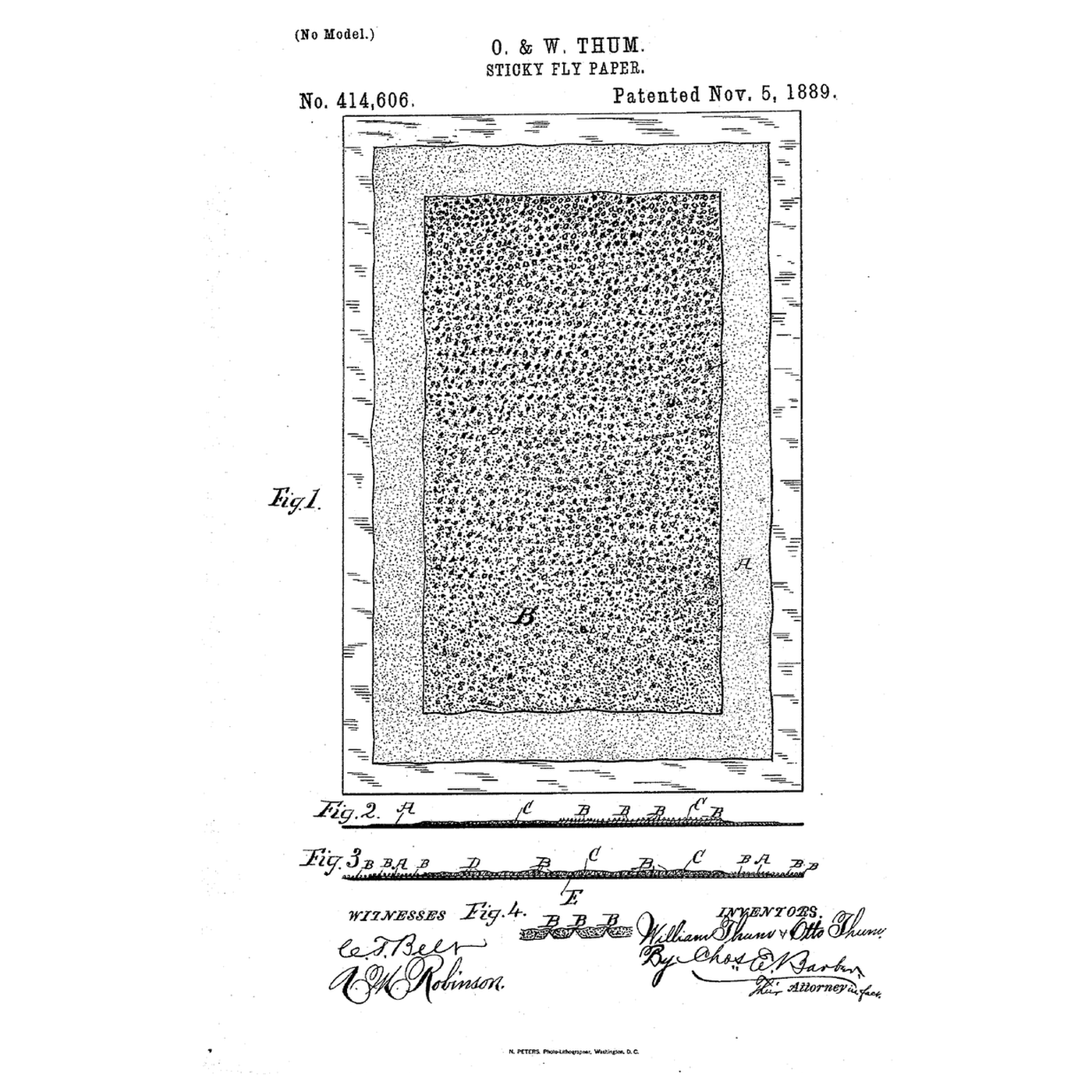


The Gritted Fly-Paper: Sand That Keeps the Sheets Apart
Sticky fly-paper catches flies on a coat of tacky material. Stored face to face in a box, the coat squeezes out and glues the sheets together.
Otto Thum and William Thum of Grand Rapids, Michigan, received US 414,606, dated 5 November 1889 (filed 16 May 1889), for sticky fly-catcher sheets whose surface carries hard projections, "small seeds, ground emery, fragments of any kind of hard resin, or coarse sand", so that the pressure in the box "will fall entirely on them, and thus relieve the sticky material altogether".
This rung computes how a sticky layer squeezes out under a stack, then makes fly-paper and stores it with and without grit.
Olùbẹ̀rẹ̀
About 2 hours
Ìlànà
1
1
Squeezed out, or held apart
Squeezed out, or held apart
Ń ṣí ìwé Jupyter…
2
2
Where the sticky comes from
Where the sticky comes from
The embedded blueprint collects pine resin, the raw material of the tacky coats; the Thums also name hard resin as a grit.
3
3
Read US 414,606
Read US 414,606
"The objects of the invention are to prevent the sticky material from spreading or running over the clean margin and onto the back of the sheets while the paper is kept in stock; also, to keep the sticky material evenly distributed on the sheet while it is kept in stock."
"We may use small seeds, ground emery, fragments of any kind of hard resin, or coarse sand; or any kind of hard material not soluble in sticky material, or only slightly so, will serve the purpose".
"For the purpose of shipping, there are from twenty-five to fifty sheets of fly-paper packed in a box. A considerable pressure is borne by the lower sheets, but if the proper-sized particles exist on the inner surface of the paper the pressure will fall entirely on them, and thus relieve the sticky material altogether".
4
4
Making it, as a program
Making it, as a program
Ààyè Iṣẹ́ Blockly
Loading Blockly workspace...
5
5
Stack it and see
Stack it and see
Make the strips as in the program. Stack the sanded ones in one pile and the plain ones in another, face to face, and put the same weight on each.
After a day and again after a week, peel the piles apart. Note which peel clean, which tear, and how far the sticky has crept onto the margins. Hang one strip of each where flies gather and count the catch.
Àwọn ohun èlò fún ìgbésẹ̀ yìí:
 Ìdì ìwé kraft (aláwọ̀ dúdú-pupa)1 ẹyọ
 Ṣúgà funfun100 g
 Ṣúgà olómi wúrà1 ẹyọ
 Iyanrìn Kékeré50 g
 Omi1 ẹyọ
Àwọn irinṣẹ́ tí a nílò:
 Ìwé lẹ́mọ́ eṣinṣin
 Ìkòkò
Ìkòkò Ìṣẹ́ná
 Ìwọ̀n
Ìwọ̀n Ìdíwọ̀n
6
6
Fly-paper that runs, dries or catches nothing
Fly-paper that runs, dries or catches nothing
Fly-paper troubleshooting.
Flow
Loading...
7
7
History and honest limits
History and honest limits
**Otto Thum** and **William Thum** of Grand Rapids, Michigan, filed US 414,606 on 16 May 1889; it is dated 5 November 1889.
**Honest limits.** Stefan's law is for a round, flat, even layer of a simple liquid; real sticky coats are neither round nor simple liquids, and the edges of a stack do not all carry the same weight. Viscosity and sizes are examples. What peels clean is the measurement.
Àwọn ohun-èlò
5- Àyè
- 100 gÀyè
- 1 ẹyọÀyè
- 50 gÀyè
- 1 ẹyọÀyè
Blueprint tó jọra
Àwọn blueprint wọ̀nyí pín ìmọ̀ — ọ̀nà, ohun-èlò tàbí ìlànà




CC0 Àgbègbè Gbogbogbò
Blueprint yìí ti jáde lábẹ́ CC0. O lè ṣe àdàkọ, yí padà, pín, àti lò láìsí ìyọ̀ǹda.
Ṣàtìlẹ́yìn Olùṣẹ́dá nípa rírà àwọn ọjà nipasẹ̀ Blueprint wọn Ẹ̀san Olùṣẹ́dá tí àwọn Olùtajà gbé kalẹ̀, tàbí ṣẹ̀dá àtúnṣe tuntun ti Blueprint yìí kí o sì fi sínú Blueprint rẹ gẹ́gẹ́ bí ìsopọ̀ láti pín owó-wíwọlé.