IṢẸ́ ỌNÀ
ẸWÀ ÀTI ÌLERA
IṢẸ́ ỌWỌ́
ÀṢÀ ÀTI ÌTÀN
ÌṢERÉ
ÀYÍKÁ
OÚNJẸ ÀTI OHUN MÍMU
REVERSE ENGINEERING
SÁYẸ́ǸSÌ
ERÉ ÌDÁRAYÁ
ÌMỌ̀-Ẹ̀RỌ
ÀWỌN OHUN WÍWỌ̀
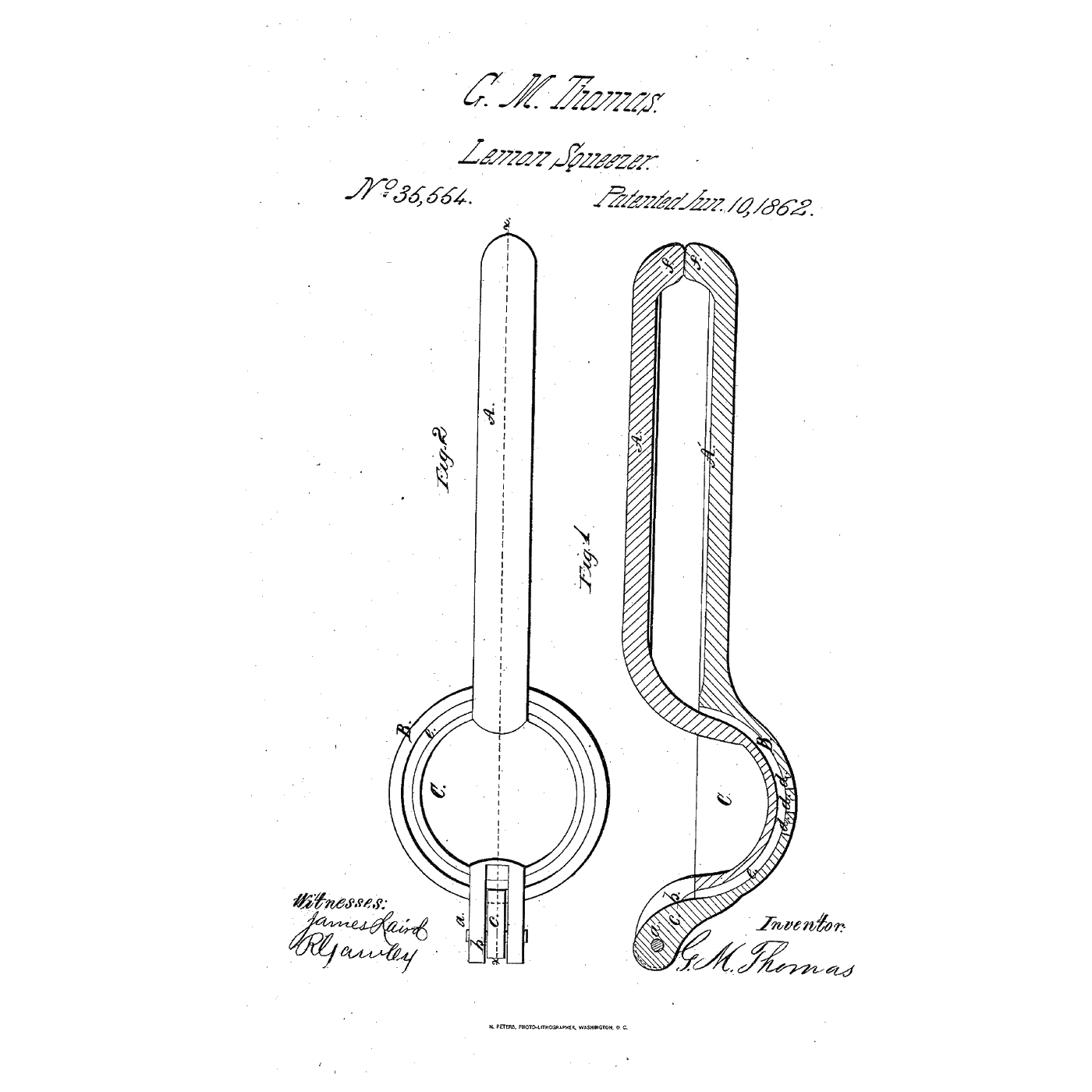


The Hinged-Bowl Lemon Squeezer: Two Cast Handles, One Bowl Inside the Other
The wooden lemon squeezers of the day soon soaked up stale juice and smelled of it.
George M. Thomas of New York received US 35,554, dated 10 June 1862, for "constructing the squeezer of cast metal and of such form or in such a manner that a very durable, economical, and light implement for the purpose is obtained, and one that may be manipulated or operated with greater facility than the ordinary kinds in general use." Two handles are pinned together at their front ends; the lower carries a perforated bowl, the upper a smaller half-sphere that fits inside it with a space between; the half lemon is put in the lower bowl and the handles are pressed together. The lower bowl hangs below its handle, so the squeezer can rest on a glass.
This rung works out the force of the handles, with a work check, then makes the squeezer from flat bar, a tin cup and a hardwood dome and squeezes lemons with it.
Àárín
About 4 hours
Ìlànà
1
1
Force at the bowls
Force at the bowls
Ń ṣí ìwé Jupyter…
2
2
A squeezer before it
A squeezer before it
The embedded blueprint presses the lemon on a cone under a lever-driven cap. Thomas puts the bowl and its half-sphere on the two handles themselves.
3
3
Read US 35,554
Read US 35,554
"The lower handle, A′, is provided with a bowl, B, of semispherical form, and perforated at its bottom, as shown at d in Fig. 1. The inner surface of the bowl B is enameled, or should be, in order to prevent oxidation. The bowl B and handle A′ are cast in one piece, and the bowl projects below the handle, the latter being on a level or in the same plane with the upper edge of the former."
"The lemon is squeezed by being divided, as usual, and one-half at a time placed in the bowl B, and forcing the bowl C down upon it by pressing the handles A A′ together."
4
4
Make the squeezer and press lemons
Make the squeezer and press lemons
**Handles.** Cut two 25 cm lengths of 20 × 5 mm mild steel flat bar. Drill both 1 cm from one end for an M6 pivot bolt, and bend the other ends slightly apart as the stops f.
**Lower bowl.** Cut the bottom 3 cm off a clean tin can about 7 cm across, punch holes in its base with a nail, and rivet its rim to the lower handle 5 cm behind the pivot so it hangs below.
**Upper dome.** Rasp a hardwood block into a half-sphere that fits inside the cup with about 5 mm to spare, and screw it to the upper handle opposite the cup.
**Test.** Bolt the handles together. Halve a lemon, put one half cut side down in the cup over a glass, and press the handles together, reading your squeeze with the spring scale hooked on the handles' ends. Weigh the juice, and compare with a half squeezed by hand.
Àwọn ohun èlò fún ìgbésẹ̀ yìí:
 Ọ̀pá Pẹrẹsẹ Irin Pẹ́lẹ́0.5 mítà
 Ìgò irin1 ẹyọ
 Ìṣù Igi Líle1 ẹyọ
 Ìṣó igi2 ẹyọ
 Àwọn pop rivet4 ẹyọ
 Àkójọ bọ́ọ̀lù onígun mẹ́fà1 ẹyọ
 Nọ́ọ̀tì Onígun Mẹ́fà1 ẹyọ
 Lẹ́mọ́ọ̀nù2 ẹyọ
Àwọn irinṣẹ́ tí a nílò:
 Ayùn Irin
 Ẹ̀rọ Ìlùkòkò Aláìlókùn
 Àkójọ Orí Ìlùkòkò
 Àwọn Ìfá (Ìfá Ọwọ́)
 Ìdìmú Tábìlì
 Ìlàǹkàn irin
 Ìṣó
Ìṣó Òòlù
Òòlù Ìdìpọ̀ ẹ̀rọ ìso pop rivet
 Ayùn
Ayùn Ìṣù àwọn ohun ìyí skurú
 Kọ́kọ́rọ́ tí a lè ṣàtúnṣe
 Ọ̀bẹ ilé ìdáná
 Òṣùwọ̀n Díjítà Ilé Ìdáná
 Ẹ̀rọ Ìwọ̀n Agbára (Òṣùwọ̀n Ìsúnkì)
 Ife ìmumi
 Ìbọ̀wọ́ Iṣẹ́ Awọ
5
5
A squeezer that sprays, slips or leaves juice
A squeezer that sprays, slips or leaves juice
Hinged-bowl lemon squeezer troubleshooting.
Flow
Loading...
6
6
History and honest limits
History and honest limits
**George M. Thomas** of New York, New York, received US 35,554, dated 10 June 1862. His handles A A′ were joined by a fulcrum pin a through a slot b in the upper handle, the bowl C was cast with the upper handle and smaller than B to leave a space e, and the handles' ends were curved at f as stops. He thought cast iron, japanned, the best material, and did not claim a cast-metal squeezer as such, but one with two handles on a fulcrum pin and bowls fitting one within the other below the handles.
**Honest limits.** Flat bar, a tin cup and a hardwood dome stand in for his cast-iron handles and bowls. The notebook ignores friction; its forces and lengths are examples. Your juice weights are the result.
Àwọn ohun-èlò
8- 0.5 mítàÀyè
- 1 ẹyọÀyè
- 1 ẹyọÀyè
- 2 ẹyọÀyè
- 4 ẹyọÀyè
- Àyè
- 1 ẹyọÀyè
- 2 ẹyọÀyè
Àwọn irinṣẹ́ tó nílò
17- Àyè
- 1 vendor sell this, none ship to you yetÀyè
- Àyè
- Àyè
- Àyè
- Àyè
- Àyè
- Àyè
Ìtọ́nisọ́nà yìí ń ṣe

Blueprint tó jọra
Àwọn blueprint wọ̀nyí pín ìmọ̀ — ọ̀nà, ohun-èlò tàbí ìlànà



CC0 Àgbègbè Gbogbogbò
Blueprint yìí ti jáde lábẹ́ CC0. O lè ṣe àdàkọ, yí padà, pín, àti lò láìsí ìyọ̀ǹda.
Ṣàtìlẹ́yìn Olùṣẹ́dá nípa rírà àwọn ọjà nipasẹ̀ Blueprint wọn Ẹ̀san Olùṣẹ́dá tí àwọn Olùtajà gbé kalẹ̀, tàbí ṣẹ̀dá àtúnṣe tuntun ti Blueprint yìí kí o sì fi sínú Blueprint rẹ gẹ́gẹ́ bí ìsopọ̀ láti pín owó-wíwọlé.