IṢẸ́ ỌNÀ
ẸWÀ ÀTI ÌLERA
IṢẸ́ ỌWỌ́
ÀṢÀ ÀTI ÌTÀN
ÌṢERÉ
ÀYÍKÁ
OÚNJẸ ÀTI OHUN MÍMU
REVERSE ENGINEERING
SÁYẸ́ǸSÌ
ERÉ ÌDÁRAYÁ
ÌMỌ̀-Ẹ̀RỌ
ÀWỌN OHUN WÍWỌ̀
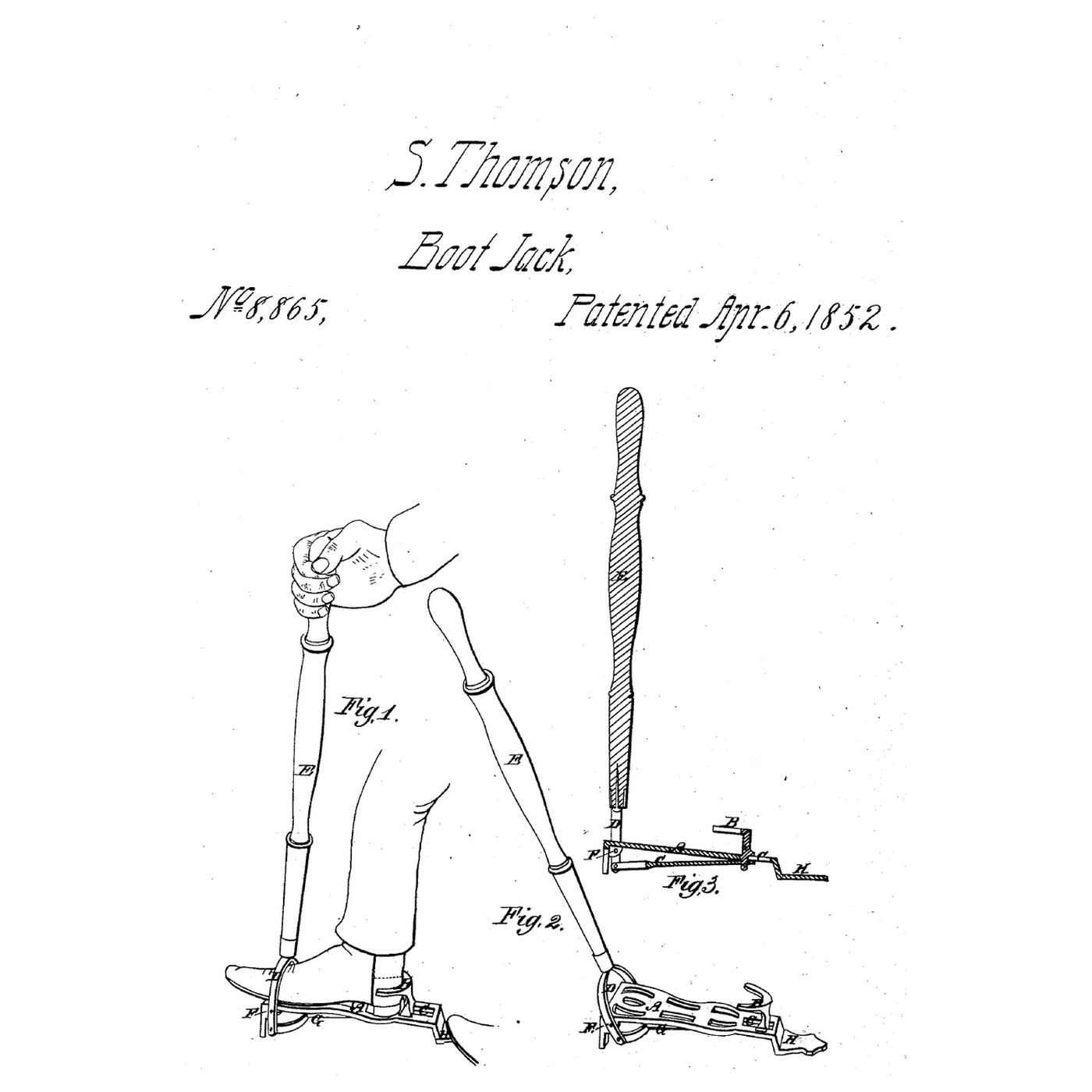


The Lever-and-Stirrup Bootjack: One Pull Holds Toe and Heel
A plain bootjack grips only the heel, so a tight boot rocks forward and has to be held down with the other foot.
Sardis Thomson of Hartsville, Massachusetts, received US 8,865, dated 6 April 1852, for a boot-jack with "a movable heel-gripper sliding in a stand connected with a toe stirrup and lever by a connecting rod, which stirrup when the foot is placed upon the stand is drawn over the toe by the lever, at the same time drawing the heel gripper forward, and crowding the foot forward in the stirrup, thereby confining the boot in the machine".
This rung works out the lever's pull on the heel gripper, then builds the jack from board, dowel and flat bar and times taking a boot off.
Àárín
About 4 hours
Ìlànà
1
1
Lever force on the heel gripper
Lever force on the heel gripper
Ń ṣí ìwé Jupyter…
2
2
Why the long handle
Why the long handle
The embedded blueprint works out the lever law. Thomson's long handle and short rod arm put a strong, short push on the heel.
3
3
Read US 8,865
Read US 8,865
"The construction is as follows, A is the stand on which the foot is placed, B is the sliding heel gripper, which has play backward and forward in the slot C, the stirrup D extends below the stand forming in connection with the handle staff E a lever, having the fulcrum at F, and is connected with the heel gripper by the connecting rod G."
"It will be seen that the heel-gripper may be made stationary and the connecting rod G dispensed with, and the foot placed upon the stand and drawn back against the heel-gripper, and the stirrup operated as above described; but I prefer the movable gripper and connecting rod as making a more perfect apparatus."
4
4
Build the jack and take a boot off
Build the jack and take a boot off
**Stand.** Saw a board 45 × 12 cm from hardwood board. Rout or saw a slot 1 cm wide and 12 cm long down its middle, starting 15 cm from the back end. Screw a block across the back end as the rest for the other foot.
**Heel gripper.** Cut a hardwood block 10 × 6 × 4 cm, cut a curved notch in its front for the heel, and hold it on the stand with a bolt through the slot so it slides.
**Stirrup and lever.** Bend 40 cm of 25 × 3 mm mild steel flat bar into a U wide enough to pass over a boot's toe. Bolt its two ends to the sides of the stand's front end so it swings: that is the fulcrum. Bolt 80 cm of wooden dowel to the top of the U as the handle.
**Rod.** Join the U, 5 cm below its pivot, to the gripper's bolt with 35 cm of steel rod, bent into an eye at each end, so drawing the handle back pulls the stirrup over the toe and pushes the gripper forward.
**Test.** Wearing a rubber boot, put it on the stand and draw the handle back; hook the spring scale to the handle once to read your pull. Time taking the boot off, and compare with a plain boot jack.
Àwọn ohun èlò fún ìgbésẹ̀ yìí:
 Pátákó Igi Líle1 ẹyọ
 Ìṣù Igi Líle1 ẹyọ
 Ọ̀pá Pẹrẹsẹ Irin Pẹ́lẹ́0.4 mítà
 Èèkàn igi0.8 mítà
 Ọ̀pá Róbótó Irin Rírọ̀0.35 mítà
 Àkójọ bọ́ọ̀lù onígun mẹ́fà1 ẹyọ
 Nọ́ọ̀tì Onígun Mẹ́fà4 ẹyọ
 Wáṣà Pẹrẹsẹ6 ẹyọ
 Ìṣó igi4 ẹyọ
Àwọn irinṣẹ́ tí a nílò:
 Ayùn Ọwọ́
 Ayùn Kópìngì
 Ẹ̀rọ Ìlùkòkò Aláìlókùn
 Àkójọ Orí Ìlùkòkò
 Ìdìmú Tábìlì
 Òòlù
Òòlù Ẹ̀mú Olórí Yíká
 Kọ́kọ́rọ́ tí a lè ṣàtúnṣe
 Ìṣù àwọn ohun ìyí skurú
 Ẹ̀rọ Ìwọ̀n Agbára (Òṣùwọ̀n Ìsúnkì)
 Aago Ìdúró
 Bàtà rọ́bà
 Pákó ìbọ́ bàtà gígùn
5
5
A jack that binds, slips or will not hold the toe
A jack that binds, slips or will not hold the toe
Lever-and-stirrup bootjack troubleshooting.
Flow
Loading...
6
6
History and honest limits
History and honest limits
**Sardis Thomson** of Hartsville, Berkshire County, Massachusetts, received US 8,865, dated 6 April 1852. The lever was thrown forward at about sixty degrees to start, the other foot rested on a projection at the back, and he noted that the gripper could be made fixed if simplicity mattered more than grip. His claims cover the heel gripper and stirrup worked by the lever, and the movable gripper with its connecting rod.
**Honest limits.** Board, flat bar, dowel and steel rod stand in for his cast stand, stirrup and staff. The notebook ignores friction and the rod's angle; its pull and lengths are examples. Your times are the result.
Àwọn ohun-èlò
9- 1 ẹyọÀyè
- 1 ẹyọÀyè
- 0.4 mítàÀyè
- 0.8 mítàÀyè
- 0.35 mítàÀyè
- Àyè
- 4 ẹyọÀyè
- 6 ẹyọÀyè
- 4 ẹyọÀyè
Àwọn irinṣẹ́ tó nílò
13- Àyè
- Àyè
- 1 vendor sell this, none ship to you yetÀyè
- Àyè
- Àyè
- Àyè
- Àyè
Ìtọ́nisọ́nà yìí ń ṣe
Blueprint tó jọra
Àwọn blueprint wọ̀nyí pín ìmọ̀ — ọ̀nà, ohun-èlò tàbí ìlànà


CC0 Àgbègbè Gbogbogbò
Blueprint yìí ti jáde lábẹ́ CC0. O lè ṣe àdàkọ, yí padà, pín, àti lò láìsí ìyọ̀ǹda.
Ṣàtìlẹ́yìn Olùṣẹ́dá nípa rírà àwọn ọjà nipasẹ̀ Blueprint wọn Ẹ̀san Olùṣẹ́dá tí àwọn Olùtajà gbé kalẹ̀, tàbí ṣẹ̀dá àtúnṣe tuntun ti Blueprint yìí kí o sì fi sínú Blueprint rẹ gẹ́gẹ́ bí ìsopọ̀ láti pín owó-wíwọlé.