IṢẸ́ ỌNÀ
ẸWÀ ÀTI ÌLERA
IṢẸ́ ỌWỌ́
ÀṢÀ ÀTI ÌTÀN
ÌṢERÉ
ÀYÍKÁ
OÚNJẸ ÀTI OHUN MÍMU
REVERSE ENGINEERING
SÁYẸ́ǸSÌ
ERÉ ÌDÁRAYÁ
ÌMỌ̀-Ẹ̀RỌ
ÀWỌN OHUN WÍWỌ̀
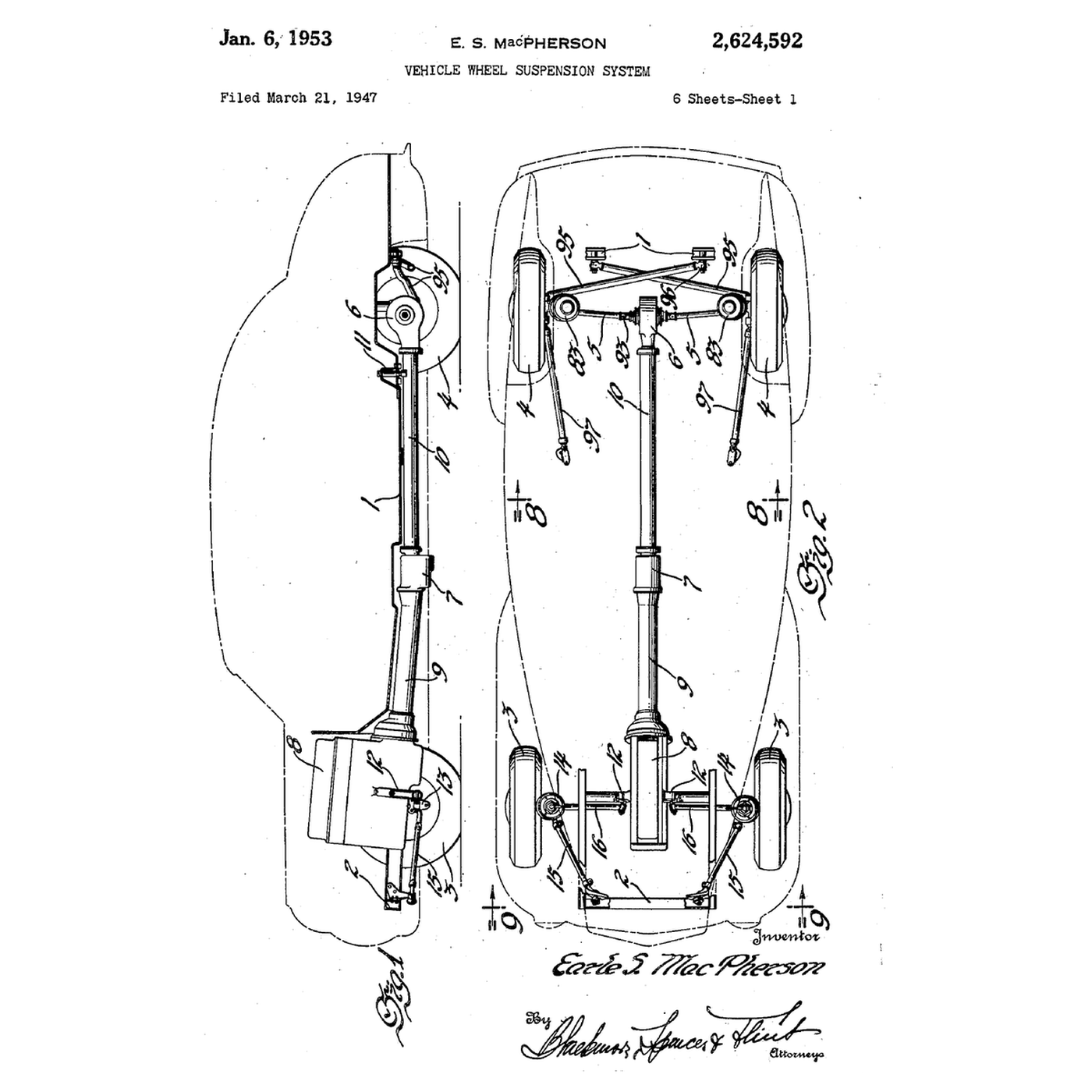

The MacPherson Strut: The Damper Is the Upper Link
Independent front suspension usually needs two wishbones per wheel, a spring and a damper. Earle S. MacPherson, an engineer at General Motors and then Ford, combined the damper, the spring and the upper link into one telescopic strut running from the hub up to the body, with a single lower link at the bottom. His patent was filed in 1947 and granted in 1953.
It is cheap, light and compact, and it leaves room across the car for the engine — which is why most small front-wheel-drive cars use it.
This rung computes how the wheel's camber changes as the suspension moves, and builds a cardboard front-view model to measure it with a protractor.
Àárín
About 3 hours
Ìlànà
1
1
Read MacPherson's patent
Read MacPherson's patent
US 2,624,592, 'Vehicle Wheel Suspension System', Earle S. MacPherson of Detroit, filed 21 March 1947 (Serial 736,262), granted 6 January 1953. The wheel's stub axle is connected *"to the body by a vertical telescopic strut"* and *"by a pair of horizontal swinging links"*; one link is *"formed as a turnbuckle"* for adjustment, and rubber bushes give *"a certain degree of universal joint action"*. The figures include a section of the strut's shock-absorber valving.
2
2
Camber change over the travel
Camber change over the travel
Ń ṣí ìwé Jupyter…
3
3
Build a front-view model
Build a front-view model
On a sheet of plywood, mark the car's centre line and 'ground'. Use the notebook's dimensions at half scale. Pin a strip of balsa as the lower link at its inner pivot. Make the strut from two cardboard tubes, one sliding in the other, pinned at the top mount and at the link's outer end. Glue a cardboard 'wheel' rigidly to the lower tube.
Move the link end up and down in 20 mm steps and measure the wheel's lean with the protractor. Compare with the notebook. Then move the inner pivot up by 20 mm and repeat: the camber curve changes — this is how suspension designers tune it.
Àwọn ohun èlò fún ìgbésẹ̀ yìí:
 Àwo igi tí a lẹ̀ pọ̀1 ewé
 Ìwé Igi Balsa1 ewé
 Ọ̀pá páálí2 ẹyọ
 Skurú ẹ̀rọ4 ẹyọ
Àwọn irinṣẹ́ tí a nílò:
 Ẹ̀rọ Ìwọ̀n Igun
 Ìdíwọ̀n
 Ẹ̀rọ Ìlùkòkò Aláìlókùn
 Àkójọ Orí Ìlùkòkò
4
4
History and context
History and context
**US 2,624,592, 'Vehicle Wheel Suspension System', Earle S. MacPherson; filed 21 March 1947, granted 6 January 1953.** The design first went into production on Ford of Britain cars in the early 1950s and became the most common front suspension on small cars.
**Honest limits.** The camber change and roll behaviour are harder to tune than with two wishbones; the strut's sliding seal carries side loads and wears; and the tall strut sets the height of the bonnet line.
Àwọn ohun-èlò
4- 1 ewéÀyè
- 1 ewéÀyè
- 2 ẹyọÀyè
- 4 ẹyọÀyè
Àwọn irinṣẹ́ tó nílò
4- Àyè
- 1 vendor sell this, none ship to you yetÀyè
Blueprint tó jọra
Àwọn blueprint wọ̀nyí pín ìmọ̀ — ọ̀nà, ohun-èlò tàbí ìlànà

The Hydraulic Shock Absorber: Liquid Forced Through a Small Passage
láti ọwọ́ Emma
Ìmọ̀ Ẹ̀rọ
11
0
0
0
0
0
Ackermann Steering: The Inner Wheel Turns Further
láti ọwọ́ Martin
Ìmọ̀ Ẹ̀rọ
12
0
0
0
0
0
The Leaf Spring: A Beam That Carries the Load and Locates the Axle
láti ọwọ́ Emma
Ìmọ̀ Ẹ̀rọ
16
0
0
0
0
0
Constant-Velocity Joint
láti ọwọ́ Emma
Ìmọ̀ Ẹ̀rọ
59
0
0
0
0
0
Universal Joint
láti ọwọ́ Martin
IṢẸ́ ỌWỌ́
50
0
0
0
0
0
CC0 Àgbègbè Gbogbogbò
Blueprint yìí ti jáde lábẹ́ CC0. O lè ṣe àdàkọ, yí padà, pín, àti lò láìsí ìyọ̀ǹda.
Ṣàtìlẹ́yìn Olùṣẹ́dá nípa rírà àwọn ọjà nipasẹ̀ Blueprint wọn Ẹ̀san Olùṣẹ́dá tí àwọn Olùtajà gbé kalẹ̀, tàbí ṣẹ̀dá àtúnṣe tuntun ti Blueprint yìí kí o sì fi sínú Blueprint rẹ gẹ́gẹ́ bí ìsopọ̀ láti pín owó-wíwọlé.