IṢẸ́ ỌNÀ
ẸWÀ ÀTI ÌLERA
IṢẸ́ ỌWỌ́
ÀṢÀ ÀTI ÌTÀN
ÌṢERÉ
ÀYÍKÁ
OÚNJẸ ÀTI OHUN MÍMU
REVERSE ENGINEERING
SÁYẸ́ǸSÌ
ERÉ ÌDÁRAYÁ
ÌMỌ̀-Ẹ̀RỌ
ÀWỌN OHUN WÍWỌ̀
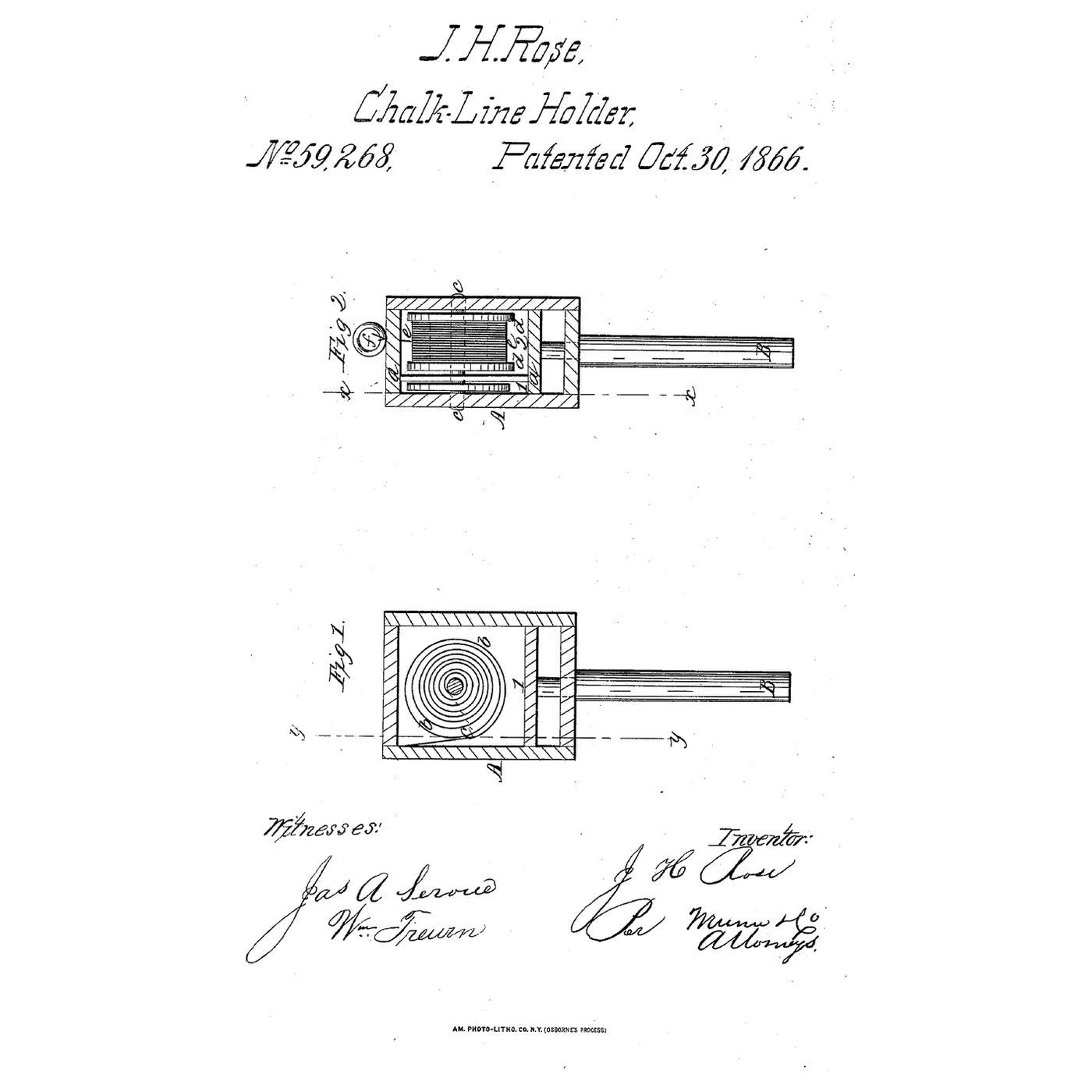


The Self-Winding Chalk-Line Reel: A Coil Spring That Reels the Line Back
Winding a carpenter's chalk line back by hand after every snap wastes time and leaves the line in a tangle.
Jonathan H. Rose of Mount Sterling, Illinois, received US 59,268, dated 30 October 1866, for a chalk-line winder "by means of a self-acting coil-spring, which, with the reel, is inclosed in a small hand-box, thereby furnishing a convenient and useful instrument for a workman, saving much time in winding the chalk-line and keeping clean and in good order, always ready for use." Drawing the line out winds the spring; letting it go, "the spring will draw the chalk-line back into the box".
This rung works out how many turns the spring must hold, then builds the box with a coiled spring-steel spring and times the line reeling back.
Àárín
About 3 hours
Ìlànà
1
1
Turns the spring must store
Turns the spring must store
Ń ṣí ìwé Jupyter…
2
2
The spring that does the work
The spring that does the work
The embedded blueprint explains how a spring's proportions set its force. Rose's flat coil spring has to store a turn for every loop of line drawn out.
3
3
Read US 59,268
Read US 59,268
"A represents a small flat rectangular wooden box, with a handle, B, at one end. The box is divided into two compartments by a thin partition, a a. A narrow compartment, No. 1, contains a long flat coil-spring, b b, the outer end of which is fastened to one side of the box, as shown in Fig. 1, and the other or central end of the spring to a spindle, c c, running through the center of the partition a a".
"The chalk-line is placed upon the reel so that when it is wound up the coil-spring b is fully expanded, and when it is drawn out for use by the holding-ring f the spring will be contracted or closed around the spindle c c by the turning of the spindle".
4
4
Build the reel and time the rewind
Build the reel and time the rewind
**Box.** From plywood make a box 12 × 12 × 5 cm inside with a thin partition dividing it into a 1.5 cm and a 3.5 cm compartment, and glue a dowel handle to one end. Drill a 6 mm hole through the partition's centre and both sides for the spindle.
**Spring.** Coil 1.2 m of spring steel strip into a flat spiral, fix its outer end to the narrow compartment's wall with a screw, and its inner end into a slot sawn in a 6 mm dowel spindle.
**Reel.** Glue two 8 cm plywood discs to the spindle in the wide compartment, 1 cm apart. Wind 2 m of cotton twine on it with the spring relaxed, thread the end out through a small hole, and tie on a ring. Put marking chalk in the wide compartment.
**Test.** Pull the line out 1 m and 2 m, counting the reel's turns through the hole, and let go; time the rewind with the stopwatch. Compare the turns with the notebook, and snap a chalk line with it.
Àwọn ohun èlò fún ìgbésẹ̀ yìí:
 Àwo igi tí a lẹ̀ pọ̀1 ẹyọ
 Àwọn dowel igi líle0.2 mítà
 Ọ̀pá irin orísun1 ẹyọ
 Ìṣó igi4 ẹyọ
 Ìdìpọ̀ Igi10 ml
 Okùn Òwú2 mítà
 Ẹ̀fun àmì30 g
Àwọn irinṣẹ́ tí a nílò:
 Ayùn Ọwọ́
 Ayùn Kópìngì
 Ìṣètò ayùn ihò
 Ẹ̀rọ Ìlùkòkò Aláìlókùn
 Àkójọ Orí Ìlùkòkò
 Ẹmú Ẹnu Pẹrẹsẹ
 Ìṣù àwọn ohun ìyí skurú
 Aago Ìdúró
 Ìdíwọ̀n
 Okùn ìsàmì ẹfun
 Ìbọ̀wọ́ Iṣẹ́ Awọ
 Gílásì Ààbò Tí Ó Mọ́
5
5
A reel that will not rewind, jams or springs back violently
A reel that will not rewind, jams or springs back violently
Self-winding chalk-line reel troubleshooting.
Flow
Loading...
6
6
History and honest limits
History and honest limits
**Jonathan H. Rose** of Mount Sterling, Brown County, Illinois, signed US 59,268 on 14 July 1866; it is dated 30 October 1866. His claim is the coil spring, spindle and reel combined with the partitioned box and handle.
**Honest limits.** A plywood box and a hand-coiled strip of spring steel stand in for his wooden box and long flat coil spring, and the line is short to suit that spring. The notebook ignores the line's thickness building up on the reel; its lengths and radii are examples. Your turn counts and times are the result.
Àwọn ohun-èlò
7- 1 ẹyọÀyè
- 0.2 mítàÀyè
- 1 ẹyọÀyè
- 4 ẹyọÀyè
- 10 mlÀyè
- 2 mítàÀyè
- 30 gÀyè
Àwọn irinṣẹ́ tó nílò
12- Àyè
- Àyè
- 1 vendor sell this, none ship to you yetÀyè
- Àyè
- Àyè
Ìtọ́nisọ́nà yìí ń ṣe
Blueprint tó jọra
Àwọn blueprint wọ̀nyí pín ìmọ̀ — ọ̀nà, ohun-èlò tàbí ìlànà



CC0 Àgbègbè Gbogbogbò
Blueprint yìí ti jáde lábẹ́ CC0. O lè ṣe àdàkọ, yí padà, pín, àti lò láìsí ìyọ̀ǹda.
Ṣàtìlẹ́yìn Olùṣẹ́dá nípa rírà àwọn ọjà nipasẹ̀ Blueprint wọn Ẹ̀san Olùṣẹ́dá tí àwọn Olùtajà gbé kalẹ̀, tàbí ṣẹ̀dá àtúnṣe tuntun ti Blueprint yìí kí o sì fi sínú Blueprint rẹ gẹ́gẹ́ bí ìsopọ̀ láti pín owó-wíwọlé.