IṢẸ́ ỌNÀ
ẸWÀ ÀTI ÌLERA
IṢẸ́ ỌWỌ́
ÀṢÀ ÀTI ÌTÀN
ÌṢERÉ
ÀYÍKÁ
OÚNJẸ ÀTI OHUN MÍMU
REVERSE ENGINEERING
SÁYẸ́ǸSÌ
ERÉ ÌDÁRAYÁ
ÌMỌ̀-Ẹ̀RỌ
ÀWỌN OHUN WÍWỌ̀



The Split-Hand Glove Stretcher: Two Halves Pushed Apart on Parallel Lines
A pair-of-tongs glove stretcher opens one finger at a time and stretches it only where the jaws press.
Charles C. Wilson of Washington, D.C., received US 175,225, dated 21 March 1876, for "a bisected block in the form of an entire hand and wrist, or two hands placed together, with an interior spreading device for the purpose of stretching the entire glove at one operation": a screw pulls two wedges up inclines so that the halves move "gradually outward from each other on parallel lines, and thus stretch all parts of the glove simultaneously and equally". The screw is graduated to show how far to turn it for each size.
This rung works out the wedges' push with a work check, then carves the split hand from hardwood, fits an M8 screw and wedges, and stretches a leather glove.
Ilọsíwájú
About 5 hours
Ìlànà
1
1
Screw, wedges and spread
Screw, wedges and spread
Ń ṣí ìwé Jupyter…
2
2
The stretcher before it
The stretcher before it
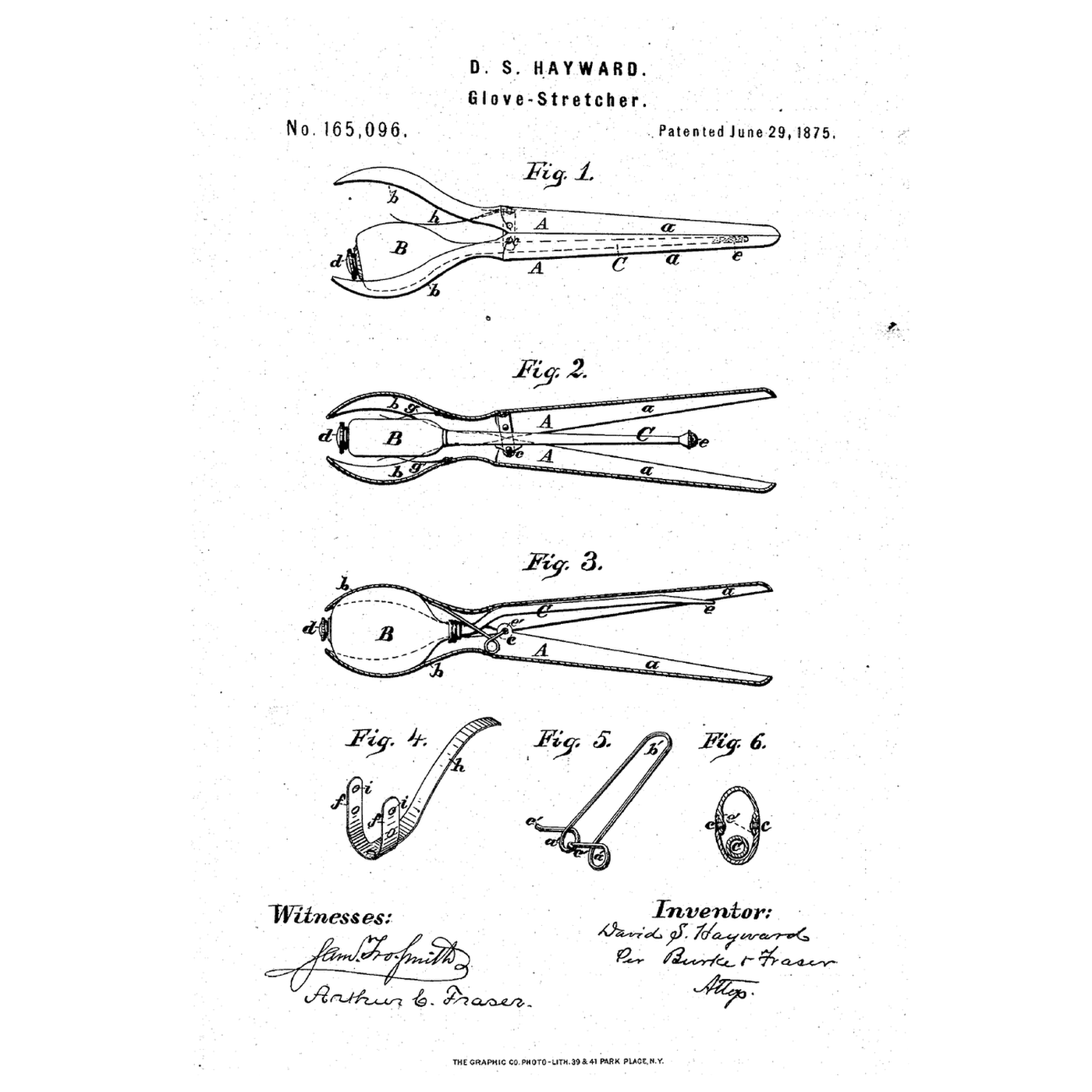
The embedded blueprint opens a glove finger with pivoted jaws. Wilson's block fills the whole glove and spreads it evenly.
3
3
Read US 175,225
Read US 175,225
"A A represent the two halves of a longitudinally-split block in the form of a hand and wrist. In each part A is a central longitudinal groove, a, extending from the wrist end inward and terminating in two inclined recesses, b b, one at the wrist and the other in the palm of the hand, as shown."
"It will thus be noticed that the glove is stretched evenly and in the same degree in all its parts on account of the two parts moving out on parallel lines; and, further, the entire glove is stretched at one operation."
4
4
Build the block and stretch a glove
Build the block and stretch a glove
**Block.** Trace round a glove, fingers together, on two pieces of hardwood board. Cut them out with the coping saw and rasp them into two matching halves of a hand. Hold them together with two dowel pins so they can slide apart but stay in line.
**Groove and inclines.** Cut a groove down the middle of each half's inner face for the screw. At the wrist and in the palm, pare an inclined recess at 20° to the groove in each half, checked with the protractor.
**Screw and wedges.** Cut two double wedges from hardwood block to fit the recesses and drill them for M8 threaded rod. Epoxy an M8 nut into a square recess at the wrist end, run 25 cm of rod through it and the wedges, and lock each wedge between two nuts. Lock a dowel handle on the rod's outer end. Mark the rod's end with a line to count turns.
**Test.** Measure the width of a leather glove's palm and fingers with the caliper. Slide the glove on, turn the handle two turns, leave it an hour and back it off. Measure again, and compare with the notebook's spread per turn.
Àwọn ohun èlò fún ìgbésẹ̀ yìí:
 Pátákó Igi Líle1 ẹyọ
 Ìṣù Igi Líle1 ẹyọ
 Àwọn dowel igi líle0.3 mítà
 Ọ̀pá oníṣọ̀kan0.25 mítà
 Nọ́ọ̀tì Onígun Mẹ́fà6 ẹyọ
 Resini epoxy5 ml
 Ìbọ̀wọ́ Awọ1 pair
Àwọn irinṣẹ́ tí a nílò:
 Ayùn Kópìngì
 Ayùn
Ayùn Àwọn Ìfá (Ìfá Ọwọ́)
 Ẹ̀rọ Ìlùkòkò Aláìlókùn
 Àkójọ Orí Ìlùkòkò
 Ẹ̀rọ Ìwọ̀n Igun
 Kọ́kọ́rọ́ tí a lè ṣàtúnṣe
 Òṣùwọ̀n Kálípà Díjítà Ìnṣì 6
 Gègé
Gègé Bébà Ìfá
5
5
A stretcher that jams, twists or stretches unevenly
A stretcher that jams, twists or stretches unevenly
Split-hand glove stretcher troubleshooting.
Flow
Loading...
6
6
History and honest limits
History and honest limits
**Charles C. Wilson** of Washington, D.C., filed US 175,225 on 6 March 1876; it is dated 21 March 1876. He also showed a single wedge worked by a screw of half the pitch, right- and left-handed threads on one shaft, and toggle joints, and wrote that these "all involve the same principle". His claims cover a two-part stretcher that expands on parallel lines and a bisected hand-shaped block moving outward on parallel lines.
**Honest limits.** Hardwood, dowel pins, an M8 rod and locked nuts stand in for his block, pins, screw and wedges. The notebook assumes a screw efficiency and ignores wedge friction; its numbers are examples. Your caliper readings are the result.
Àwọn ohun-èlò
7- 1 ẹyọÀyè
- 1 ẹyọÀyè
- 0.3 mítàÀyè
- 0.25 mítàÀyè
- 6 ẹyọÀyè
- 5 mlÀyè
- 1 pairÀyè
Àwọn irinṣẹ́ tó nílò
10- Àyè
- Àyè
- 1 vendor sell this, none ship to you yetÀyè
- 1 vendor sell this, none ship to you yetÀyè
- Àyè
Blueprint tó jọra
Àwọn blueprint wọ̀nyí pín ìmọ̀ — ọ̀nà, ohun-èlò tàbí ìlànà

CC0 Àgbègbè Gbogbogbò
Blueprint yìí ti jáde lábẹ́ CC0. O lè ṣe àdàkọ, yí padà, pín, àti lò láìsí ìyọ̀ǹda.
Ṣàtìlẹ́yìn Olùṣẹ́dá nípa rírà àwọn ọjà nipasẹ̀ Blueprint wọn Ẹ̀san Olùṣẹ́dá tí àwọn Olùtajà gbé kalẹ̀, tàbí ṣẹ̀dá àtúnṣe tuntun ti Blueprint yìí kí o sì fi sínú Blueprint rẹ gẹ́gẹ́ bí ìsopọ̀ láti pín owó-wíwọlé.