IṢẸ́ ỌNÀ
ẸWÀ ÀTI ÌLERA
IṢẸ́ ỌWỌ́
ÀṢÀ ÀTI ÌTÀN
ÌṢERÉ
ÀYÍKÁ
OÚNJẸ ÀTI OHUN MÍMU
REVERSE ENGINEERING
SÁYẸ́ǸSÌ
ERÉ ÌDÁRAYÁ
ÌMỌ̀-Ẹ̀RỌ
ÀWỌN OHUN WÍWỌ̀


The Spring-Rocked Cradle: Tapered Springs and a Treadle
A cradle that swings freely is soothing; one that rocks too far tips. Springs can hold the swing in check and keep it going.
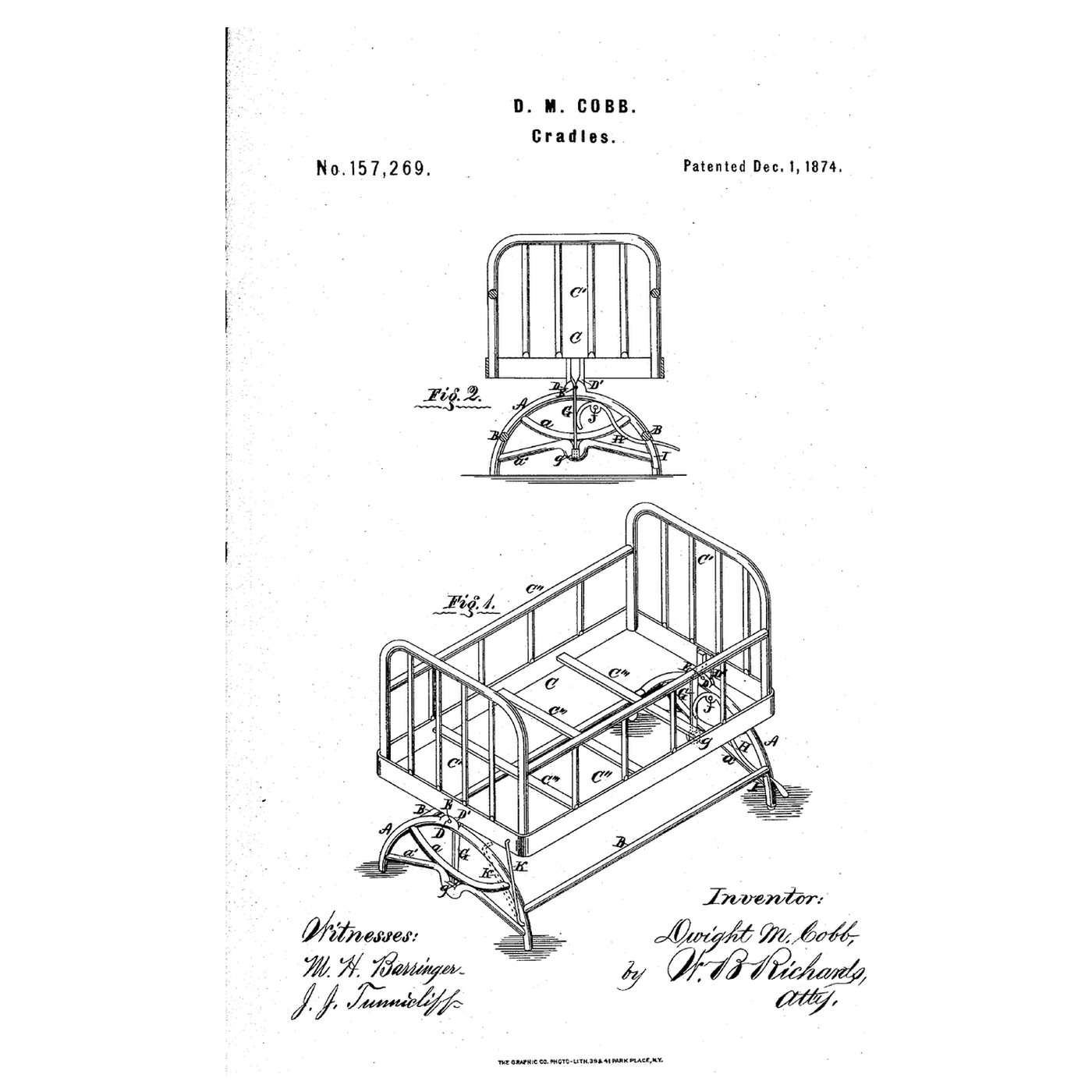
Dwight M. Cobb of Galesburg, Illinois, received US 157,269, dated 1 December 1874 (filed 9 June 1874), for a cradle whose crib is pivoted on arched stands, with flat springs at each end "tending to resist too rapid movement as the center of gravity of the crib is carried over to either side", and a treadle by which "the impulse necessary to rock the cradle" may be given.
This rung works out when springs keep a pivoted crib rocking rather than tipping, and why the springs taper, then builds a small model and times its swing.
Àárín
About 2 hours
Ìlànà
1
1
Rocking or tipping, and the tapered spring
Rocking or tipping, and the tapered spring
Ń ṣí ìwé Jupyter…
2
2
Why a swing has a period
Why a swing has a period
The embedded blueprint times a pendulum; a rocking crib has a period too, set by its springs as well as its weight.
3
3
Read US 157,269
Read US 157,269
"The nature of this invention relates to improvements in cradles; and the invention consists in mounting the cradle or crib upon a suitable frame in such manner that it may be rocked by a treadle, one end of which impinges against said spring, and by which the impulse necessary to rock the cradle may be given".
"The springs G are common flat bars, tapering from their upper ends downward". "The manner of rocking the crib upon the lower frame will be plainly seen, the springs G tending to resist too rapid movement as the center of gravity of the crib is carried over to either side, their tapered forms distributing the strain upon them, which is naturally heaviest at their upper ends, so as to make their flexure equal at any part of their lengths".
"This improvement may be readily adapted to rocking-chairs, &c."
4
4
Build a model and time it
Build a model and time it
Make a small box (the crib) and pivot it on a dowel through its ends, a little below its middle, resting on two plywood uprights. Fix a strip of spring steel upright at each end so that the crib's rocking bends it.
Load the crib with a weight, tip it and let go. Time ten swings with the stopwatch. Add weight higher up in the box and time it again: it slows, and with enough weight high up it tips over. Swap in a stiffer strip and repeat. Compare with the notebook.
Àwọn ohun èlò fún ìgbésẹ̀ yìí:
 Àwo igi tí a lẹ̀ pọ̀1 ẹyọ
 Àwọn dowel igi líle1 ẹyọ
 Ọ̀pá irin orísun2 ẹyọ
Àwọn irinṣẹ́ tí a nílò:
 Ibùsùn ọmọ-ọwọ́ tí a ń mì
 Ìwọ̀n
Ìwọ̀n Aago Ìdúró
 Ẹ̀rọ Ìlùkòkò Aláìlókùn
 Ìdíwọ̀n
5
5
A cradle that tips, stops or jerks
A cradle that tips, stops or jerks
Rocking cradle troubleshooting.
Flow
Loading...
6
6
History and honest limits
History and honest limits
**Dwight M. Cobb** of Galesburg, Illinois, filed US 157,269 on 9 June 1874; it is dated 1 December 1874. A catch holds the crib still when rocking is not wanted.
**Honest limits.** The notebook treats rocking as small swings with linear springs and ignores friction; the tapered-spring figures assume a simple cantilever of constant thickness. All values are examples. Your timed swings are the measurement.
Àwọn ohun-èlò
3- 1 ẹyọÀyè
- 1 ẹyọÀyè
- 2 ẹyọÀyè
Àwọn irinṣẹ́ tó nílò
5- Àyè
- Àyè
- 1 vendor sell this, none ship to you yetÀyè
- Àyè
Blueprint tó jọra
Àwọn blueprint wọ̀nyí pín ìmọ̀ — ọ̀nà, ohun-èlò tàbí ìlànà



CC0 Àgbègbè Gbogbogbò
Blueprint yìí ti jáde lábẹ́ CC0. O lè ṣe àdàkọ, yí padà, pín, àti lò láìsí ìyọ̀ǹda.
Ṣàtìlẹ́yìn Olùṣẹ́dá nípa rírà àwọn ọjà nipasẹ̀ Blueprint wọn Ẹ̀san Olùṣẹ́dá tí àwọn Olùtajà gbé kalẹ̀, tàbí ṣẹ̀dá àtúnṣe tuntun ti Blueprint yìí kí o sì fi sínú Blueprint rẹ gẹ́gẹ́ bí ìsopọ̀ láti pín owó-wíwọlé.