IṢẸ́ ỌNÀ
ẸWÀ ÀTI ÌLERA
IṢẸ́ ỌWỌ́
ÀṢÀ ÀTI ÌTÀN
ÌṢERÉ
ÀYÍKÁ
OÚNJẸ ÀTI OHUN MÍMU
REVERSE ENGINEERING
SÁYẸ́ǸSÌ
ERÉ ÌDÁRAYÁ
ÌMỌ̀-Ẹ̀RỌ
ÀWỌN OHUN WÍWỌ̀
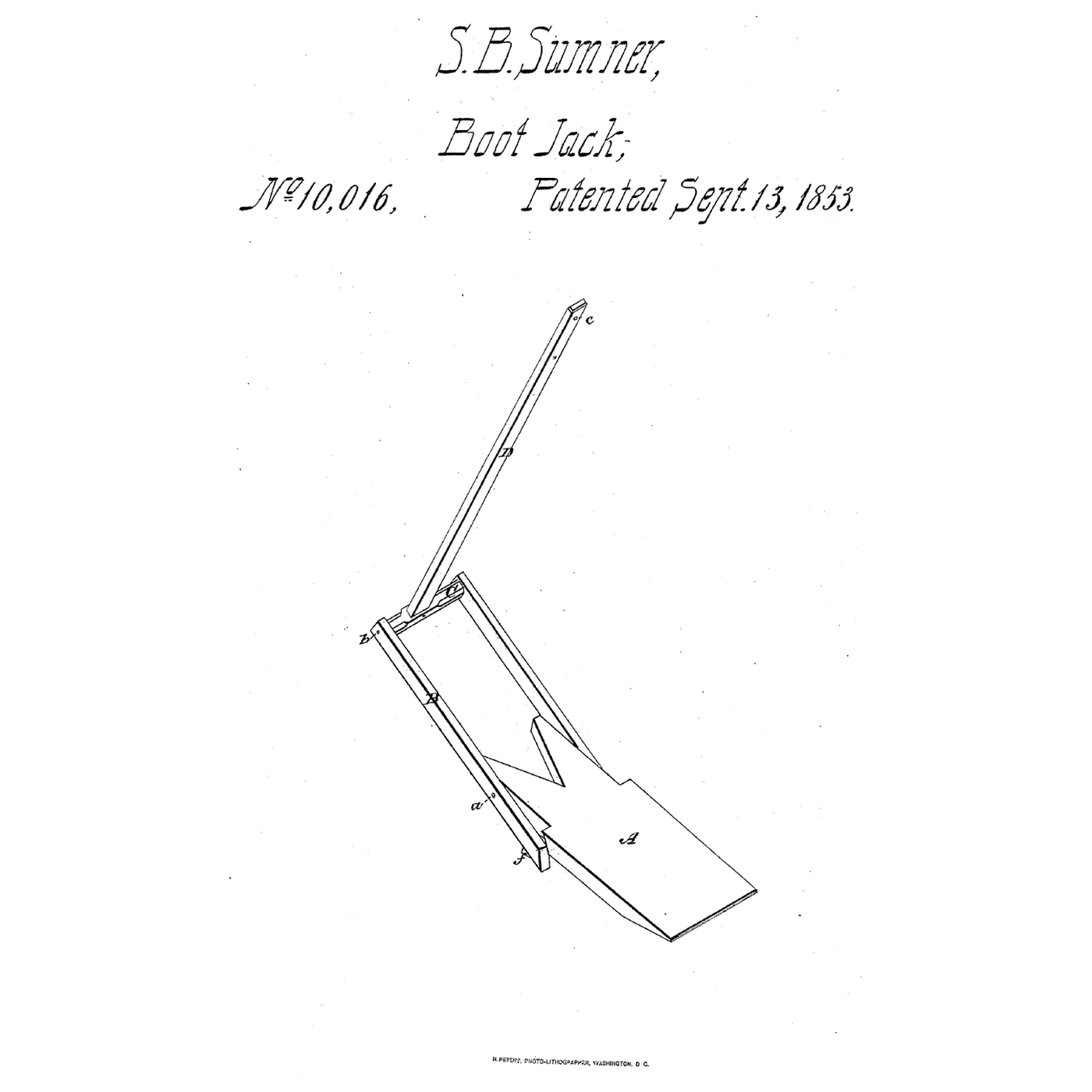


The Toe-Holding Bootjack: A Shaft That Pins the Boot Down
A plain bootjack grips the heel, but a tight boot lifts off the jack and comes up with the foot.
Samuel B. Sumner of Grantville, Massachusetts, received US 10,016, dated 13 September 1853, for an improvement in machines for taking off boots: two side bars pivoted to an ordinary bootjack and joined by a shaft, into which a bar is mortised. With one foot on the jack and the heel of the other in the jaws, "the bar D, being grasped by the hand, the shaft C, is pressed down upon the toe of the boot, by which means it is easily withdrawn."
This rung works out how hard the shaft holds the toe, then builds the jack from hardwood and dowel and times taking a boot off with and without the bar.
Olùbẹ̀rẹ̀
About 3 hours
Ìlànà
1
1
Force on the toe
Force on the toe
Ń ṣí ìwé Jupyter…
2
2
Why the long bar helps
Why the long bar helps
The embedded blueprint works out the lever law. Sumner's bar is a lever that turns the side bars about their pivot and presses the shaft on the toe.
3
3
Read US 10,016
Read US 10,016
"A is the body of the ordinary boot jack. B are two side bars, pivoted to the jack at the point a. These side bars are connected together by the shaft C, which is permitted to revolve around the points b, and into which is mortised the bar or handle D."
"f, is the bar or bridge upon which the jack rests as usual for the purpose of raising the forked end from the ground."
4
4
Build the jack and take a boot off
Build the jack and take a boot off
**Body.** Saw a board 40 × 12 cm from hardwood board. Cut a V-notch 7 cm deep and 7 cm wide in one end with the coping saw: the jaws. Glue and screw a 3 cm block across the underside 12 cm from the notch: the bridge.
**Side bars.** Saw two strips 28 × 3 cm. Bolt one to each side of the body 3 cm behind the bottom of the notch, loose enough to swing, with a washer each side.
**Shaft and bar.** Cut 16 cm of hardwood dowel to span between the side bars' free ends, about 20 cm back from the pivot, and screw it on. Drill its middle, glue in 50 cm of dowel as the bar, and drill a hole near the bar's top to hang the jack up.
**Test.** Wearing a rubber boot, stand on the jack with the other foot, heel in the jaws, and time taking the boot off without touching the bar. Then do it again pulling the bar so the shaft presses the toe; hook the spring scale to the bar once to read your pull. Compare with a plain bought boot jack.
Àwọn ohun èlò fún ìgbésẹ̀ yìí:
 Pátákó Igi Líle1 ẹyọ
 Àwọn dowel igi líle0.7 mítà
 Àkójọ bọ́ọ̀lù onígun mẹ́fà1 ẹyọ
 Nọ́ọ̀tì Onígun Mẹ́fà2 ẹyọ
 Wáṣà Pẹrẹsẹ4 ẹyọ
 Ìṣó igi6 ẹyọ
 Ìdìpọ̀ Igi10 ml
Àwọn irinṣẹ́ tí a nílò:
 Ayùn Ọwọ́
 Ayùn Kópìngì
 Ẹ̀rọ Ìlùkòkò Aláìlókùn
 Àkójọ Orí Ìlùkòkò
 Ìṣù àwọn ohun ìyí skurú
 Kọ́kọ́rọ́ tí a lè ṣàtúnṣe
 Bébà Ìfá
 Ìdíwọ̀n
 Gègé
Gègé Ẹ̀rọ Ìwọ̀n Agbára (Òṣùwọ̀n Ìsúnkì)
 Aago Ìdúró
 Bàtà rọ́bà
 Pákó ìbọ́ bàtà gígùn
5
5
A jack that slides, pinches or will not hold the toe
A jack that slides, pinches or will not hold the toe
Toe-holding bootjack troubleshooting.
Flow
Loading...
6
6
History and honest limits
History and honest limits
**Samuel B. Sumner** of Grantville, Norfolk County, Massachusetts, signed US 10,016 on 5 April 1853; it is dated 13 September 1853. His claim is the side bars, shaft and bar arranged on an instrument for taking off boots.
**Honest limits.** Bolts, a screwed-on dowel and a glued dowel stand in for Sumner's pivots and mortise. The notebook treats the hand's pull as square to the bar; its pull and lengths are examples. Your times and pull are the result.
Àwọn ohun-èlò
7- 1 ẹyọÀyè
- 0.7 mítàÀyè
- Àyè
- 2 ẹyọÀyè
- 4 ẹyọÀyè
- 6 ẹyọÀyè
- 10 mlÀyè
Àwọn irinṣẹ́ tó nílò
13- Àyè
- Àyè
- 1 vendor sell this, none ship to you yetÀyè
- Àyè
- Àyè
- 1 vendor sell this, none ship to you yetÀyè
- Àyè
- Àyè
Ìtọ́nisọ́nà yìí ń ṣe
Blueprint tó jọra
Àwọn blueprint wọ̀nyí pín ìmọ̀ — ọ̀nà, ohun-èlò tàbí ìlànà


CC0 Àgbègbè Gbogbogbò
Blueprint yìí ti jáde lábẹ́ CC0. O lè ṣe àdàkọ, yí padà, pín, àti lò láìsí ìyọ̀ǹda.
Ṣàtìlẹ́yìn Olùṣẹ́dá nípa rírà àwọn ọjà nipasẹ̀ Blueprint wọn Ẹ̀san Olùṣẹ́dá tí àwọn Olùtajà gbé kalẹ̀, tàbí ṣẹ̀dá àtúnṣe tuntun ti Blueprint yìí kí o sì fi sínú Blueprint rẹ gẹ́gẹ́ bí ìsopọ̀ láti pín owó-wíwọlé.