IṢẸ́ ỌNÀ
ẸWÀ ÀTI ÌLERA
IṢẸ́ ỌWỌ́
ÀṢÀ ÀTI ÌTÀN
ÌṢERÉ
ÀYÍKÁ
OÚNJẸ ÀTI OHUN MÍMU
REVERSE ENGINEERING
SÁYẸ́ǸSÌ
ERÉ ÌDÁRAYÁ
ÌMỌ̀-Ẹ̀RỌ
ÀWỌN OHUN WÍWỌ̀
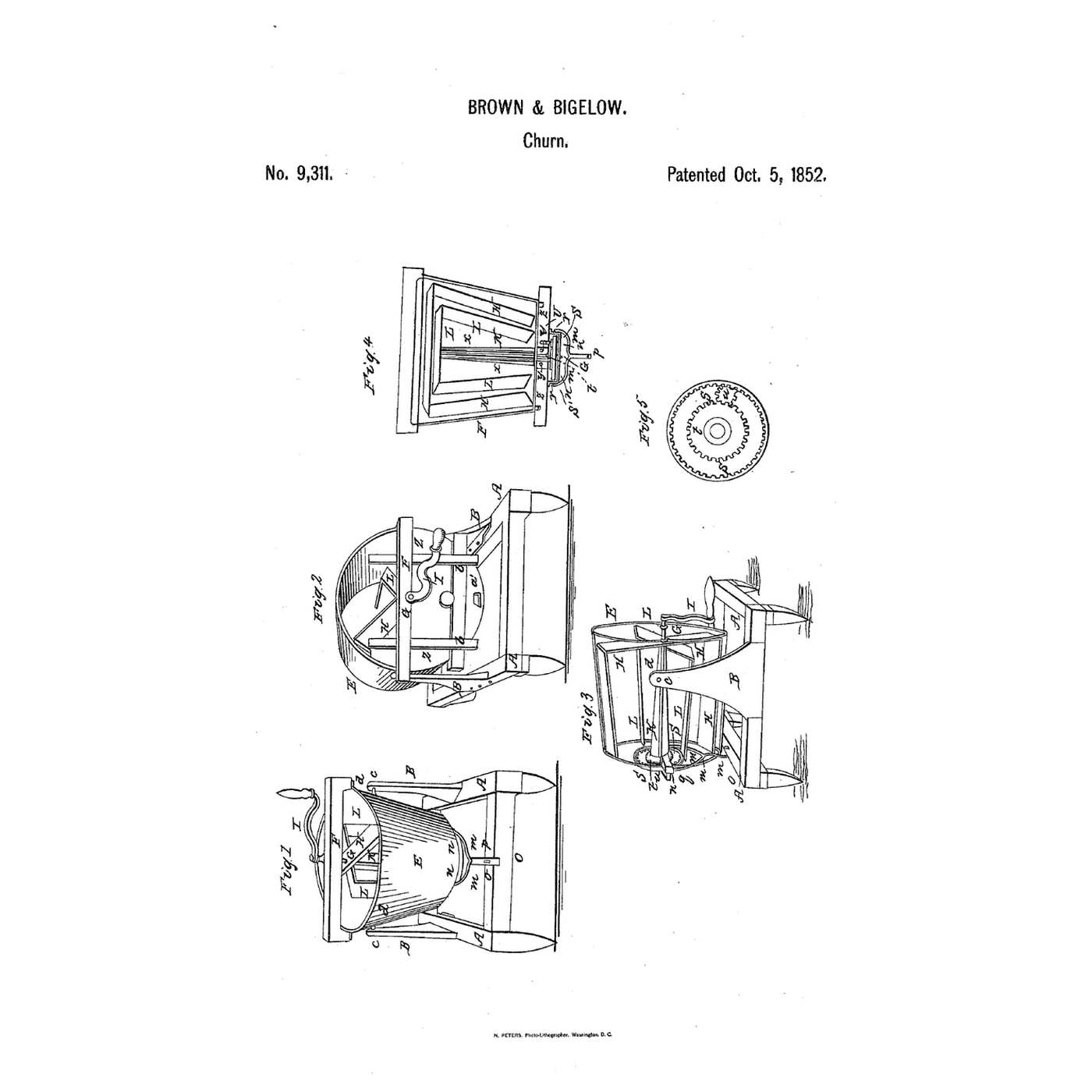

Tilting-Tub Counter-Fan Churn: Two Fans Turn Opposite Ways, the Tub Tips to Drain and Work
Brown and Bigelow wanted one churn to make the butter and then work it, by tipping the tub on its side.
Lucian A. Brown and Hubbard Bigelow of Hartford, Connecticut, received US 9,311, dated 5 October 1852, assigned to Henry K. W. Welch. Their conical tub E swings on journals between two standards. The crank turns a fan H on the shaft G; a shell with inside gear on G's lower end turns, through a small pinion u, a spur gear t on a hollow shaft round G, which carries a second fan L the opposite way. A conical tube K, of tin or any other suitable material and watertight to the tub's bottom, keeps the cream from the hollow shaft. When the butter has come, the tub is tipped about 90 degrees: the buttermilk runs out at an aperture in the cover and the turning fans knead, work and roll the butter.
This rung works out the gear train, then prints the gears, inner fan and conical tube, builds the tub and frame, and makes and works butter.
Ilọsíwájú
About 6 hours, plus printing
Ìlànà
1
1
The gear train
The gear train
Ń ṣí ìwé Jupyter…
2
2
Gears driving more than one beater before it
Gears driving more than one beater before it
The embedded blueprint drives several beaters from one crank through gears. Brown and Bigelow use an inside gear and a pinion to turn two fans opposite ways on one axis.
3
3
Read US 9,311
Read US 9,311
"In this horizontal position of the tub E we continue the rotation of the crank I, as in the operation of churning, and the butter thus becomes kneaded, worked and rolled, as the beater H in its revolutions scrapes the butter from the inside of the tub, while the beater L, revolving in the opposite direction, in close proximity to and inside of the other, will strike the butter forced over the beater H by the accumulation by scraping off the butter on the side of the tub, while the buttermilk and water, extracted from the butter by this process, runs down over the now inclined bottom of the tub E, and escapes by the aperture a' of the cover Z, Z, Z, into any receptacle placed under the aperture to receive it."
4
4
Print the parts
Print the parts
Print the shell gear S with 72 inside teeth (/uploads/blueprints/tilting-tub-counter-fan-churn-shell-gear.stl), the 12-tooth stud pinion u (/uploads/blueprints/tilting-tub-counter-fan-churn-stud-pinion.stl), the 48-tooth spur gear t printed in one with the hollow shaft x (/uploads/blueprints/tilting-tub-counter-fan-churn-spur-gear-and-hollow-shaft.stl), the inner fan L (/uploads/blueprints/tilting-tub-counter-fan-churn-inner-fan.stl) and the conical tube K (/uploads/blueprints/tilting-tub-counter-fan-churn-conical-tube.stl). Print in PETG at 0.2 mm layers, 30 % infill, 4 walls; wash before first use.
Àwọn ohun èlò fún ìgbésẹ̀ yìí:
 Okùn PETG1 ẹyọ
Àwọn irinṣẹ́ tí a nílò:
 Ẹ̀rọ ìtẹ̀ 3D oníwàyà (FDM)
5
5
Tub, tube and frame
Tub, tube and frame
Use a tapered food-grade container about 250 mm across the top. Drill a 20 mm hole in the centre of its bottom and seal the conical tube's flange round it inside with food-safe silicone. Bolt a short carriage bolt through each side at mid-height as the journals d, with washers and silicone, and hang the tub by them in holes near the tops of two pine standards on a pine base. Screw a pine cross bar under the bottom (his q q) with a 4 mm screw standing down from it 37.5 mm off centre as the stud V, and a pine bridge below it (his n n) with a step hole for the shaft.
Àwọn ohun èlò fún ìgbésẹ̀ yìí:
 Àgọ́ ìtọ́jú ti ìpele oúnjẹ1 ẹyọ
 Ìdílẹ̀ Silikoni1 ẹyọ
 Bọ́ọ̀tù orí róbótó1 ẹyọ
 Wáṣà Pẹrẹsẹ1 ẹyọ
 Pákó igi pine1 ẹyọ
 Skurú ẹ̀rọ1 ẹyọ
 Nọ́ọ̀tì Onígun Mẹ́fà1 ẹyọ
 Ìsúrù igi #8 x 1"1 ẹyọ
Àwọn irinṣẹ́ tí a nílò:
 Ìṣètò ayùn ihò
 Ẹ̀rọ Ìlùkòkò Aláìlókùn
 Àkójọ Orí Ìlùkòkò
 Ayùn Ọwọ́
 Ìṣù àwọn ohun ìyí skurú
 Kọ́kọ́rọ́ tí a lè ṣàtúnṣe
6
6
Shafts, fans and crank
Shafts, fans and crank
Pass the hollow shaft up through the conical tube from below so the spur gear sits under the bottom, and glue the inner fan on its top just above the tube. Run a 10 mm stainless rod as the shaft G down through it, fix the shell gear on its foot with a set screw so the pinion on the stud meshes with both gears, and rest its end in the bridge's step. Bolt a pine bar F across the mouth as G's upper bearing; under it fix two hardwood blades reaching close to the tub's side as fan H, and above it a crank. A pine fork pivoted on the bridge, its handle pinned to the frame, holds the tub upright. Cut the container's lid in two, with a hole near the rim of one half as the aperture a'.
Àwọn ohun èlò fún ìgbésẹ̀ yìí:
 Ọ̀pá Róbótó Irin Rírọ̀1 ẹyọ
 Àwọn dowel igi líle1 ẹyọPákó igi pine1 ẹyọ
 Ẹpọ́ksì Ẹ̀yà Méjì1 ẹyọSkurú ẹ̀rọ1 ẹyọÌsúrù igi #8 x 1"1 ẹyọ
Àwọn irinṣẹ́ tí a nílò:
 Ayùn IrinẸ̀rọ Ìlùkòkò AláìlókùnÀkójọ Orí ÌlùkòkòÌṣù àwọn ohun ìyí skurú
 Ayùn Kópìngì
7
7
The build in 3D
The build in 3D
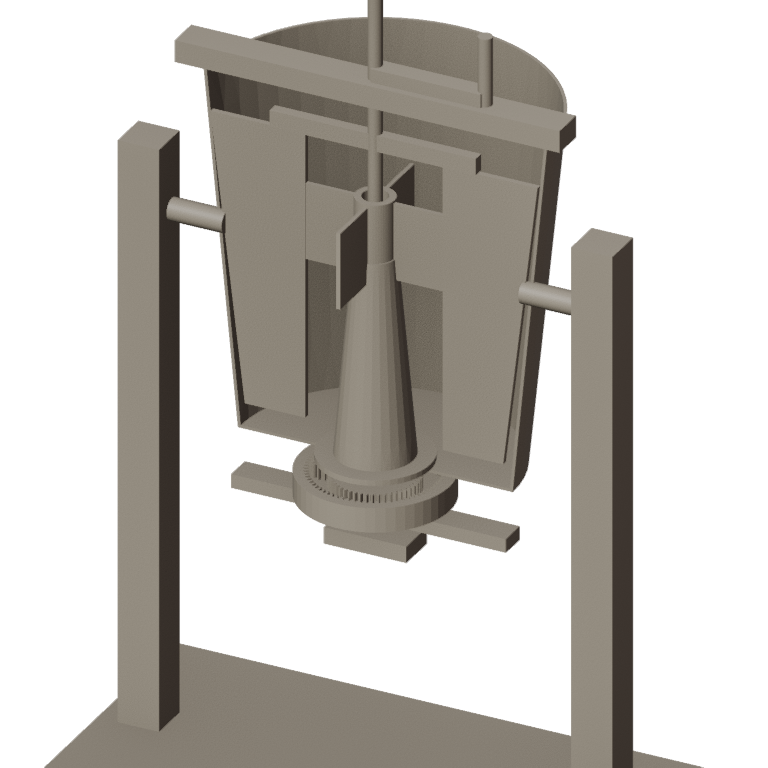
FreeCAD model of this build, not of the patent: the conical tub cut away on its journals between the standards, the outer fan H, the conical tube K with the inner fan L on the hollow shaft above it, and under the bottom the shell gear, stud pinion and spur gear between the cross bar and bridge.
8
8
Churn, tip and work
Churn, tip and work
Let the heavy cream stand until it reaches about 15 °C, checked with the thermometer. Pour in 2 litres, fit both cover halves and crank steadily; time until the butter comes. Set a jug under the aperture, free the fork and tip the tub about 90 degrees onto its side, aperture down; crank on so the fans knead the butter while the buttermilk runs out. Stand it up, add cold water, churn a little, tip and drain again until the water runs clear; work in a pinch of salt the same way and weigh the butter.
Àwọn ohun èlò fún ìgbésẹ̀ yìí:
 Ọ̀rá wàrà tó nípọn2000 ml
 Iyọ̀ Òkun Rúkèrúdò1 ẹyọ
 Omi1 ẹyọ
Àwọn irinṣẹ́ tí a nílò:
 Ẹ̀rọ ìwọ̀n ooru oníhun tí ó dúró sí inú
 Aago Ìdúró
 Òṣùwọ̀n Díjítà Ilé Ìdáná
 Àwo ìdàpọ̀ ńlá ti irin tí kò ń yá
9
9
Gears that jam, a tub that leaks
Gears that jam, a tub that leaks
Tilting-tub counter-fan churn troubleshooting.
Flow
Loading...
10
10
History and honest limits
History and honest limits
**Lucian A. Brown and Hubbard Bigelow** of Hartford, Connecticut, assignors to Henry K. W. Welch, received US 9,311, dated 5 October 1852; they signed the specification on 12 April 1852. They wrote that a cover is needed to stop the cream spattering, though the figure does not show it, and that working the butter in the tub saves lifting and the buttermilk. The ratio of 2 to 3, they wrote, was "a fact only learned by experiments, and corroborated by their repetition." They claimed the combination of the tub E and its appendages with the frame and standards, or any other frame adapted to use the tub in a vertical and a horizontal position.
**Honest limits.** A container, pine and printed parts stand in for theirs; the gear sizes are ours. FDM prints hold food in their layer lines, so wash well and replace when worn. Your times and weights are the result.
Àwọn ohun-èlò
15- 1 ẹyọÀyè
- Àyè
- 1 ẹyọÀyè
- 1 ẹyọÀyè
- 1 ẹyọÀyè
- 1 ẹyọÀyè
- 2 ẹyọÀyè
- 1 ẹyọÀyè
- 2 ẹyọÀyè
- Àyè
- 1 ẹyọÀyè
- 1 ẹyọÀyè
- 2000 mlÀyè
- 1 ẹyọÀyè
- 1 ẹyọÀyè
Àwọn irinṣẹ́ tó nílò
13- 1 vendor sell this, none ship to you yetÀyè
- Àyè
- Àyè
- Àyè
- Àyè
Àwọn fáìlì àpẹrẹ
1Ìtọ́nisọ́nà yìí ń ṣe

Blueprint tó jọra
Àwọn blueprint wọ̀nyí pín ìmọ̀ — ọ̀nà, ohun-èlò tàbí ìlànà
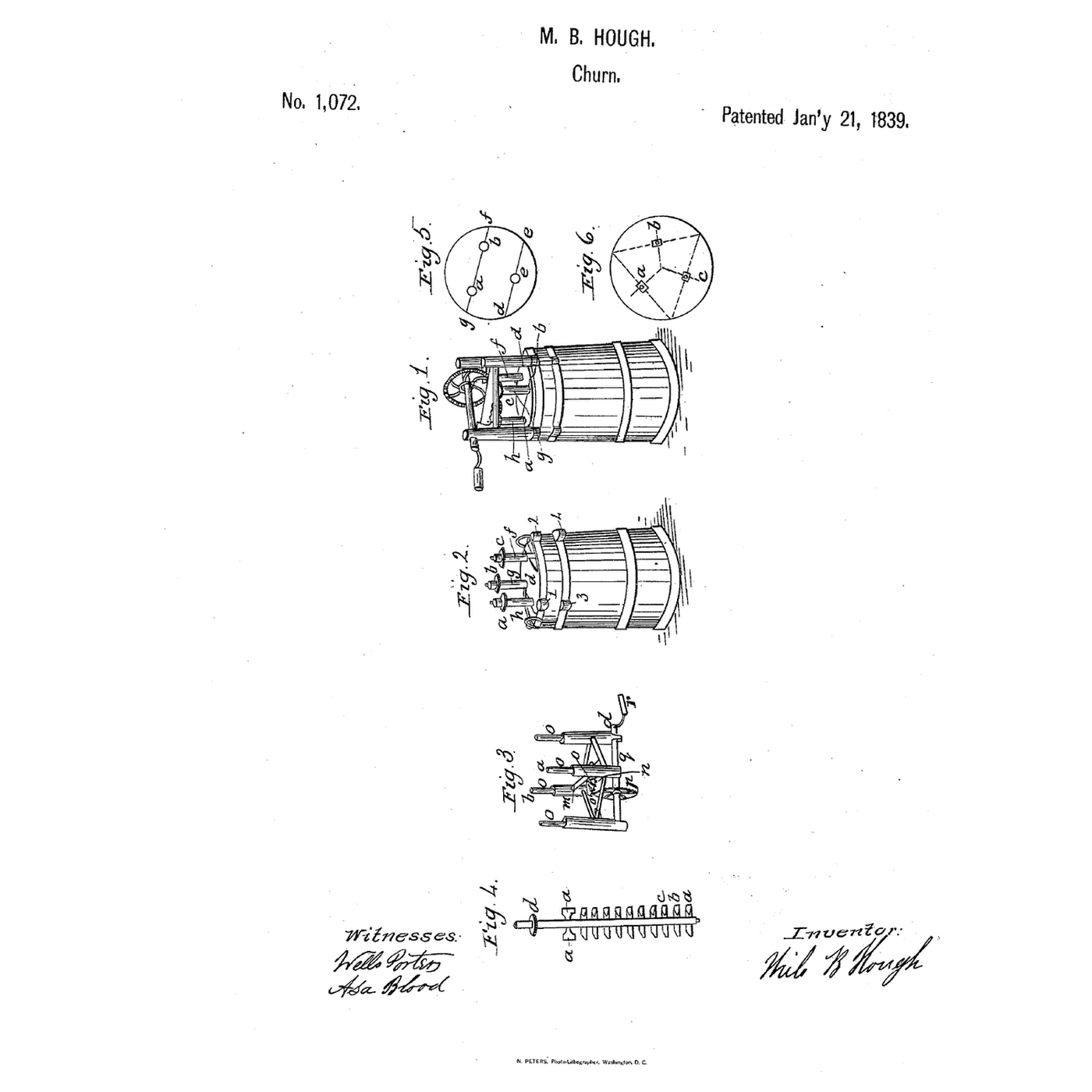
Three-Shaft Geared Churn: Fans Above, Screw-Form Beaters Below, One Crank
láti ọwọ́ TheChef
OÚNJẸ ÀTI OHUN MÍMU
19
0
0
0
0
0
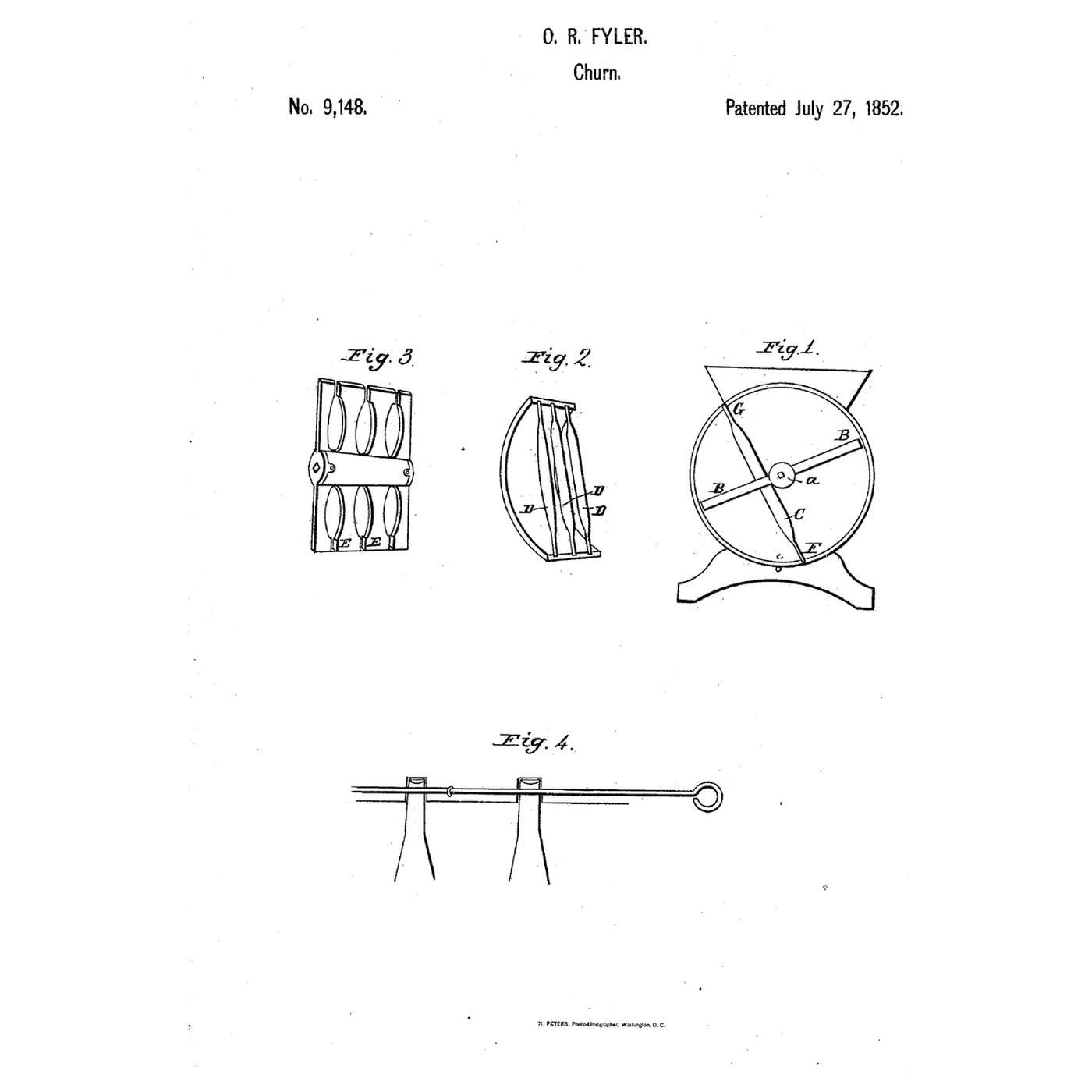
Post-and-Float Butter-Working Churn: Floats Revolving Astride Fixed Posts
láti ọwọ́ Woody
Iṣẹ́ Igi
24
0
0
0
0
0

Churning Butter from Cream — The 5,000-Year-Old Fat Separation
láti ọwọ́ TheChef
IṢẸ́ ỌWỌ́
49
0
0
0
0
0
CC0 Àgbègbè Gbogbogbò
Blueprint yìí ti jáde lábẹ́ CC0. O lè ṣe àdàkọ, yí padà, pín, àti lò láìsí ìyọ̀ǹda.
Ṣàtìlẹ́yìn Olùṣẹ́dá nípa rírà àwọn ọjà nipasẹ̀ Blueprint wọn Ẹ̀san Olùṣẹ́dá tí àwọn Olùtajà gbé kalẹ̀, tàbí ṣẹ̀dá àtúnṣe tuntun ti Blueprint yìí kí o sì fi sínú Blueprint rẹ gẹ́gẹ́ bí ìsopọ̀ láti pín owó-wíwọlé.