

Understanding the Antikythera Mechanism — The World's First Analog Computer
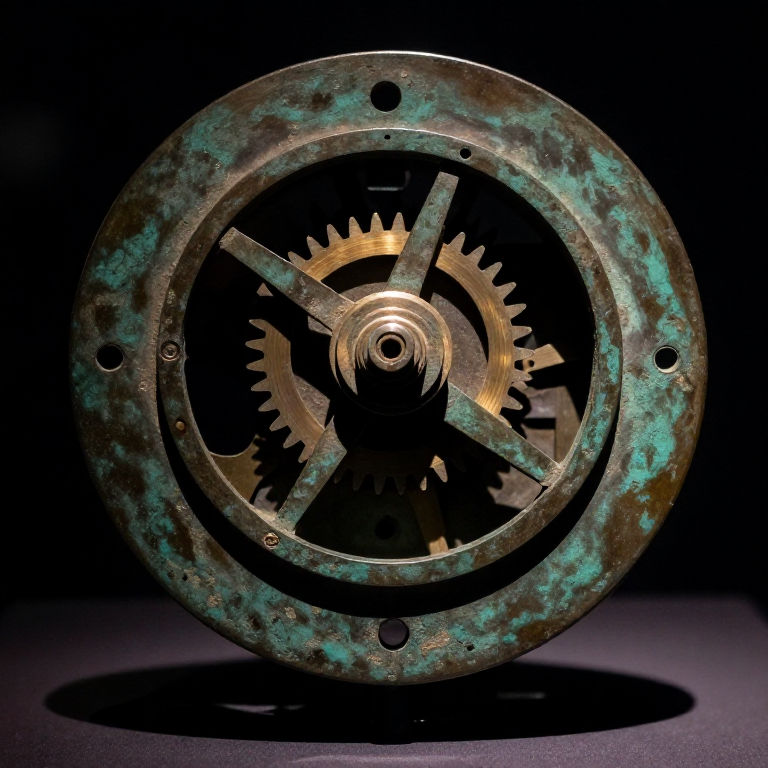
In 1900, a Greek sponge diver found the wreck of a Roman cargo ship off the island of Antikythera. Among the recovered artefacts was a corroded bronze lump that sat largely unexamined in the Athens National Archaeological Museum for decades until physicist Derek de Solla Price published the first rigorous analysis in 1959. What he found inside the corrosion had been built approximately 150–100 BCE: a hand-cranked geared bronze device containing at least 30 interlocking gears of extraordinary precision, capable of predicting solar and lunar eclipses, tracking the Metonic calendar cycle, calculating the positions of the five planets known in antiquity, and determining the dates of the four-yearly Panhellenic games (including the Olympics).
The Antikythera Mechanism is simultaneously the most sophisticated instrument surviving from antiquity and the earliest known example of a gear-driven computing machine — a category that would not re-emerge in European technology until the astronomical clocks of the 13th century, over 1,400 years later. Its discovery shattered the assumption that precision gearing was a medieval invention. The mechanism uses triangular-toothed bronze gears with module approximately 0.5 mm (gear module = pitch diameter / number of teeth) — a level of precision that would require a watchmaker's lathe to replicate today and remains unexplained given the tools available in the 1st century BCE Mediterranean.
This is a reference and study blueprint rather than a complete build guide — replicating the Antikythera Mechanism with period tools is at the extreme boundary of ancient craft capability and requires specialist metalworking beyond the scope of a single maker session. This blueprint documents the mechanism's architecture, gear train logic, and astronomical calculations to serve as a knowledge foundation for makers interested in mechanical computing, epicyclic gearing, and the history of precision instruments. The blueprint connects to the mathematical traditions (Pythagorean ratios, Babylonian eclipse cycles) that the mechanism encodes in bronze and gear teeth.
Ìlànà
The physical artefact — what survived and what was reconstructed
The physical artefact — what survived and what was reconstructed
The mechanism survived as 82 fragments (labelled A–G and 1–75 in the research literature), the largest being Fragment A, which contains the main drive wheel and several gear clusters. CT scanning (2005 and 2016 by the Antikythera Mechanism Research Project) revealed hidden inscriptions and gear teeth inside the corroded bronze layers that were invisible to surface examination. The inscriptions included an instruction manual in ancient Greek describing the dials and their functions, allowing researchers to identify what each gear cluster calculated even when the gears themselves were missing or fragmentary.
The reconstructed mechanism was approximately 33 cm × 18 cm × 9 cm — the size of a large shoebox — housed in a wooden case with two main display faces (front and back). The front face showed the solar and lunar positions in the Greek zodiac calendar. The back face had two large spiral dials: the upper showing the 19-year Metonic cycle (235 synodic months = 19 solar years, the cycle that synchronises solar and lunar calendars) and the lower showing the 18-year Saros eclipse prediction cycle (223 synodic months ≈ 18 years, after which solar and lunar eclipses repeat in the same pattern).
The gear train — counting teeth and understanding ratios
The gear train — counting teeth and understanding ratios
The main drive gear (b1) has 223 teeth and is connected to the hand crank. One full turn of b1 represents one synodic month (the period from one full moon to the next, approximately 29.53 days). The gear train then computes derived cycles through interlocking gear ratios. The Metonic cycle gears compute 235 months / 19 years through the ratio chain: b1(223) → b2(64) → c1(38) × e2(96) → e3(223) × e4(188) = 235 months output, using the intermediate gears to achieve the fractional ratio 235/19 through cascaded integer tooth counts that approximate it.
The genius of the mechanism's designers is that they expressed the irrational astronomical ratio 235/19 as a product of integer tooth counts on cascaded gears, each of which could be physically cut. The Saros cycle (223 months) appears directly in the b1 tooth count — 223 teeth on the main drive wheel means one turn of the input = one synodic month, and 223 turns = 223 synodic months = one Saros cycle. This is an elegant encoding: the fundamental astronomical period is literally built into the tooth count of the first gear.
The differential turntable — computing synodic periods mechanically
The differential turntable — computing synodic periods mechanically
The most sophisticated element of the Antikythera Mechanism is the differential turntable (gears e5–k1 in the modern reconstruction by Tony Freeth's team, published in Nature 2021). A differential gear takes two input rotations and produces an output that is the sum or difference of the two inputs — the same mechanism used in modern car differentials to allow the driven wheels to turn at different speeds on curves. In the Antikythera Mechanism, the differential is used to compute the synodic period of a planet (the time between successive alignments of the planet and the Sun as seen from Earth) by subtracting the planet's sidereal period from the solar period — the same calculation used in modern ephemeris tables.
The five-planet display (known from the inscription references but not fully physically recovered) used separate epicyclic gear trains for each planet, each computing the planet's synodic period through a different tooth-count ratio. Mercury (synodic period 115.88 days), Venus (583.92 days), Mars (779.94 days), Jupiter (398.88 days), and Saturn (378.09 days) each required a separate gear sub-system. The accuracy of the surviving gears, measured against known astronomical periods, shows errors of less than 1% — achieved with no measuring instruments beyond a dividing wheel and a hand-cut file.
Cutting triangular-tooth bronze gears — the foundational skill
Cutting triangular-tooth bronze gears — the foundational skill
The Antikythera gears use triangular teeth (equilateral triangular profile rather than the modern involute tooth form). Triangular teeth are simpler to cut — a file with a triangular cross-section driven along radial lines on the gear blank produces the correct tooth form in a single pass — but they mesh with more sliding friction and wear faster than involute teeth. For a gear of module 0.5 mm (the approximate scale of the Antikythera gears), each tooth is only 1.57 mm tall — requiring needle files and optical magnification to cut accurately. Period tools could not have achieved this miniaturisation: most reconstructors believe the actual mechanism was built at a larger scale than surviving fragments suggest and was subsequently corroded into a smaller apparent size, or that highly specialised hand tools (dividing plates, lapping jigs) were used that have not survived.
For a study model at approximately 5× the original scale (module 2.5 mm, tooth height 7.85 mm), triangular-tooth gears are achievable with standard files and a dividing head or geometric layout. Mark the gear blank with the required number of tooth spaces using a protractor or dividing plate (a disc with holes at precisely spaced angular positions). File each tooth space to a 60° V-profile. The resulting gears can demonstrate all the gear-ratio calculations of the original without requiring the lost precision of the ancient craftsmen.
Àwọn ohun èlò fún ìgbésẹ̀ yìí:
 Pẹlẹbẹ Bronse1 ẹyọ
Àwọn irinṣẹ́ tí a nílò:
 Òkúta Ọlọ
 Àkójọ Ìfá Kékeré
 Ẹ̀rọ Ìwọ̀n Igun
The Metonic cycle — encoding 19 years in bronze
The Metonic cycle — encoding 19 years in bronze
The Metonic cycle (named for the Greek astronomer Meton of Athens, ~432 BCE) is the observation that 235 synodic months = 19 solar years to within 2 hours accuracy — after exactly 19 years, the phases of the Moon recur on the same calendar dates. This cycle was known to Babylonian astronomers from at least the 5th century BCE (the Babylonian 'Saros cycle' is a related discovery) and was used to intercalate 13-month years into the 12-month lunar calendar to keep festivals aligned with seasons.
In the mechanism, the Metonic pointer completed one revolution of the 235-cell spiral dial in exactly 19 years of crank-turning. Each cell of the spiral corresponds to one synodic month. The cell labels (partially recovered from inscription fragments) identified months by name and indicated when a 13th intercalary month was to be added to keep the lunar and solar calendars synchronised. This was the instrument's primary practical function for its owners: a portable, reliable, mechanical calendar that computed when to add the intercalary month — a question of religious and civic importance throughout the Greek world, since festivals were lunar-calendar dated and their dates relative to planting seasons needed to be correct for agricultural planning.
The Saros eclipse prediction cycle — the lower back dial
The Saros eclipse prediction cycle — the lower back dial
The lower back spiral dial tracked the 223-month Saros cycle — the period after which solar and lunar eclipses repeat in the same sequence. Babylonian astronomers had tabulated eclipse occurrences over centuries and discovered that if a solar eclipse occurs today, another solar eclipse will occur approximately 18 years, 11 days later (223 synodic months later) at the same node of the Moon's orbit. The same applies to lunar eclipses. This allows forward prediction of eclipse dates without any understanding of orbital mechanics — pure pattern recognition applied to centuries of systematic observation.
The mechanism's eclipse-prediction cells (partially legible on Fragment 19) are labelled with glyphs indicating predicted eclipse type (solar or lunar), magnitude (partial or total), and time of day (important because a solar eclipse on the wrong side of Earth would be invisible at the observer's location). The level of astronomical knowledge encoded in this small spiral dial represents the synthesis of at least 200 years of Babylonian systematic eclipse recording, translated into Greek mathematical notation and then into a mechanical gear system — the first example of encoding a predictive scientific model into a physical computing machine.
The front zodiac dial and lunar anomaly
The front zodiac dial and lunar anomaly
The front main dial showed two concentric rings: an outer ring with the 12 months of the Egyptian calendar (365 days, 12 × 30-day months + 5 epagomenal days) and an inner ring with the 12 signs of the Greek/Babylonian zodiac (each 30° of the ecliptic). A Solar pointer moved one zodiac degree every day, completing the zodiac in one sidereal year. A Moon pointer moved approximately 13.18° per day, lapping the Sun pointer once per synodic month.
The Moon pointer was not driven by a simple gear ratio — the Moon's orbital speed varies by approximately ±6% due to the ellipticity of its orbit (it moves faster at perigee, the closest point to Earth, and slower at apogee). The mechanism's designer captured this variation using a pin-and-slot epicyclic mechanism (identified by Freeth in 2006): a small pin on an epicycle gear engages a slot in the output gear. As the epicycle rotates, the pin's radial position relative to the slot changes sinusoidally, causing the output gear to speed up and slow down by the correct ±6% to match the observed lunar anomaly. This is the first known mechanical representation of a sinusoidal function — implemented in bronze gears two millennia before trigonometric functions were formally defined.
Making a scale model of the main gear train
Making a scale model of the main gear train
To physically understand the mechanism, build a simplified 3-gear demonstration of the Metonic cycle ratio. The target ratio is 235:19 (synodic months to solar years). Approximate this with two gears: a 47-tooth drive gear meshing with a 4-tooth intermediate gear — ratio 47/4 = 11.75. Then the intermediate's second stage (on the same shaft) drives the output: 5-tooth gear driving a 20-tooth gear — ratio 5/20 = 1/4. Combined ratio = 11.75 / 4 = 2.9375. Two such stages combined: 2.9375² = 8.63 — not the Metonic cycle.
A better demonstration uses the actual Antikythera tooth counts at 5× scale: cut b1 with 223 teeth at module 2.5 mm (gear PCD = 223 × 2.5 / π ≈ 177 mm diameter), drive it at one revolution per synodic month (arbitrary time scale), and trace 235 revolutions of b1 against a calendar strip. At revolution 235 of b1, the calendar pointer returns to its starting position — exactly 19 years of the solar calendar have elapsed. This demonstration is physically compelling and takes approximately 4 hours to build with basic metalworking tools.
Àwọn irinṣẹ́ tí a nílò:
 Ọ̀kọ̀ Ìlùhò
Modern replicas and the maker's contribution
Modern replicas and the maker's contribution
Several teams have built physical replicas of the Antikythera Mechanism using modern machine tools: the Freeth-Jones replica (Science Museum, London, 2012), the Tatjana van Vark replica (Netherlands, hand-built over three years), and LEGO replicas. Each reveals different aspects of the mechanism's design: LEGO models demonstrate the gear topology but not the precision requirements; machined metal replicas demonstrate the precision but use CNC tools the ancient makers did not have; hand-built bronze replicas at reduced tooth count demonstrate the ancient craft challenge most faithfully.
The most productive maker contribution today is documentation — rigorous measurement, 3D modelling, and publication of the gear geometry from CT scan data, which the UCL Antikythera Research Team made partially open-access in 2021 with their paper 'A Model of the Cosmos in the ancient Greek Antikythera Mechanism' (Scientific Reports). Building from this published data at accessible scale requires only a milling machine, a rotary table, and 0.5 mm module gear cutters — equipment available in any well-equipped maker space. A 5× scale working replica of the main gear train is a realistic six-month project for an experienced machinist-maker.
What the mechanism reveals about ancient Greek science
What the mechanism reveals about ancient Greek science
The Antikythera Mechanism demonstrates that ancient Greek astronomy was far more mathematically sophisticated and empirically grounded than the surviving texts suggest. The gear ratios encode the Babylonian eclipse and planetary period data (which the Greeks adopted and refined), the Metonic and Callippic calendar cycles (Callippos refined the Metonic cycle to 940 months = 76 years, a ratio also found in the mechanism's gear counts), and the anomalistic month (the Moon's varying orbital speed) — three distinct sources of astronomical knowledge synthesised into a single mechanical system.
The mechanism also reveals that precision gear-cutting was a specialised artisan capability in the 1st century BCE Mediterranean — one that was lost with the decline of the institutions (the Mouseion, the great workshops of Alexandria and Corinth, the astronomical observatories of Hipparchus) that supported it. The technique was not rediscovered until al-Biruni's mechanical calendar computers in 11th century CE Persia and the astronomical clocks of medieval Europe, each invented independently from zero — not recovered from the ancient knowledge that was physically lying in the Aegean sea. The re-discovery of the Antikythera Mechanism teaches a sobering lesson about knowledge preservation: the most sophisticated technology of a civilisation can vanish completely, leaving only physical ruins and no living tradition of its use.
Astronomical accuracy — how close did it get?
Astronomical accuracy — how close did it get?
The Metonic cycle ratio of 235 synodic months to 19 solar years is accurate to approximately 2 hours per 19-year cycle — an error of 0.0006%. The Saros eclipse cycle (223 months) is accurate to approximately 51 minutes per 18-year cycle. The mechanism's gear ratios were designed to match these observed periods, not to compute them from first principles — the designers were engineers, not theorists. They were given the empirical periods (measured by Babylonian astronomers over centuries of systematic recording) and tasked with building gears whose rotation ratios matched those periods as closely as possible with integer tooth counts.
The resulting errors in gear-based approximation of the true astronomical periods are surprisingly small: the Metonic gear train (235 teeth on the output wheel for 19 input turns) is exact by definition — no approximation needed. The Saros gear train accumulates approximately 0.01 days of error per cycle, meaning after 10 Saros cycles (180 years) the mechanism's eclipse predictions would be off by only a quarter of a day — accurate enough for practical use within a human lifetime. This combination of observational accuracy (Babylonian), mathematical synthesis (Greek), and engineering implementation (unknown craftsmen) represents one of the most remarkable convergences in the history of science.
The lost knowledge and open research questions
The lost knowledge and open research questions
Despite 120 years of study and the most advanced imaging technology available, significant questions about the Antikythera Mechanism remain unanswered. Who built it? The construction quality matches the best known Rhodian metalwork of the period (Rhodes was a major centre of Greek astronomical and mechanical expertise around 150 BCE), and Cicero mentions having seen a similar device made by Posidonius of Apamea (who worked in Rhodes) — but no maker's name survives on the mechanism itself. How was the front planetary display constructed? The 2021 UCL reconstruction proposes an upper front dial of five planetary pointers, but the physical gears for four of the five planets are missing, and the reconstruction remains partially conjectural.
Most importantly: were other devices like it built, and where are they? The Antikythera Mechanism was found in a cargo ship — it was being transported, not built on the ship. It may have been one of several produced by the same workshop, bound for a customer in Rome. The surviving copies of these instruments (if any exist) may still be in private collections, unrecognised for what they are, or may have been melted for their bronze in some later century's metal shortage. The open research question is not whether ancient Greek precision gearing existed — we have the proof in hand — but why it did not spread and compound into an earlier industrial revolution. That question belongs to economic history rather than mechanical engineering.
Àwọn ohun-èlò
1- 1 ẹyọÀyè
Àwọn irinṣẹ́ tó nílò
4- Àyè
- Àyè
Àwọn Ohun Èlò Ìtọ́nisọ́nà Tí A So Pọ̀

Blueprint tó jọra
Àwọn blueprint wọ̀nyí pín ìmọ̀ — ọ̀nà, ohun-èlò tàbí ìlànà


CC0 Àgbègbè Gbogbogbò
Blueprint yìí ti jáde lábẹ́ CC0. O lè ṣe àdàkọ, yí padà, pín, àti lò láìsí ìyọ̀ǹda.
Ṣàtìlẹ́yìn Olùṣẹ́dá nípa rírà àwọn ọjà nipasẹ̀ Blueprint wọn Ẹ̀san Olùṣẹ́dá tí àwọn Olùtajà gbé kalẹ̀, tàbí ṣẹ̀dá àtúnṣe tuntun ti Blueprint yìí kí o sì fi sínú Blueprint rẹ gẹ́gẹ́ bí ìsopọ̀ láti pín owó-wíwọlé.