IṢẸ́ ỌNÀ
ẸWÀ ÀTI ÌLERA
IṢẸ́ ỌWỌ́
ÀṢÀ ÀTI ÌTÀN
ÌṢERÉ
ÀYÍKÁ
OÚNJẸ ÀTI OHUN MÍMU
REVERSE ENGINEERING
SÁYẸ́ǸSÌ
ERÉ ÌDÁRAYÁ
ÌMỌ̀-Ẹ̀RỌ
ÀWỌN OHUN WÍWỌ̀
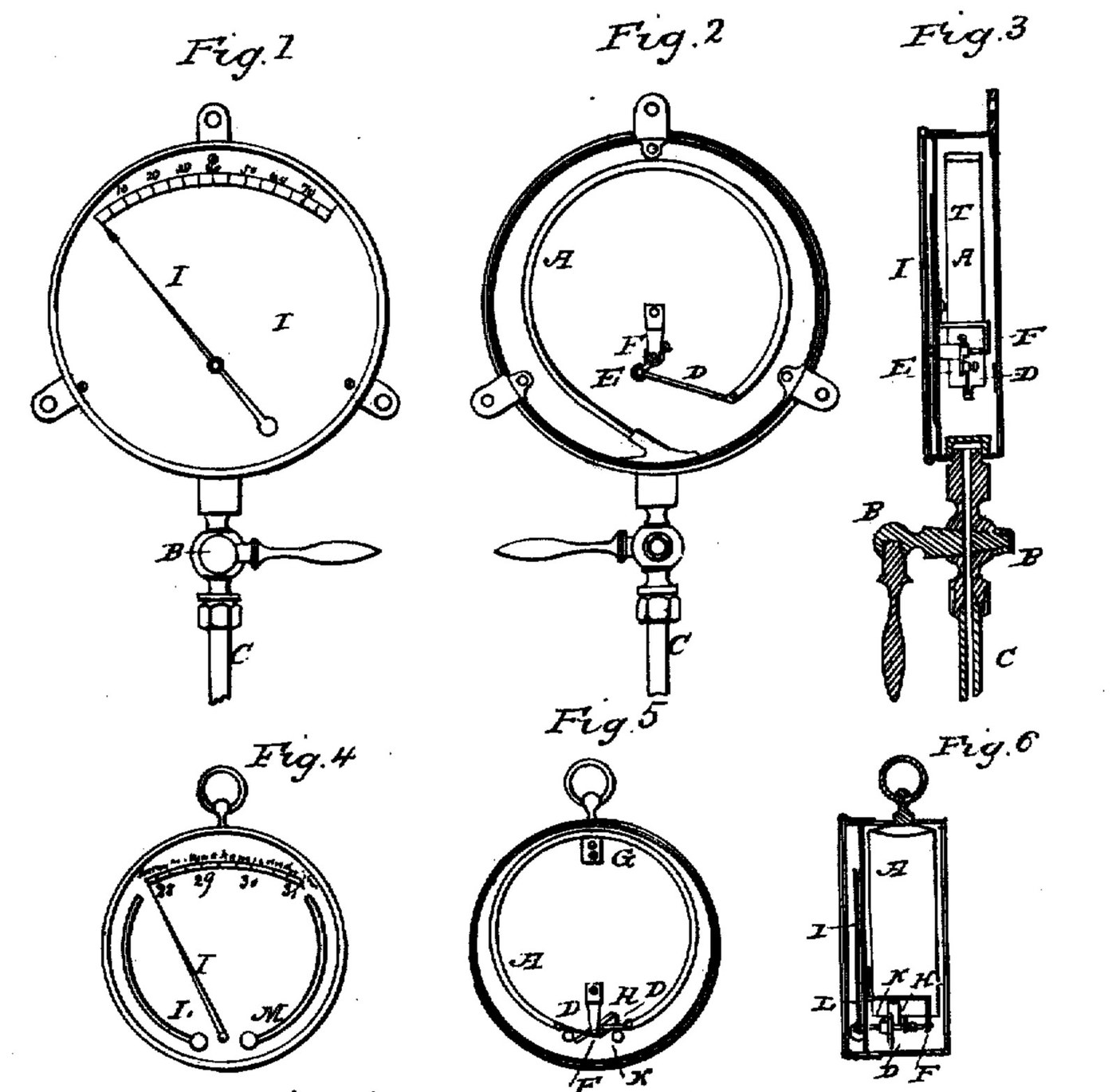


Vacuum Gauge: Flattened Curved Tube Driving an Index (Bourdon, US 9,163)
A vacuum gauge shows how far a line or vessel has been pumped below atmospheric pressure. Eugène Bourdon (US 9,163, 1852) found that a thin metal tube, flattened and bent into a curve, straightens a little under internal pressure and curls up more when the air is drawn out of it.
One end is open to the line through a cock; the closed end drives a lever on a spindle that carries the index. With the air withdrawn the index moves the opposite way to a pressure gauge, "and the instrument is then a vacuum gage."
Source: E. Bourdon, "Pressure-Gage", US Patent 9,163 (1852). Picture: its Figs. 1-6.
Ilọsíwájú
Unknown
Ìlànà
1
1
Read Bourdon
Read Bourdon
"If the air be withdrawn from the interior of the tube A by means of an air pump or otherwise the curvature of the tube is increased and the index moves in the opposite direction and the instrument is then a vacuum gage."
2
2
Make the tube
Make the tube
Flatten a thin metal tube so its section is no longer round (Bourdon draws oval, flat, cross and Y sections) and bend it into a near circle. Close one end (how is not given) and leave the other open. Bourdon: the wall depends on the size, motion, pressure and metal; his only figure is brass about 1/100 in. thick for a barometer about 4 in. across. The metal, wall and size for the vacuum gauge are not given.
Àwọn ohun èlò fún ìgbésẹ̀ yìí:
 Irin tí a kò mọ̀1 tube
Àwọn irinṣẹ́ tí a nílò:
 Ọ̀nà ìṣẹ̀dá àìmọ̀
 Ìwọ̀n tí a kò mọ̀
3
3
Fit the movement
Fit the movement
Fix the open end of the tube in the case, connected through a cock to a pipe to the line or vessel. Join the closed end by a link to a short lever on a small spindle that carries the index (or drive the spindle by a toothed sector and pinion, or by a silk thread wound round it and kept tight by a spring). The lever multiplies the tube's movement at the index.
Àwọn ohun èlò fún ìgbésẹ̀ yìí:
 Fáàfù àìmọ̀1 cockIrin tí a kò mọ̀1 link, lever, spindle and indexIrin tí a kò mọ̀1 case
Àwọn irinṣẹ́ tí a nílò:
 Ẹ̀rọ Ìlùkòkò Onídúró
 Àkójọ Orí Ìlùkòkò
 Àwọn Ìfá (Ìfá Ọwọ́)
4
4
Graduate the dial
Graduate the dial
Fit a dial behind the index. Bourdon graduates the arc by submitting the instrument to known pressures alongside an ordinary mercury gauge and marking each on the dial; equal steps of pressure give nearly equal degrees. Connect the gauge to a pump drawing the air out: the tube curls more and the index moves the opposite way to a pressure gauge. The reference used to mark a vacuum scale is not given.
Àwọn ohun èlò fún ìgbésẹ̀ yìí:
 Ohun èlò tí a kò mọ̀1 dial
Àwọn irinṣẹ́ tí a nílò:
 Ẹ̀rọ ìfàfẹ́fẹ́jáde
Àwọn ohun-èlò
3- 1 caseÀyè
- 1 cockÀyè
- 1 dialÀyè
Àwọn irinṣẹ́ tó nílò
6- 1 vendor sell this, none ship to you yetÀyè
Ìtọ́nisọ́nà yìí ń ṣe
CC0 Àgbègbè Gbogbogbò
Blueprint yìí ti jáde lábẹ́ CC0. O lè ṣe àdàkọ, yí padà, pín, àti lò láìsí ìyọ̀ǹda.
Ṣàtìlẹ́yìn Olùṣẹ́dá nípa rírà àwọn ọjà nipasẹ̀ Blueprint wọn Ẹ̀san Olùṣẹ́dá tí àwọn Olùtajà gbé kalẹ̀, tàbí ṣẹ̀dá àtúnṣe tuntun ti Blueprint yìí kí o sì fi sínú Blueprint rẹ gẹ́gẹ́ bí ìsopọ̀ láti pín owó-wíwọlé.