

ART
BEAUTY & WELLNESS
CRAFT
CULTURE & HISTORY
ENTERTAINMENT
ENVIRONMENT
FOOD & DRINKS
GREEN FUTURE
REVERSE ENGINEERING
SCIENCES
SPORTS
TECHNOLOGY
WEARABLES
Mica Collection Jharkhand — Extracting Muscovite Mica Sheets from Mines
English
DidiiKamal

Created by

DidiiKamal

23. April 2026IN
0
0
0
0
0

Mica Collection Jharkhand — Extracting Muscovite Mica Sheets from Mines

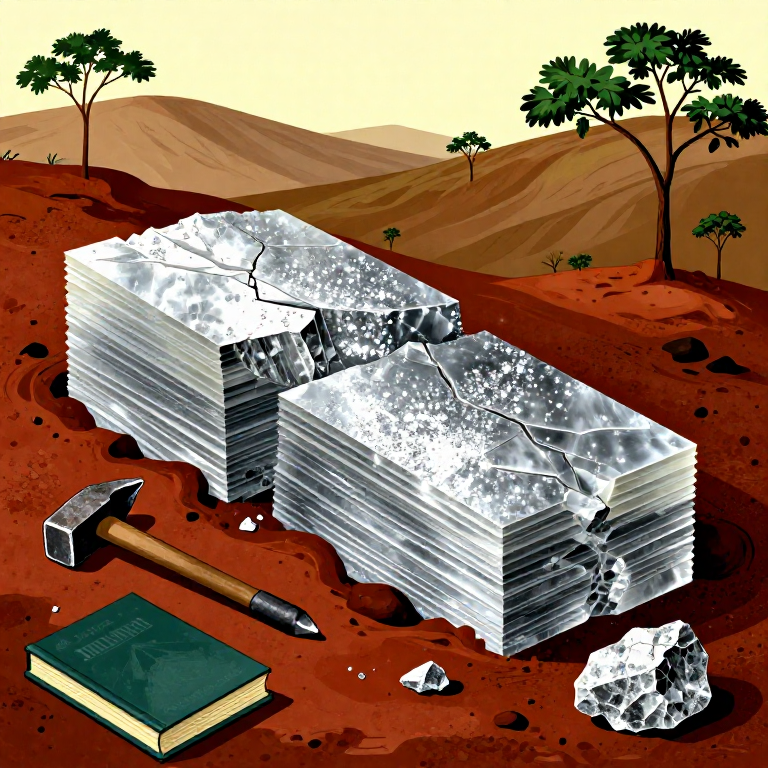
Traditional method of collecting muscovite mica from the mica belt of Jharkhand and Bihar. India produces approximately 60% of the world's sheet mica, with the Koderma-Giridih-Hazaribagh belt being the most prominent. Mica is found in pegmatite rocks which are formed from granite. This blueprint covers the identification of mica-rich veins, surface collection, extraction from shallow mines, dividing books into sheets, cleaning, classification by size, quality inspection, and packaging.

Intermediate
1-2 days per site

Instructions

1

Understanding the Mica Mineral

Mica is a silicate mineral group found in layered structures. Muscovite (KAl2(AlSi3O10)(OH)2) is the most common and commercially important mica. Its hardness on the Mohs scale is 2-2.5. Muscovite is transparent to translucent, colorless to light yellow. Its most distinctive property is basal cleavage — it splits easily into thin, flexible sheets. Mica is a poor conductor of electricity and heat, can withstand temperatures up to 800 degrees Celsius, and is therefore used in electrical equipment, insulation, and cosmetics. The mica belt of Jharkhand-Bihar is approximately 150 km long and 30 km wide.
2

Identifying Pegmatite Veins

Mica is found in pegmatite rocks — these are coarse-grained igneous rocks formed by the slow cooling of granitic magma. Pegmatite veins are clearly distinct from surrounding rocks — they contain large crystals of quartz (white), feldspar (pink-white), and mica (bright silvery). In the districts of Koderma, Giridih, and Hazaribagh, pegmatite veins generally run in a north-south direction and can be 5-50 meters wide. Identifying mica-rich pegmatite: shiny mica flakes are scattered on the surface and large silvery books are visible in the rock.

Materials for this step:

Geological Survey Map (Koderma-Giridih region)Geological Survey Map (Koderma-Giridih region)1 set

Tools needed:

Hand Lens (10x magnification)Hand Lens (10x magnification)
Geological HammerGeological Hammer
3

Site Survey and Preparation for Mining

Upon reaching the potential mining site, first inspect the surface. Note the direction, width, and slope of the pegmatite vein. Estimate the thickness of the overburden — if it exceeds 3 meters, a shallow mine will need to be excavated. Check the size and quality of mica fragments scattered on the surface — if surface pieces are large and clean, there is a higher probability of good quality below. Clear the work area — remove bushes, grass, and loose rocks. Set up a shaded area for tools and water.

Materials for this step:

Drinking WaterDrinking Water5 liters
Tarpaulin Sheet (3m x 3m)Tarpaulin Sheet (3m x 3m)1 piece

Tools needed:

MacheteMachete
Measuring Tape (30m)Measuring Tape (30m)
Notebook and PencilNotebook and Pencil
4

Surface Collection

Mica books and fragments are found scattered in the soil above and around the pegmatite vein — these have separated from the rock through weathering. In surface collection, mica is extracted by digging the upper soil by hand or with a small pickaxe. The most scattered fragments are found in the upper 30-60 cm of soil. Pick up each piece carefully — mica is soft and can break with careless handling. Place collected mica in bamboo baskets without letting pieces press against each other. Surface mica is typically small in size (2-5 cm) and mixed in quality.

Materials for this step:

Bamboo Collection BasketBamboo Collection Basket2 pieces

Tools needed:

Pickaxe (small)Pickaxe (small)
Hand TrowelHand Trowel
Work Gloves (cotton)
5

Extracting Mica from a Shallow Mine

Larger and higher-quality mica books must be extracted from within the rock. Break the rock along the pegmatite vein using a chisel and hammer. Mica books are typically lodged in pockets between quartz and feldspar — finding these pockets is the key skill. When a mica pocket is found, carefully remove the rock around it — never strike the hammer directly on the mica as it will shatter. Insert the chisel into the crack between the mica and surrounding rock and gradually separate them. Good pockets can yield mica books 15-30 cm in diameter, sometimes up to 60 cm.

Tools needed:

Cold Chisel (flat, 25mm)Cold Chisel (flat, 25mm)
Cold Chisel (pointed)Cold Chisel (pointed)
Sledgehammer (3 kg)Sledgehammer (3 kg)
Hand Hammer (1 kg)Hand Hammer (1 kg)
Safety GogglesSafety Goggles
6

Freeing Mica Books from the Rock

When the mica book has been loosened on all sides, carefully extract it. Hold it with both hands and gently rock it out — do not jerk. If the book is still attached on one side, cut that joint with a thin chisel. Large books (bigger than 20 cm) are very valuable — do not break them under any circumstances. Place extracted books on flat ground on a soft surface (sack or cloth). A mica book is an accumulation of hundreds of thin sheets — a thick book can contain 50-300 leaves. Also collect small fragments stuck to the rock — these are useful too.

Materials for this step:

Jute SackJute Sack2 pieces
Cotton Cloth SheetCotton Cloth Sheet1 piece

Tools needed:

Thin Flat Chisel (10mm)Thin Flat Chisel (10mm)
Hand Hammer (500g)Hand Hammer (500g)
7

Splitting Books into Sheets

Splitting a mica book into sheets (films) is a skilled task. Place the book on a flat surface. Using the tip of a thin knife or needle at the edge, find the cleavage plane between two layers. The basal cleavage of mica is so perfect that layers separate with almost no resistance. Gradually advance the knife tip and lift the layer. Sheets can be split as thin as 0.025 mm (25 microns). For commercial use, classification is by thickness: thin (0.018-0.05 mm) is the most valuable. Perform splitting in a calm, patient environment — thin sheets can blow away in the wind.

Tools needed:

Splitting Knife (thin blade)Splitting Knife (thin blade)
Sewing Needle (large)Sewing Needle (large)
Flat Work TableFlat Work Table
8

Cleaning the Mica Sheets

Split sheets may have soil, dust, and particles of other minerals adhering to them. Gently wipe clean with a dry soft cloth. If there is stubborn dirt, soak in lukewarm water and clean with a soft brush — mica is not damaged by water. After cleaning, dry the sheets in shade — direct sunlight can cause sheets to curl. Trim away crusts of other minerals (quartz, feldspar) stuck to the edges using scissors. Clean, transparent sheets are the most valuable.

Materials for this step:

Clean WaterClean Water5 liters
Soft Cotton ClothSoft Cotton Cloth2 pieces

Tools needed:

Soft Bristle BrushSoft Bristle Brush
Tin Snips (straight blade)Tin Snips (straight blade)
9

Trimming — Cutting Sheets to Shape

Natural mica sheets are irregular in shape and edges may be jagged or torn. For commercial use, they are cut into regular shapes (rectangular) — this is called trimming. Place the sheet on a flat surface and cut away defective edges, cracks, and areas with mineral inclusions using scissors. Try to preserve the maximum possible rectangular area — larger area equals higher value. Do not discard the small cut pieces (scrap mica) — these are ground into mica powder. According to the Bureau of Indian Standards (BIS), the minimum size for trimmed mica is 2.5 cm x 2.5 cm.

Tools needed:

Tin Snips (straight blade)Tin Snips (straight blade)
Steel Ruler (30cm)Steel Ruler (30cm)
Flat Work TableFlat Work Table
10

Size Grading

Trimmed mica sheets are graded by area. The Indian mica industry standard classification: OEEM (Special) — over 103 sq cm (most valuable, rare), No. 1 — 64-103 sq cm, No. 2 — 42-64 sq cm, No. 3 — 23-42 sq cm, No. 4 — 13-23 sq cm, No. 5 — 6.5-13 sq cm, No. 5 1/2 — 3.2-6.5 sq cm, No. 6 — 2.5-3.2 sq cm (smallest commercial size). Measure each sheet and place it in the appropriate grade pile. Grades OEEM and No. 1 are extremely valuable — a single large sheet can be worth more than hundreds of small ones.

Tools needed:

Steel Ruler (30cm)Steel Ruler (30cm)
Grading Template (cardboard cutouts)Grading Template (cardboard cutouts)
11

Quality Inspection

After size grading, quality inspection of each sheet is essential. Quality criteria: transparency — hold the sheet against light, clean and transparent sheets are the best. Color — colorless (clear ruby muscovite) is most valuable, then light green, then brown. Defects — cracks, air bubbles, mineral inclusions (such as black spots from biotite and tourmaline), and waviness — all reduce the grade. Indian quality classification: V1 (clear, stain-free, flat) is the highest, V4 (heavily stained, buckled) is the lowest.

Tools needed:

Hand Lens (10x magnification)Hand Lens (10x magnification)
Light Box (inspection)Light Box (inspection)
12

Weighing and Record-Keeping

Weigh the mica separately for each grade and quality category. The value of mica is determined by a combination of size, quality, and weight — large, clean sheets are worth many times more per kilogram. Keep detailed records for each batch: mining site, date, grade, quality category (V1-V4), weight, and estimated number of sheets. On average, a day of hand-mining yields 5-15 kilograms of raw mica, of which 40-60% remains as usable sheets after trimming.

Materials for this step:

Record NotebookRecord Notebook1 piece

Tools needed:

Weighing Scale (digital, 0-50 kg)Weighing Scale (digital, 0-50 kg)
13

Packaging and Storage

Mica sheets are extremely fragile — they will break during transport without proper packaging. Make separate bundles for each grade. Stack sheets flat on top of each other with layers of soft paper in between. Place the bundle between thick cardboard pieces and tie with cotton cloth strips. Place large bundles in wooden crates, packing the edges with newspaper to prevent the sheets from shifting. Pack scrap mica (small pieces and shavings) in separate sacks — these are sold to powder-making units. The storage area must be dry and well-ventilated — moisture can cause mica sheets to delaminate.

Materials for this step:

Tissue Paper (acid-free)Tissue Paper (acid-free)50 sheets
Corrugated Cardboard SheetCorrugated Cardboard Sheet10 pieces
Cotton Binding StripCotton Binding Strip5 meters
Wooden Packing CrateWooden Packing Crate1 piece
Newspaper (padding)Newspaper (padding)2 kg
Jute Sack (for scrap mica)Jute Sack (for scrap mica)3 pieces
14

Safety Precautions and Environmental Protection

Safety is extremely important in mica mining. Always install supports in shallow mines — unsupported mines risk collapse. Wear safety goggles when breaking rock — stone fragments can fly and injure eyes. Prolonged exposure to silica dust (from quartz) can cause silicosis — always wear a mask during dusty work. Child labor has been a serious issue in mica mining in India — only adult workers should perform mining operations. After mining, level the mine area and replant vegetation. Keep mica waste rock in organized piles, away from water sources.

Materials for this step:

Dust Mask (N95 rated)2 pieces
Safety GogglesSafety Goggles1 piece
Hard HatHard Hat1 piece

Materials

18

Tools Required

24

CC0 Public Domain

This blueprint is released under CC0. You are free to copy, modify, distribute, and use this work for any purpose, without asking permission.

Support the Maker by purchasing products through their Blueprint where they earn a Maker Commission set by Vendors, or create a new iteration of this Blueprint and include it as a connection in your own Blueprint to share revenue.

Discussion

(0)

Log in to join the discussion

Loading comments...