
Saffron Harvest in Khorasan — From Field to Drying and Grading
Instructions
Identification of Saffron Plant
Identification of Saffron Plant
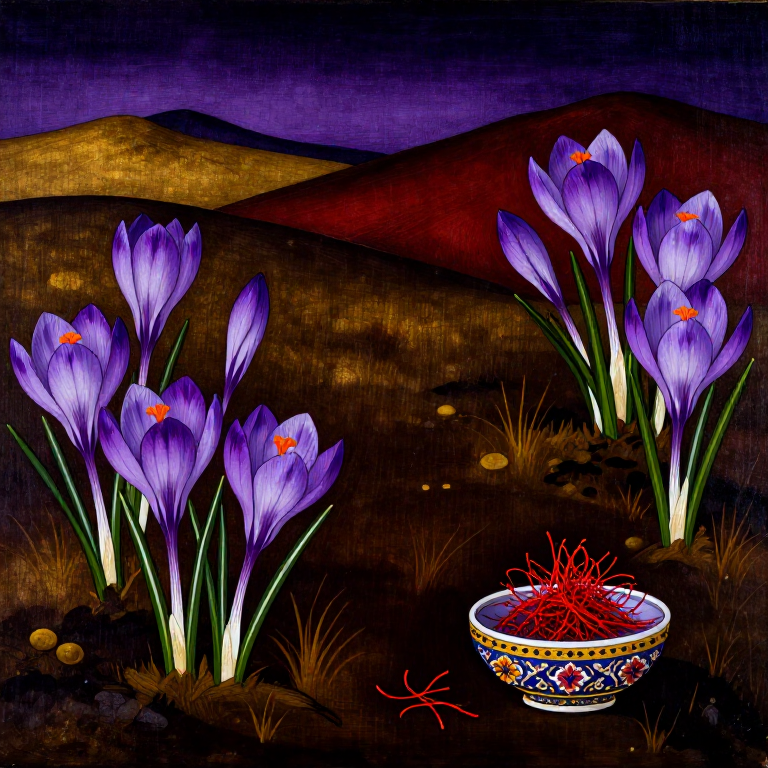
Saffron is obtained from the flower of the plant Crocus sativus. This plant is a perennial bulbous plant from the Iridaceae family. Each bulb (corm) produces 1 to 3 purple flowers in autumn. Each flower has exactly 3 red-colored stigmas (stigma) which is the commercial saffron. To produce 1 kilogram of dried saffron, approximately 150,000 to 200,000 flowers are needed.
Identify the harvest time
Identify the harvest time
Prepare harvesting tools
Prepare harvesting tools
Tools needed:
 Wicker Harvesting Baskets
 Damp Cloth Cover
Pick the flowers at dawn
Pick the flowers at dawn
Materials for this step:
 Fresh Saffron Flowers (Crocus sativus)500 flowers
Tools needed:
Wicker Harvesting BasketQuickly transport flowers to the processing site
Quickly transport flowers to the processing site
Tools needed:
Damp Cloth Cover Clean Processing Area
Open the petals
Open the petals
Separate the stigmas
Separate the stigmas
Tools needed:
 Clean Flat Tray
 Tweezers (optional)
Initial classification of saffron threads
Initial classification of saffron threads
Separate the saffron threads based on length and color. Complete dark red threads (without yellow section) have the highest quality and are called "Sargol" or Negin. Threads that have a slightly yellow section are called "Pushal". Broken or crushed filaments should be kept separately. This classification has a significant impact on the final price.
Tools needed:
 Sorting Trays
Dry the stigmas — traditional Iranian method
Dry the stigmas — traditional Iranian method
Materials for this step:
 Fresh Saffron Stigmas1 batch
Tools needed:
 Fine Metal Mesh Screen
 Heat Source
 Thermometer
Quality assessment of drying
Quality assessment of drying
Dried saffron should be brittle and break with finger pressure — not bend. The color should be dark red with a brownish tint. If the saffron threads are still flexible, they should be dried longer. The weight of saffron after drying will be approximately 20 percent of its fresh weight (a ratio of 5 to 1 fresh to dry weight). The smell of dried saffron should be fragrant and mild.
Final grading of saffron
Final grading of saffron
Tools needed:
Sorting Trays Precision Scale (0.01g)
Saffron Authenticity Test
Saffron Authenticity Test
Place a few saffron threads in cold water. Authentic saffron slowly (10 to 15 minutes) releases a golden yellow color and the threads remain red. Counterfeit saffron immediately releases red color and the threads become colorless. Also, rub it between wet fingers — authentic saffron gives a golden yellow color, not red.
Materials for this step:
Tools needed:
 Small Glass Bowl
Package the saffron
Package the saffron
Materials for this step:
 Dark Glass Jars with Airtight Lids5 pieces
 Labels5 pieces
Proper saffron storage
Proper saffron storage
Tools needed:
 Cool Dark Storage Area
Calculate yield and record information
Calculate yield and record information
Typical yield: approximately 1 kilogram of dry saffron is obtained from every 150,000 flowers. Each hectare of land (with a density of 50 corms per square meter) produces approximately 3 to 5 kilograms of dry saffron. Record the final weight, number of flowers, harvest date, and climatic conditions. This information is essential for improving the harvest in subsequent years.
Tools needed:
 Field NotebookPrecision Scale (0.01g)
Materials
5- 500 flowersPlaceholder
- 1 batchPlaceholder
- Placeholder
- 5 piecesPlaceholder
Tools Required
14- Placeholder
- Placeholder
- Placeholder
- Placeholder
- Placeholder
- Placeholder
- Placeholder
- Placeholder
- Placeholder
- Placeholder
- Placeholder
- Placeholder
- Placeholder
CC0 Public Domain
This blueprint is released under CC0. You are free to copy, modify, distribute, and use this work for any purpose, without asking permission.
Support the Maker by purchasing products through their Blueprint where they earn a Maker Commission set by Vendors, or create a new iteration of this Blueprint and include it as a connection in your own Blueprint to share revenue.