
ART
BEAUTY & WELLNESS
CRAFT
CULTURE & HISTORY
ENTERTAINMENT
ENVIRONMENT
FOOD & DRINKS
GREEN FUTURE
REVERSE ENGINEERING
SCIENCES
SPORTS
TECHNOLOGY
WEARABLES
Extracting Molybdenum from Molybdenite — The Slippery Lead That Strengthens Steel
English
Peter

Created by

Peter

01. May 2026SE
0
0
0
0
0

Extracting Molybdenum from Molybdenite — The Slippery Lead That Strengthens Steel

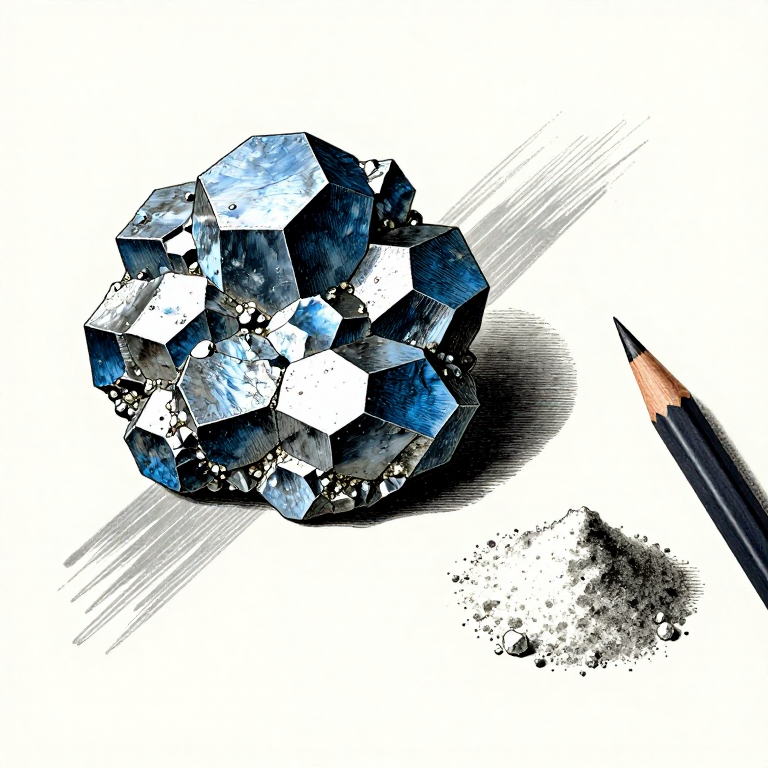
Molybdenum (Mo, element 42) was confused with lead and graphite for centuries. Its primary ore, molybdenite (MoS₂), is a soft, grey, slippery mineral that looks and feels almost identical to graphite — both leave dark marks on paper, both have a greasy feel, and both occur as grey metallic flakes. The name molybdenum comes from the Greek molybdos ('lead'), reflecting this ancient confusion. It was Carl Wilhelm Scheele who first distinguished molybdenite from graphite in 1778 by treating it with nitric acid and observing a white residite (molybdic acid, H₂MoO₄) that graphite did not produce.

Peter Jacob Hjelm, working at Scheele's suggestion, first isolated metallic molybdenum in 1781 by reducing molybdic acid with carbon. The metal was impure (contaminated with molybdenum carbide and oxide), and truly pure molybdenum was not produced until 1893 when Henri Moissan used an electric furnace.

Molybdenite (MoS₂) contains 60% molybdenum by mass. It has a layered crystal structure identical in principle to graphite — sheets of molybdenum atoms sandwiched between sheets of sulfur atoms, with weak van der Waals forces between the layers. This explains its slipperiness and its use as a solid lubricant (molybdenum disulfide grease). The extraction involves roasting to molybdenum trioxide (MoO₃) followed by carbon reduction.

HAZARD: Roasting molybdenite produces sulfur dioxide (SO₂), a toxic, choking gas. Molybdenum trioxide (MoO₃) dust is irritating to mucous membranes and causes a condition called molybdenosis in livestock grazing on molybdenum-rich soils. Use respiratory protection throughout. Work outdoors during roasting.

Advanced
5-7 hours

Instructions

1

Understand molybdenum chemistry and its critical role in steel

Molybdenum (Mo, element 42) is a silvery-white, hard transition metal with a density of 10.28 g/cm³, melting point of 2623 °C (sixth highest of all elements), and Mohs hardness of 5.5. It is in Group 6 alongside chromium and tungsten, and shares many properties with tungsten: high melting point, high strength at elevated temperatures, and exceptional resistance to thermal and mechanical stress.

Molybdenum's most important application is in high-strength, low-alloy (HSLA) steels. Adding just 0.25–1% molybdenum to steel dramatically increases its hardenability, high-temperature strength, and corrosion resistance. Molybdenum-bearing steels are used in pressure vessels, oil and gas pipelines, automotive components, and structural applications. Approximately 80% of all molybdenum produced goes into steel and iron alloys.

Molybdenum is also biologically essential — it is the heaviest element known to be required by most living organisms. The enzyme nitrogenase, which fixes atmospheric nitrogen into ammonia in legume root nodules, uses a molybdenum-iron cofactor (FeMo-co) at its active site. Without molybdenum, biological nitrogen fixation — and therefore most natural plant nutrition — would not function. Molybdenum is a trace nutrient in soils, and molybdenum deficiency causes crop failure in certain acidic soils worldwide.

2

Identify molybdenite and distinguish it from graphite

Molybdenite (MoS₂) forms soft, flexible, metallic grey flakes and plates with a distinctive bluish-silver luster — slightly more silvery-blue than graphite's grey-black. Key identification features: Mohs hardness 1–1.5 (extremely soft — softer than a fingernail), specific gravity 4.7–4.8 (significantly heavier than graphite at 2.1–2.3), perfect basal cleavage producing thin, flexible flakes, and a greenish-grey streak on paper (graphite's streak is more purely black-grey).

The density difference is the most reliable field distinction between molybdenite and graphite. Pick up a specimen of each — molybdenite feels noticeably heavier for its size. The bluish tinge of molybdenite's luster (compared to graphite's more neutral grey) is subtle but visible with practice. Under a hand lens, molybdenite flakes often show a more metallic, reflective quality than graphite.

Molybdenite occurs in high-temperature hydrothermal veins and porphyry deposits, typically associated with copper, tungsten, and tin mineralization. Major deposits include Climax and Henderson (Colorado, USA — among the largest molybdenum deposits on Earth), Endako (British Columbia, Canada), and numerous porphyry copper-molybdenum deposits in Chile. Many of the world's large copper mines produce molybdenite as a byproduct.

Tools needed:

Geological HammerGeological Hammer
Hand Lens (10x)Hand Lens (10x)
Streak Plate (unglazed porcelain)Streak Plate (unglazed porcelain)
3

Prepare the molybdenite concentrate

Molybdenite is so soft (Mohs 1–1.5) that it requires almost no crushing — it flakes apart with finger pressure. Separate molybdenite flakes from the host rock (typically quartz or granite) by gently breaking specimens and peeling away the grey, metallic flakes. Molybdenite often occurs as concentrated pockets or veins of nearly pure MoS₂ within quartz — these can be extracted cleanly.

Collect the flakes into a pile and weigh. You need 200–400 grams of relatively pure molybdenite. The material should be predominantly grey, metallic flakes with minimal quartz contamination. Because molybdenite is hydrophobic (water-repelling) — a property exploited in industrial froth flotation — it tends not to stick to wet surfaces, which can be used to advantage during sorting.

Wear gloves during handling. Molybdenite is not acutely toxic, but the fine flakes coat everything they touch with a grey metallic film, and the dust should not be inhaled. The slippery, greasy feel of molybdenite on your gloved fingers is identical to graphite — this is the property that caused centuries of confusion between the two minerals.

Materials for this step:

Molybdenite Ore (molybdenum disulfide)Molybdenite Ore (molybdenum disulfide)400 grams

Tools needed:

Geological HammerGeological Hammer
Dust Mask (P2)Dust Mask (P2)
Nitrile Rubber Gloves (Thick)Nitrile Rubber Gloves (Thick)
4

Roast molybdenite to molybdenum trioxide

OUTDOORS ONLY — produces toxic sulfur dioxide gas. Roasting converts molybdenite to molybdenum trioxide: 2MoS₂ + 7O₂ → 2MoO₃ + 4SO₂↑. The reaction is strongly exothermic — once started, it partially sustains itself. Sulfur dioxide (SO₂) is released in significant quantities and is a toxic, choking, acrid gas. Stand well upwind at all times.

Spread the molybdenite flakes in a thin layer (under 1 cm) in a refractory dish. Heat in a charcoal fire to 500–600 °C. The molybdenite begins to oxidize, and the grey metallic flakes gradually transform into a pale yellowish-white powder — this is molybdenum trioxide (MoO₃). Stir frequently with a long steel rod to expose fresh surfaces to air.

MoO₃ sublimes at 795 °C, so do not heat above 750 °C or the oxide will be lost as vapor. This is a critical temperature control point — if the fire is too hot, MoO₃ vapor escapes as fine white fumes. Keep the temperature in the 500–700 °C range and allow plenty of time (1–2 hours) for complete oxidation. The roasting is complete when the entire charge is a pale yellow-white powder with no remaining grey metallic flakes.

Materials for this step:

Charcoal (hardwood lump)Charcoal (hardwood lump)3 kg

Tools needed:

Refractory Dish (shallow ceramic)Refractory Dish (shallow ceramic)
Steel Stirring RodSteel Stirring Rod
P100 RespiratorP100 Respirator
Leather Gauntlet GlovesLeather Gauntlet Gloves
5

Reduce molybdenum trioxide with carbon

Mix the roasted MoO₃ powder with finely powdered charcoal at approximately 1:0.3 by weight. The reduction reaction is: MoO₃ + 3C → Mo + 3CO (simplified; intermediate suboxides MoO₂ and Mo₂O₃ form during the stepwise reduction). Pack the mixture tightly into a clay or graphite crucible.

Place the crucible in a forced-air charcoal furnace and heat to the maximum achievable temperature. The reduction of MoO₃ by carbon begins at approximately 900 °C and proceeds more rapidly above 1100 °C. Molybdenum has a melting point of 2623 °C — like tungsten, it cannot be melted in a charcoal furnace. The product forms as a grey metallic powder or sintered mass, not a molten button.

Maintain maximum temperature for 2–3 hours. Carbon monoxide is produced — an odorless, lethal gas — so outdoor operation with good ventilation is essential. The crucible should be well-sealed (lid or inverted crucible) to maintain a reducing atmosphere inside, preventing the MoO₃ from subliming away before it can react with the carbon.

Materials for this step:

Charcoal (crushed, fine)120 grams
Charcoal (hardwood lump)Charcoal (hardwood lump)5 kg

Tools needed:

Clay Crucible (deep)Clay Crucible (deep)
Charcoal Furnace (small)Charcoal Furnace (small)
Bellows (hand-operated)Bellows (hand-operated)
P100 RespiratorP100 Respirator
Safety GogglesSafety Goggles
6

Extract and identify the molybdenum product

Allow the crucible to cool completely, then break it open. The product should be a dark grey metallic powder or partially sintered mass. Molybdenum metal powder is a dark silver-grey color, darker than tungsten powder. It has a density of 10.28 g/cm³ — noticeably denser than iron (7.87) but less dense than tungsten (19.25).

Molybdenum is paramagnetic — not attracted to magnets. This distinguishes it from iron or nickel contamination. Under a hand lens, well-reduced molybdenum particles show metallic luster on individual grain surfaces.

A chemical confirmation test: dissolve a small amount of the grey powder in hot, concentrated nitric acid. Molybdenum dissolves to produce a colorless or pale yellow solution. Adding excess ammonia (NH₃) and then ammonium phosphate ((NH₄)₂HPO₄) produces a bright canary-yellow precipitate of ammonium phosphomolybdate ((NH₄)₃PMo₁₂O₄₀) — a classic qualitative test for molybdenum that is specific and highly sensitive. This striking yellow precipitate is unmistakable.

Tools needed:

Hand Lens (10x)Hand Lens (10x)
Small MagnetSmall Magnet
Glass Sample Vial (50ml)Glass Sample Vial (50ml)
7

Understand the MoS₂ lubricant application

Molybdenite's most direct practical application is as a solid lubricant. MoS₂ has one of the lowest coefficients of friction of any material — 0.03 to 0.06, compared to 0.10–0.15 for graphite. Its layered crystal structure, with sulfur atoms on the outer surfaces of each layer, creates naturally slippery sliding planes. Unlike graphite (which requires moisture to lubricate effectively), MoS₂ lubricates well in vacuum and dry environments, making it essential for space applications — NASA uses MoS₂ lubricants extensively in satellite bearings and mechanisms.

To demonstrate the lubricant properties, rub a piece of raw molybdenite on a clean metal surface (a steel plate or knife blade). The grey MoS₂ transfers as a thin, adherent film. Rubbing two such treated surfaces together demonstrates the remarkable slipperiness — the friction reduction compared to bare metal is immediately obvious. This same principle is used in MoS₂-based greases, spray lubricants, and dry-film lubricant coatings for industrial applications.

The lubricant property arises from the crystal structure: each molybdenum atom is bonded to six sulfur atoms in a trigonal prismatic arrangement, forming rigid MoS₂ sheets. Between the sheets, only weak van der Waals forces operate (through S—S contacts). These weak interlayer bonds allow the sheets to slide over each other with minimal resistance — the same mechanism that makes graphite slippery, but more effective because sulfur-sulfur interactions are weaker than the carbon-carbon interactions in graphite.

8

Clean up and document results

Molybdenite flakes and MoO₃ dust should be cleaned up with damp cloths. MoO₃ is a mild irritant to mucous membranes but is not highly toxic to humans — the main risk is to ruminant livestock (cattle and sheep), which are unusually sensitive to molybdenum because it interferes with their copper metabolism, causing a condition called molybdenosis. Do not release MoO₃ into pasture areas. Dispose of residues responsibly.

The molybdenum metal powder should be stored in a sealed glass vial. It is stable in air at room temperature but oxidizes when heated. The material is not hazardous to handle with gloves.

Document the complete experiment: molybdenite weight, roasting temperature and time, MoO₃ yield, charcoal ratio, reduction temperature and time, and final metal powder yield. From 400 grams of pure molybdenite (MoS₂, 60% Mo), theoretical molybdenum yield is 240 grams. Roasting losses (MoO₃ sublimation if temperature exceeded 750 °C) and incomplete reduction mean practical yield will be significantly less. Even a small amount of grey metallic powder that passes the density and phosphomolybdate tests represents a successful replication of Hjelm's 1781 experiment — the isolation of the element that steelmakers would later call indispensable.

Materials

3

Tools Required

15

CC0 Public Domain

This blueprint is released under CC0. You are free to copy, modify, distribute, and use this work for any purpose, without asking permission.

Support the Maker by purchasing products through their Blueprint where they earn a Maker Commission set by Vendors, or create a new iteration of this Blueprint and include it as a connection in your own Blueprint to share revenue.

Discussion

(0)

Log in to join the discussion

Loading comments...