
ART
BEAUTY & WELLNESS
CRAFT
CULTURE & HISTORY
ENTERTAINMENT
ENVIRONMENT
FOOD & DRINKS
GREEN FUTURE
REVERSE ENGINEERING
SCIENCES
SPORTS
TECHNOLOGY
WEARABLES
Flint Collection and Identification — Raw Material for Stone Tools
English
HerrHammer

Created by

HerrHammer

22. April 2026DE
0
0
0
0
0

Flint Collection and Identification — Raw Material for Stone Tools

Guide to recognizing, collecting, and evaluating flint (Flint, SiO₂) as raw material. From the chalk cliffs of the Baltic Sea coast to the moraine fields of northern Germany — where to find flint, how to assess quality, and how to store it safely for further processing.

Beginner
3-4 hours

Instructions

1

What Is Flint?

Flint is microcrystalline quartz (SiO2) with a Mohs hardness of 7. It forms in chalk and limestone formations from dissolved silicic acid that deposits around organic cores. Flint fractures conchoidally, producing sharp edges — the foundation of stone tool making for over 2.5 million years.
2

Getting to Know Collecting Sites in Northern Germany

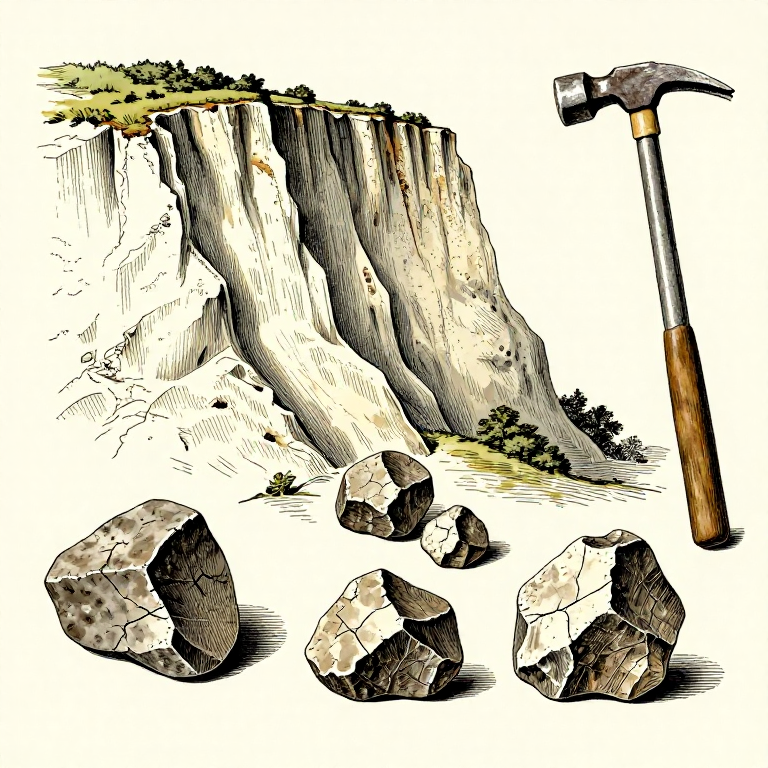
The best collecting sites are in the chalk zone: Ruegen (Jasmund chalk cliffs), Helgoland, the Baltic Sea beaches of Schleswig-Holstein, and the moraine landscapes of Mecklenburg-Western Pomerania. Flint is freed from chalk formations by glacial erosion and can be found in gravel pits, on beaches, and on freshly ploughed fields.
3

Identifying Flint by Color

Flint has a white crust (cortex) of chalk surrounding the dark core. The core is gray, black, brown, or honey-colored — depending on the location. Ruegen flint is mostly dark gray to black. Baltic beach flint often shows a smooth, abraded surface.
4

Checking for Conchoidal Fracture

The decisive test: flint fractures with a smooth, conchoidal (shell-shaped) break. If you strike a stone and the fracture surface looks smooth, slightly curved, and glassy, it is very likely flint. A grainy or dull fracture indicates a different type of stone.

Tools needed:

Geological HammerGeological Hammer
5

Performing the Spark Test

Strike the stone with a piece of carbon steel (not stainless steel). Flint produces bright, hot sparks — hence its name (Feuerstein means fire stone in German). This test only works with carbon steel, not with stainless steel or another piece of flint.

Tools needed:

Carbon Steel StrikerCarbon Steel Striker
6

Scratch Test for Hardness Determination

Flint (hardness 7) scratches glass (hardness 5.5) effortlessly. Hold the stone at a firm angle against a glass shard and draw it across. If it leaves a visible groove, this confirms the flint identification. Wear protective gloves during this test.

Materials for this step:

Glass Fragment (for testing)Glass Fragment (for testing)1 piece

Tools needed:

Leather Work GlovesLeather Work Gloves
7

Assessing Quality — Grain

Good flint has an extremely fine grain — the fracture surface feels smooth like glass. Coarse flint with visible grain or embedded fossils fractures unevenly and is poorly suited for fine tools. Homogeneous, fine-grained pieces are the most valuable.

Tools needed:

Hand Lens (10x)Hand Lens (10x)
8

Checking for Cracks and Frost Damage

Lightly tap the flint and listen to the sound. A bright, ringing tone indicates intact material. A dull, muffled tone suggests internal cracks — often caused by frost. Cracked flint breaks uncontrollably and is unusable for tools.
9

Selecting the Right Size

For tool making, collect nodules at least fist-sized (8-15 cm diameter). Smaller pieces are sufficient for arrowheads and scrapers. For large blades and axes, pieces of 15-25 cm are needed. Do not carry more than 5-8 kg per trip — flint is heavy.

Materials for this step:

Flint NodulesFlint Nodules5 kilogram
10

Collecting Safely

Wear sturdy shoes and gloves. Freshly broken flint has razor-sharp edges. Wrap each stone individually in newspaper or cloth before placing it in the backpack. Stones that strike each other directly can splinter.

Materials for this step:

Newspaper or Cloth WrappingNewspaper or Cloth Wrapping10 pieces

Tools needed:

Sturdy BackpackSturdy Backpack
Leather Work GlovesLeather Work Gloves
11

Removing the Chalk Cortex (Optional)

The white chalk crust (cortex) can be left on or removed. To remove it, soak the stone in water for 24 hours and brush off the soft chalk. For tool making, the cortex does not need to be removed beforehand — it will be knocked off during knapping.

Materials for this step:

Water for SoakingWater for Soaking5 liters

Tools needed:

Stiff Bristle BrushStiff Bristle Brush
12

Washing and Drying the Finds

Wash collected flint under running water to remove dirt and sand. Let the stones air dry — not in direct sun, as rapid temperature changes can cause cracks. Flint dries completely in 2-3 hours.
13

Labeling and Storing the Flint

Label each stone with a pencil or wax marker on the cortex side: collecting site and date. Store flint dry and frost-free — moisture that seeps into cracks and freezes will destroy the stone. A shelf in the workshop is ideal.

Tools needed:

Pencil or Wax MarkerPencil or Wax Marker
14

Documenting the Collecting Site

Record GPS coordinates, surrounding rock type (chalk, moraine, beach), quality, and quantity of flint found. Good collecting sites yield material for years. Be aware of local collecting regulations — collecting is often prohibited in nature reserves.

Tools needed:

Field NotebookField Notebook
15

Cleaning Up the Collecting Site

Fill in any holes you dug, take all litter with you, and leave the collecting site as you found it. Responsible collecting ensures access for others and preserves nature.

Materials

4

Tools Required

8

CC0 Public Domain

This blueprint is released under CC0. You are free to copy, modify, distribute, and use this work for any purpose, without asking permission.

Support the Maker by purchasing products through their Blueprint where they earn a Maker Commission set by Vendors, or create a new iteration of this Blueprint and include it as a connection in your own Blueprint to share revenue.

Discussion

(0)

Log in to join the discussion

Loading comments...