
ART
BEAUTY & WELLNESS
CRAFT
CULTURE & HISTORY
ENTERTAINMENT
ENVIRONMENT
FOOD & DRINKS
GREEN FUTURE
REVERSE ENGINEERING
SCIENCES
SPORTS
TECHNOLOGY
WEARABLES
Jaggery Production — Traditional Jaggery Making Process from Sugarcane
English
Pankha

Created by

Pankha

23. April 2026IN
0
0
0
0
0

Jaggery Production — Traditional Jaggery Making Process from Sugarcane

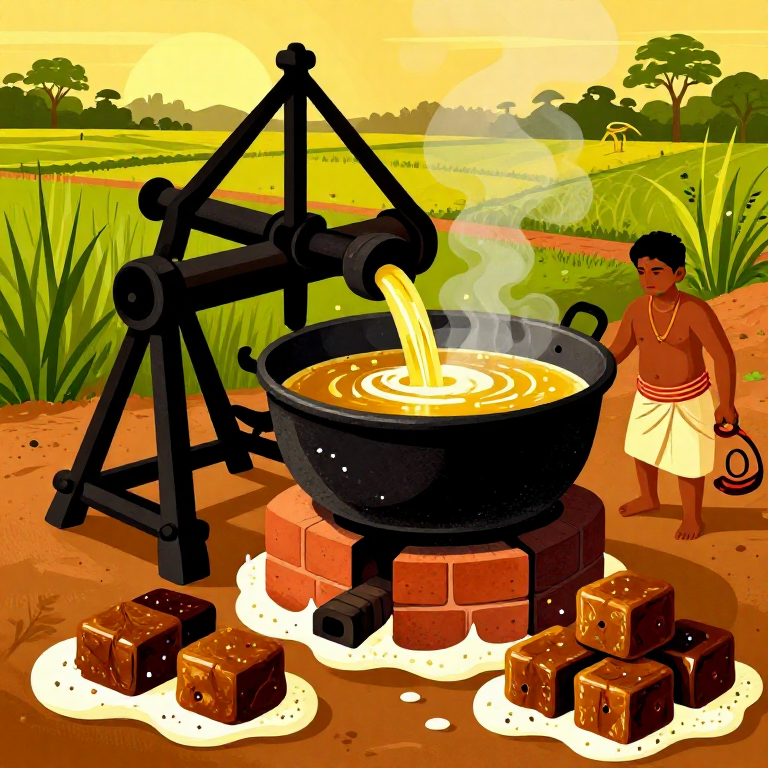
Complete process of traditional jaggery production in Maharashtra. Maharashtra is India's largest sugarcane and jaggery producing state, with Kolhapur district being particularly renowned for jaggery. Kolhapuri jaggery has been awarded a Geographical Indication (GI) tag since 2019. This process includes crushing sugarcane (Saccharum officinarum) to extract juice, purification using okra paste or lime water, boiling for 3-5 hours, identifying the setting point (forming a hard ball in cold water, ~118-120°C), stirring with a wooden paddle, and pouring into molds. Approximately 100

Advanced
6-10 hours per batch

Instructions

1

Introduction to Sugarcane and Jaggery

Jaggery (gul) is a type of unrefined sugar made from sugarcane juice. Sugarcane (Saccharum officinarum) is a tropical grass that stores sugar in its stalks. Maharashtra is the largest sugarcane-producing state in India. Kolhapur, Sangli, Satara, and Solapur are the major jaggery-producing districts. Sugarcane juice contains approximately 18-20% sugar and 80% water. In jaggery making, water is removed by evaporation and the remaining concentrate solidifies in molds.
2

Selecting Mature Sugarcane

Fully mature sugarcane is essential for making jaggery. Sugarcane matures 10-14 months after planting. Signs of maturity: internodes are thick and juicy, leaves begin to dry, and the stalk color turns yellowish instead of green. Sugar content (Brix) should be 18-21%. Immature sugarcane has less sugar in the juice and yields less jaggery. After cutting, sugarcane must be processed as quickly as possible (within 2-3 hours) because the juice starts to ferment rapidly.

Materials for this step:

Mature Sugarcane (10-14 months old)Mature Sugarcane (10-14 months old)100 kg
3

Cutting and Cleaning the Sugarcane

Cut the sugarcane at ground level. Remove the green top portion (shenda) and leaves. The top contains less sugar and degrades juice quality. Clean soil, dry leaves, and other impurities from the cane stalks. Cut the stalks to appropriate lengths for the crusher. Clean sugarcane prevents soil from mixing into the juice and maintains good jaggery quality.

Tools needed:

Sugarcane Cutting Machete (कोयता)Sugarcane Cutting Machete (कोयता)
Sugarcane Stripping BladeSugarcane Stripping Blade
4

Crushing the Sugarcane to Extract Juice

The traditional method uses a bullock-driven crusher (charak). The modern method uses an electric power crusher. The sugarcane stalks are pressed between two iron rollers. Juice collects in the channel below. For better extraction, pass the cane through the rollers two or three times. Typically, 60-70% of the cane weight is extracted as juice. Begin processing immediately after extraction — juice starts fermenting within 2-3 hours.

Tools needed:

Sugarcane Crusher (कोलू)Sugarcane Crusher (कोलू)
5

Straining the Juice

Strain the freshly extracted sugarcane juice through clean cloth. This removes cane fibers (bagasse), soil, and other coarse impurities. Use finely woven cotton cloth or a stainless steel strainer. Collect the strained juice in a clean vessel. This step is important because impure juice causes dark spots and grit in the jaggery.

Tools needed:

Muslin Cloth StrainerMuslin Cloth Strainer
Collection Vessel (स्टील हंडा)Collection Vessel (स्टील हंडा)
6

Preparing the Furnace

The traditional jaggery furnace is built of bricks with a large iron pan (kadhai) mounted on top. The kadhai is typically 4-6 feet in diameter and 1-2 feet deep. Sugarcane bagasse is used as fuel in the furnace — this ensures no part of the sugarcane goes to waste. Light the furnace and heat the kadhai. The kadhai should be clean and dry. Temperature control of the furnace is critical — too much heat will burn the jaggery.

Materials for this step:

Sugarcane Bagasse (fuel)Sugarcane Bagasse (fuel)30 kg

Tools needed:

Brick Furnace (भट्टी)Brick Furnace (भट्टी)
Large Iron Kadhai (कढई, 4-6 ft diameter)Large Iron Kadhai (कढई, 4-6 ft diameter)
7

Heating the Juice and Purification with Okra

Pour the strained juice into the kadhai and heat over medium flame. While the juice is heating, prepare okra (lady finger) paste: mix 5-6 okras with water to make a sticky paste. When the juice begins to boil, add this okra paste. The mucilage in the okra binds the impurities, which rise to the surface as scum. Alternative method: adding a small amount of lime water (calcium hydroxide) to slightly raise the pH — this causes impurities to aggregate. The okra method is more traditional.

Materials for this step:

Fresh Okra (भेंडी)Fresh Okra (भेंडी)6 pieces
Sugarcane Juice (strained)Sugarcane Juice (strained)60 liters

Tools needed:

Stirring Ladle (दाट्या)Stirring Ladle (दाट्या)
8

Removing the Scum

After adding the okra paste, dark-colored scum collects on the surface of the juice. Continuously skim off this scum with a flat perforated skimmer. Scum removal is extremely important — insufficient removal makes the jaggery dark in color and bitter in taste. Keep the flame at medium while skimming. The most scum appears in the first 20-30 minutes. Once all scum is removed, the juice appears clean and golden.

Tools needed:

Perforated Skimmer (झारा)Perforated Skimmer (झारा)
9

Continuous Boiling

After scum removal, increase the flame and let the juice boil vigorously. This boiling stage continues for 3-5 hours. Water in the juice reduces through evaporation and the juice gradually thickens. Approximately 1/5 of the original juice volume remains. Stir occasionally during boiling to prevent scorching at the bottom. The color of the juice gradually changes from golden to brown. Flame control is critical — too much heat gives the jaggery a black color and burnt taste.

Tools needed:

Long Wooden Stirring PaddleLong Wooden Stirring Paddle
10

Identifying the Setting Point (Ball Test)

The most critical moment in jaggery making is identifying the setting point. To test this, perform the ball test (gola pariksha): take a bowl of cold water, drop a drop of the boiling juice into the cold water. If the drop dissolves in the water, more time is needed. If the drop forms a hard ball that can be broken between the fingers, the juice is ready. This stage occurs at approximately 118-120 degrees Celsius. Experienced jaggery artisans can also identify this from the sound of the bubbling and the smell.

Materials for this step:

Cold Water (for ball test)Cold Water (for ball test)1 bowl
11

Removing from the Heat

Once the setting point is reached, immediately remove the kadhai from the heat or pull the fuel out from the furnace. If left too long, the jaggery will burn and become bitter. If removed too early, the jaggery will not set properly. This moment is recognized through experience — this is why jaggery making is considered skilled artisanship.

Tools needed:

Heat-Resistant GlovesHeat-Resistant Gloves
12

Vigorous Stirring

After removing from the heat, stir the hot jaggery concentrate vigorously and continuously. Stirring incorporates air, slightly cools the jaggery, and lightens its color to golden-brown. Continue stirring for 10-15 minutes. Well-stirred jaggery has a uniform color, no granular texture, and is smooth. While stirring, the concentrate gradually thickens — it should still be pourable before being poured into molds.

Tools needed:

Wooden Stirring Paddle (लाकडी दांड्या)Wooden Stirring Paddle (लाकडी दांड्या)
13

Pouring into Molds

Immediately pour the stirred hot jaggery into prepared molds. Traditional molds are made of clay or wood. Wet the molds with water beforehand so the jaggery does not stick. Pour equal amounts into each mold for uniform-sized blocks. Jaggery sets in the molds within 15-30 minutes. Before it fully cools, shape it into a round form by hand (hatmola gul). Commercial production uses buckets, square molds, or powder form.

Tools needed:

Wooden Jaggery Molds (साचे)Wooden Jaggery Molds (साचे)
Water Spray BottleWater Spray Bottle
14

Cooling, Quality Checking, and Storage

Let the jaggery blocks cool completely (2-3 hours). Once cooled, remove from the molds. Check quality: good jaggery has a golden-brown color, is hard but brittle, and has a sweet taste. Very dark color indicates over-boiling or impurities. Sticky jaggery indicates under-boiling. From 100 kg of sugarcane, approximately 10-12 kg of jaggery is produced. Store jaggery in a dry, cool place. Keep away from moisture — jaggery dissolves when exposed to dampness. Jaggery retains iron, calcium, potassium, and phosphorus because it is unrefined. Kolhapuri jaggery has held a GI tag since 2019.

Materials for this step:

Dry Jute Sack (for storage)Dry Jute Sack (for storage)2 pieces

CC0 Public Domain

This blueprint is released under CC0. You are free to copy, modify, distribute, and use this work for any purpose, without asking permission.

Support the Maker by purchasing products through their Blueprint where they earn a Maker Commission set by Vendors, or create a new iteration of this Blueprint and include it as a connection in your own Blueprint to share revenue.

Discussion

(0)

Log in to join the discussion

Loading comments...