ART
BEAUTY & WELLNESS
CRAFT
CULTURE & HISTORY
ENTERTAINMENT
ENVIRONMENT
FOOD & DRINKS
REVERSE ENGINEERING
SCIENCES
SPORTS
TECHNOLOGY
WEARABLES
English

Rose Otto Distillation — Rosa damascena in Isparta
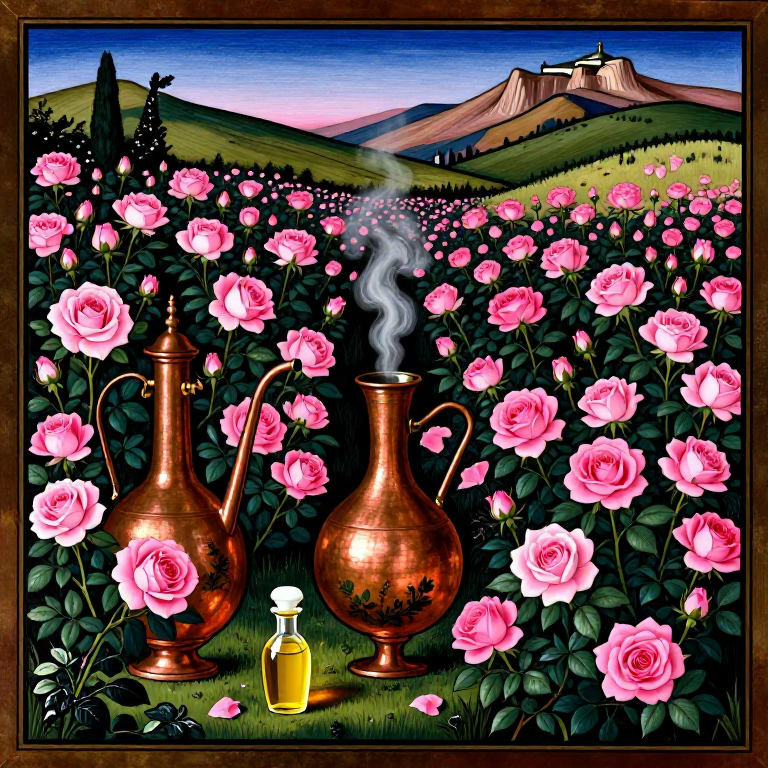
Complete guide to distilling rose otto from Rosa damascena (Damask rose) flowers using traditional copper alembic stills in Isparta. Turkey is the world's second-largest rose oil producer after Bulgaria. Rose otto is among the world's most expensive essential oils — approximately 3,500-4,000 kg of petals yield only 1 kg of oil.
Advanced
12-16 hours (harvest to separation)
Instructions
1
1
Understanding Rosa damascena and the History of Isparta Rose Oil
Understanding Rosa damascena and the History of Isparta Rose Oil
Rosa damascena (Damask rose) is the primary rose species used in rose oil production. The plant originates from the Middle East and was brought to Anatolia during the Ottoman period. Rose cultivation in Isparta was started in the 1880s by Ispartali Muftuzade Ismail Efendi. Today, approximately 30,000 donums of rose gardens exist in Isparta and surrounding areas (Burdur, Afyon). Rosa damascena is a shrubby plant reaching 1-2 meters in height that blooms every year in May-June. Each flower has 30-40 petals. The main components of rose oil are terpene alcohols such as citronellol (34-55%), geraniol (15-22%), and nerol (5-10%). These compounds create the characteristic rose scent.
2
2
Determining the Harvest Time in the Rose Garden
Determining the Harvest Time in the Rose Garden
The rose harvest runs from the second half of May to mid-June — in Isparta this period is approximately 20-30 days. Signs of the right harvest time: flowers have fully opened but petals have not yet begun to fall. Half-open or wilted flowers yield less oil. Harvesting must begin at dawn — around 04:30-05:00 — and be completed by 09:00-10:00 at the latest, before the heat of the sun increases. The reason: as daytime temperature rises, volatile oils evaporate from the petals and oil yield drops by 30-40%. Flowers gathered while still covered in dew have the highest oil content.
3
3
Collecting the Rose Petals
Collecting the Rose Petals
Harvesting is done by hand — machines are not used because the petals are very delicate and mechanical damage causes oil loss. Hold the flower by its stem and gently pluck the petals with your fingertips. Some producers pick the flower whole. Place collected petals in cotton cloth sacks or wicker baskets — do not use plastic bags, as heat builds up inside plastic and petals ferment, degrading oil quality. An experienced picker can collect approximately 40-50 kg of petals per day. During harvest season, thousands of seasonal workers are employed in Isparta. Do not crush or compress the petals during collection.
Materials for this step:
 Cotton Cloth Sacks10 pieces
 Wicker Harvest Baskets4 pieces
Tools needed:
 Pruning Gloves (thornproof)
4
4
Quickly Transporting the Petals to the Distillery
Quickly Transporting the Petals to the Distillery
Collected rose petals must be distilled within 12 hours at most — beyond this, enzymatic decomposition begins, volatile oils oxidize, and both oil yield and quality drop significantly. Ideally, distillation should begin within 4-6 hours of harvesting. During transport, do not stack sacks on top of each other — the petals underneath get crushed and early fermentation begins. If transporting by vehicle, use a shaded, ventilated area. Traditionally in Isparta, distilleries are located near rose gardens to minimize transport time. Weigh and record the petals immediately upon arrival at the distillery.
Tools needed:
Platform Scale (100 kg capacity)
5
5
Preparing the Copper Alembic Still System
Preparing the Copper Alembic Still System
Traditional Isparta rose oil distillation uses a copper alembic. The system consists of three main parts: the cucurbit (lower part where petals and water are placed), the cap with swan neck (upper part that directs steam to the condenser), and the cooling condenser coil (water-cooled spiral tube that liquefies steam). A standard copper alembic has a capacity of 300-500 liters. Before distillation, the alembic must be thoroughly cleaned — residue from previous distillations degrades oil quality. Check all connection points — steam leaks cause yield loss. Seal connection points with flour dough — this is a traditional and effective method.
Materials for this step:
 Wheat Flour Dough (sealing paste)2 kilogram
 Distilled Water (1 Liter)500 liters
Tools needed:
Copper Alembic Still (300-500 liter)
 Stiff Bristle Brush
6
6
Loading the Still Pot
Loading the Still Pot
Put clean water in the bottom of the pot — the water volume should be approximately 3-4 times the weight of the petals (300-400 liters of water for 100 kg of petals). Gently place rose petals by hand on top of the water. Do not compress the petals — they must be loose so steam can circulate between them. Approximately 70-100 kg of petals are loaded into a 300-liter alembic. After loading, place the lid and seal all connection points with flour dough. Connect the swan neck tube to the cooling serpentine. Fill the cooling tank with cold water.
Materials for this step:
 Fresh Rose Petals (Rosa damascena)100 kilogramDistilled Water (1 Liter)400 litersWheat Flour Dough (sealing paste)1 kilogram
Tools needed:
Copper Alembic Still (300-500 liter)
7
7
Conducting the Steam Distillation Process
Conducting the Steam Distillation Process
Light the fire under the pot to start heating. In Isparta, wood fire is traditionally used. It takes approximately 45-60 minutes for the water to start boiling. Once boiling begins, adjust the fire intensity — too vigorous boiling damages the petals and causes undesirable compounds in the oil. A moderate, steady boil is ideal. Steam breaks down the cell structure of the petals, releasing volatile oils. These oil molecules rise with the steam, pass through the swan neck tube to the condenser. The first distillation (first water) takes 2-3 hours. Throughout this time, monitor the condenser tank water temperature — if the water warms up, replace with fresh cold water. The temperature of the distillate coming out should not exceed 35 degrees Celsius.
Materials for this step:
 Firewood (dried oak)50 kilogram
Tools needed:
 Thermometer (0-100°C)
 Fire Poker
8
8
First Water and Cohobation (Second Distillation)
First Water and Cohobation (Second Distillation)
The distillate obtained from the first distillation (first water) contains most of the rose oil and rose water. However, there are also oil components remaining dissolved in the distillate. To recover these, cohobation (second distillation) is performed: re-distill the rose water obtained from the first water. Cohobation increases oil yield by 15-20%. The second distillation takes 1.5-2 hours. Some producers repeat this process a third time. The oil from the second distillation is combined with that from the first. Total distillation time (first water + cohobation) is 4-6 hours.
Tools needed:
Copper Alembic Still (300-500 liter)
Thermometer (0-100°C)9
9
Oil-Water Separation in the Florentine Flask
Oil-Water Separation in the Florentine Flask
The distilled liquid from the condenser flows into a Florentine flask (essencier). This special glass or copper vessel allows the oil and water to separate by density difference. Rose oil has a density of 0.848-0.861 g/ml — it is lighter than water, so it collects on the surface. Rose water drains from the bottom of the Florentine flask into a separate container; the thin oil layer on top is the rose oil. This process requires patience — the oil layer can be very thin (only 20-25 ml of rose oil from 100 kg of petals). Use a small glass pipette to collect the oil. Work carefully and slowly to prevent water from mixing with the oil.
Materials for this step:
 Amber Glass Bottles (50 ml)5 pieces
Tools needed:
 Florentine Flask (essencier)
 Glass Pipette
 Graduated Cylinder (100 ml)
10
10
Filtering and Storing the Rose Oil
Filtering and Storing the Rose Oil
Pass the collected raw rose oil through fine-pore filter paper to remove water droplets and particles. Transfer the filtered oil into dark-colored (amber) glass bottles — clear glass causes the oil to degrade from light exposure. Fill the bottles to the top, leaving no air space — oxygen oxidizes the oil. Seal the caps tightly. Store rose oil in a cool (15-20 degrees Celsius), dark place. An interesting property: pure rose oil solidifies below 21 degrees Celsius (freezing point approximately 18-21 degrees Celsius) — this is normal and an indicator of purity. Before use, warm the bottle in the palm of your hand to liquefy the oil again. Properly stored rose oil retains its quality for years.
Materials for this step:
 Filter Paper (Qualitative)10 piecesAmber Glass Bottles (50 ml)5 pieces
Tools needed:
 Glass FunnelGlass Pipette
11
11
Separating and Storing the Rose Water (Hydrosol)
Separating and Storing the Rose Water (Hydrosol)
The rose water (hydrosol) separated from the Florentine flask is a valuable by-product. Rose water contains water-soluble volatile oil compounds and has a delicate rose scent. Traditional Isparta rose water is used in cosmetics, food (Turkish delight, baklava), and traditional medicine. Pour the rose water into clean glass or stainless steel containers. Do not add any additives — pure rose water can be stored in a cool place for 6-12 months. From 1 kg of petals, approximately 1-1.5 liters of rose water is obtained — much more than the oil. Isparta rose water (Isparta gulabirasi) is a geographically registered product.
Materials for this step:
 Glass Storage Bottles (1 liter)10 pieces
Tools needed:
 Stainless Steel Funnel
 Fine Mesh Strainer
12
12
Rose Oil Quality Control
Rose Oil Quality Control
Perform basic tests to verify the quality of pure rose oil. Freezing test: pure rose oil solidifies at 18-21 degrees Celsius — oil that does not solidify at this temperature is likely impure or adulterated. Density test: density at 20 degrees Celsius should be in the range of 0.848-0.861 g/ml. Color: light yellow to light greenish-yellow. Scent: rich, deep, honey-floral rose scent — a sharp or chemical scent is a sign of adulteration. Paper test: drop a drop of rose oil on white paper — when evaporated, it should not leave a greasy stain (mineral oil adulteration leaves a greasy stain). ISO 9842:2003 standard defines rose oil quality parameters.
Materials for this step:
 White Blotting Paper5 sheets
Tools needed:
Thermometer (0-100°C) HydrometerGraduated Cylinder (100 ml)
13
13
Yield Calculation and Record-Keeping
Yield Calculation and Record-Keeping
Keep detailed records of each distillation batch: amount of petals used (kg), distillation duration, amount of rose oil obtained (ml), amount of rose water (liters), harvest date, and weather conditions. Standard yield: 1 kg (approximately 1,170 ml) of rose oil is obtained from 3,500-4,000 kg of petals. This corresponds to approximately a 0.025-0.030% yield rate. 20-30 ml of rose oil is expected from 100 kg of petals. Yield varies depending on petal quality, harvest timing, distillation technique, and climate conditions. These records provide critical reference for improving yield in future seasons. In Isparta, rose oil prices range from 8,000-15,000 euros per kg — it is one of the most valuable essential oils in the world.
Materials for this step:
 Record-Keeping Notebook1 piece
Tools needed:
 Digital Weighing Scale (0.1g precision)Graduated Cylinder (100 ml)
Materials
11- 10 piecesPlaceholder
- 4 piecesPlaceholder
- 3 kilogramPlaceholder
- 900 litersPlaceholder
- 100 kilogramPlaceholder
- 10 piecesPlaceholder
- 10 piecesPlaceholder
- 10 piecesPlaceholder
- 5 sheetsPlaceholder
- 1 piecePlaceholder
Tools Required
14- Placeholder
- Placeholder
- Placeholder
- Placeholder
- Placeholder
- Placeholder
- Placeholder
- Placeholder
- Placeholder
- Placeholder
- Placeholder
- Placeholder
CC0 Public Domain
This blueprint is released under CC0. You are free to copy, modify, distribute, and use this work for any purpose, without asking permission.
Support the Maker by purchasing products through their Blueprint where they earn a Maker Commission set by Vendors, or create a new iteration of this Blueprint and include it as a connection in your own Blueprint to share revenue.