Collaboration
ART
BEAUTY & WELLNESS
CRAFT
CULTURE & HISTORY
ENTERTAINMENT
ENVIRONMENT
FOOD & DRINKS
REVERSE ENGINEERING
SCIENCES
SPORTS
TECHNOLOGY
WEARABLES
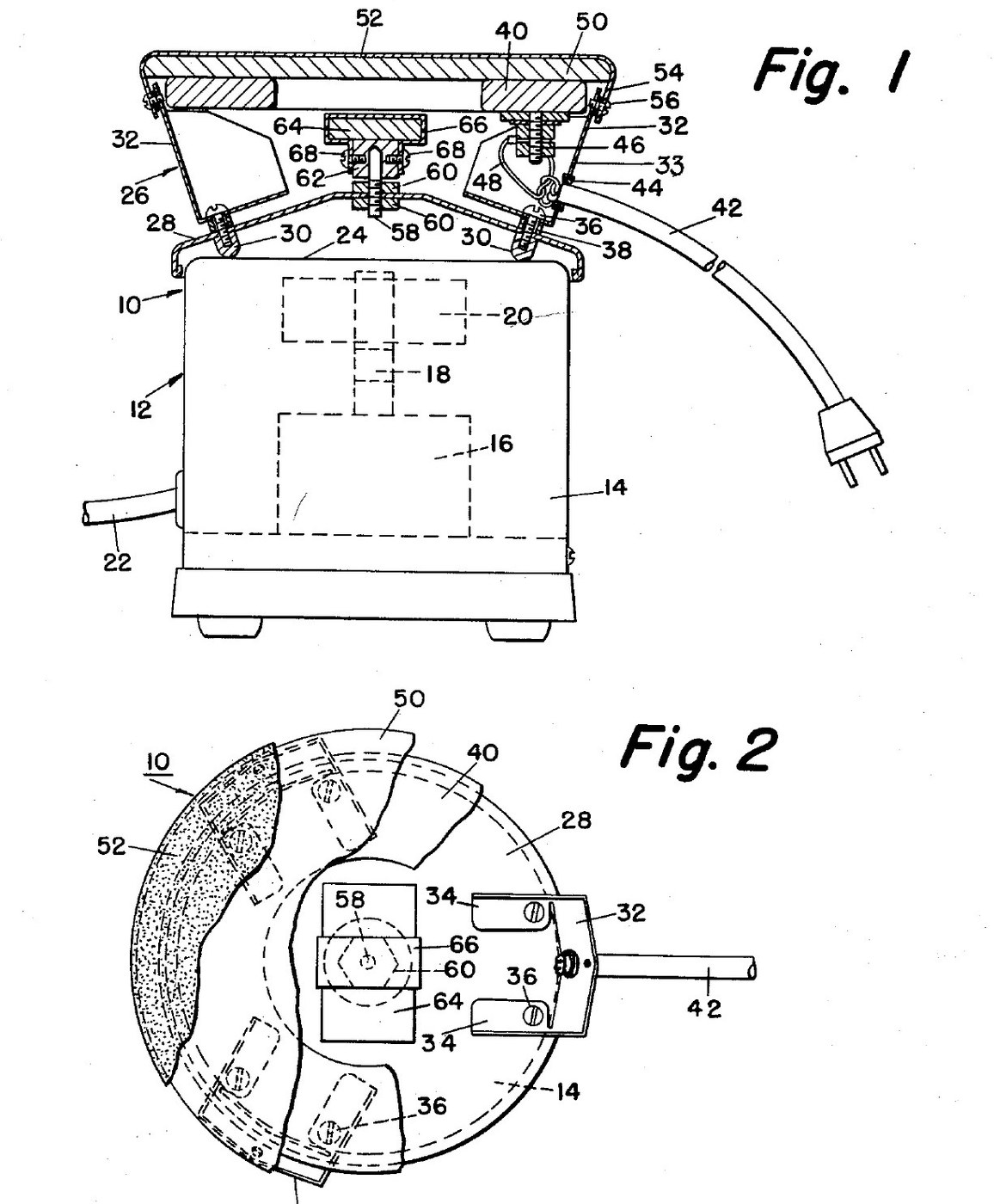


Hot Plate Magnetic Stirrer: Ring Heater over a Relay Magnet on a Shielded Spindle (Hug, US 3,028,476)
A laboratory stand that heats a vessel and stirs it at the same time. A motor in the base spins a bar magnet; in Theodore Hug's design (US 3,028,476, 1962) that magnet turns a second, free bar magnet on a spindle inside the hot plate, which in turn spins a coated stirring bar in the vessel.
A stainless-steel radiation shield and an air gap keep the ring heater's heat away from the motor. The relay magnet sits about 1/2 in. under the aluminium heat sink: closer, eddy currents in the sink slow the stirring.
Source: T. Hug, "Hot Plate and Magnetic Stirrer", US Patent 3,028,476 (filed 1960, granted 1962). Picture: its Figs. 1-2.
Advanced
Unknown
Instructions
1
1
Read Hug
Read Hug
"Attempts have been made to couple conventional heating means to magnetic stirrers, but the same have proved to be unsuccessful. Thus, the base of a laboratory vessel must be positioned relatively close to the driving rotating magnet ... Moreover, if an appreciable amount of heat from the heating means is transmitted to the motor of the magnetic stirrer, it will drastically reduce the useful operating life of said motor."
2
2
Build the stirrer base
Build the stirrer base
Make a housing of aluminium (or another non-magnetic material) and mount an electric motor inside with its shaft upright. Fix a permanent bar magnet horizontally on the top of the shaft, just under the housing top. Wire the motor through a rheostat to its cord so the speed can be varied. Sizes, motor rating and how the housing is formed are not given.
Materials for this step:
 Aluminium Sheet1 housing
 Electric Motor1 piece
 Bar Magnet Set1 drive magnet
 Rheostat1 piece
 Flexible Cord with Plug1 piece
Tools needed:
 Unknown Dimensions
 Unknown Forming Method
3
3
Make the radiation shield
Make the radiation shield
Shape a radiation shield of non-magnetic stainless steel so it straddles the top of the housing, on stainless-steel legs (a poor conductor of heat) that stand on the housing top. Bore its centre and fit a threaded spindle there with a nut on each side of the shield. Tap a blind thread in each leg.
Materials for this step:
 Stainless Steel Sheet - 3041 shield and legs
 Threaded Rod1 spindle
 Hex Nut2 pieces
Tools needed:
 Tin Snips
 Drill Press
 Drill Bit Set
 Tap and Die SetUnknown Forming Method
4
4
Fit the relay magnet
Fit the relay magnet
Bore a blind cavity in a hub of non-magnetic material so it turns freely on the spindle. Lay a permanent bar magnet 1/4 in. by 1 in. by 1 3/4 in. on top of the hub and hold it with a strap screwed to the hub. The hub and strap material is not given.
Materials for this step:
Bar Magnet Set1 relay magnet, 1/4 x 1 x 1 3/4 in. Unknown Material1 hub and strap
 Machine Screws2 pieces
Tools needed:
 Metal LatheDrill PressDrill Bit SetTap and Die Set
5
5
Mount the supports
Mount the supports
Make three support members of non-magnetic stainless steel, each an upright with flanges. Screw the flanges down into the legs, with small tubular spacers of insulating material round the screws between the shield and the flanges, so air can circulate and carry heat away. Fit a grommet in one support for the heater cord. The spacer material is not given.
Materials for this step:
Stainless Steel Sheet - 3041 three supportsMachine Screws3 pieces Unknown Insulating Material3 tubular spacers
Tools needed:
Tin SnipsDrill PressDrill Bit Set6
6
Fit the heater and top
Fit the heater and top
Mount an annular ring heater (elements in a non-magnetic sheath) coaxial with the spindle; join its cord wires to its threaded stud between two nuts. Above it lay an aluminium heat sink, a flat plate wider than the heater, so the relay magnet is about 1/2 in. below it. Cover with a top plate of aluminium or stainless steel whose edge is spun into an inverted dish, and screw the edge to the tops of the supports. The patent claims a blackened outer surface on the heat sink and top plate (how is not given). In use, set the hot plate on the stirrer and put a stirring bar (a short bar magnet sealed in glass or coated with PTFE) in the vessel: the drive magnet turns the relay magnet, which turns the bar.
Materials for this step:
 Heating Element1 ring heaterFlexible Cord with Plug1 pieceHex Nut2 pieces
 Aluminium Plate1 heat sinkAluminium Sheet1 top plateMachine Screws3 pieces
Tools needed:
 Metal Spinning ToolMetal LatheDrill PressDrill Bit Set
Materials
13- 1 top platePlaceholder
- 1 piecePlaceholder
- 1 relay magnet, 1/4 x 1 x 1 3/4 in.Placeholder
- 1 piecePlaceholder
- 1 piecePlaceholder
- 1 three supportsPlaceholder
- 1 spindlePlaceholder
- 4 piecesPlaceholder
- 1 hub and strapPlaceholder
- 8 piecesPlaceholder
- 3 tubular spacersPlaceholder
- 1 ring heaterPlaceholder
- 1 heat sinkPlaceholder
This blueprint makes

CC0 Public Domain
This blueprint is released under CC0. You are free to copy, modify, distribute, and use this work for any purpose, without asking permission.
Support the Maker by purchasing products through their Blueprint where they earn a Maker Commission set by Vendors, or create a new iteration of this Blueprint and include it as a connection in your own Blueprint to share revenue.