
ART
BEAUTY & WELLNESS
CRAFT
CULTURE & HISTORY
ENTERTAINMENT
ENVIRONMENT
FOOD & DRINKS
GREEN FUTURE
REVERSE ENGINEERING
SCIENCES
SPORTS
TECHNOLOGY
WEARABLES
Collecting frankincense resin from Boswellia trees — from tree to resin
English
AbuJackcmair

Created by

AbuJackcmair

22. April 2026SA
0
0
0
0
0

Collecting frankincense resin from Boswellia trees — from tree to resin

A comprehensive guide to collecting frankincense resin (frankincense gum) from sacred Boswellia sacra trees in the Arabian Peninsula. This blueprint covers identifying the Boswellia sacra tree, the technique of making incisions in the bark, collecting resin tears, drying and grading by quality. A tradition spanning more than 5000 years in southern Arabia.
Intermediate
2-3 hours harvesting + 2-3 weeks drying

Instructions

1

Recognizing the Boswellia tree

The frankincense tree (Boswellia sacra) is a small to medium-sized tree with a height ranging between 2-8 meters. It grows in arid and semi-arid regions in southern Arabia (Dhofar in Oman, Hadramawt in Yemen, and the southern region in Saudi Arabia) and East Africa. It is characterized by papery, peeling bark, compound pinnate leaves, and small white flowers tinged with yellow. The tree typically grows on rocky limestone slopes.

2

Understanding Boswellia species

There are several Boswellia species that produce frankincense. Boswellia sacra (the most famous, growing in Oman and Yemen) produces high-quality frankincense. Boswellia carterii grows in Somalia. Boswellia serrata grows in India. Boswellia papyrifera grows in Ethiopia and Sudan. Each species has distinctive characteristics in color and aroma. Omani frankincense (Hojari) is considered among the finest varieties in the world.
3

Choosing the Right Time for Harvesting

The frankincense harvesting season begins in late February or March and continues until September. Harvesting takes place during the dry season when the trees have less growth and the resin is thicker and of higher quality. In the Omani Dhofar region, the first harvest (lowest quality) occurs in March-April, the second harvest (medium quality) in May-June, and the third harvest (highest quality) in July-September.

4

Selecting suitable trees

Select mature trees at least 8-10 years old with a trunk diameter of 10 cm or more. Healthy trees with thick bark produce more and better resin. Avoid diseased or very young trees. Do not harvest from the same tree more than 2-3 times per season to allow recovery. Excessive tapping weakens the tree and can kill it.
5

Prepare tapping tools

The traditional tool is the mingaf (a small sharp sickle) or a special tapping knife. The blade must be sharp and clean to make precise cuts without tearing the bark. Clean the tool with alcohol before use to prevent disease transmission between trees. Also prepare a basket or container for collecting the dried pieces.

Materials for this step:

Rubbing Alcohol (for cleaning)Rubbing Alcohol (for cleaning)100 milliliter

Tools needed:

Tapping Knife (mingaf)Tapping Knife (mingaf)
Collection BasketCollection Basket
Work GlovesWork Gloves
6

Making incisions in the bark (tapping)

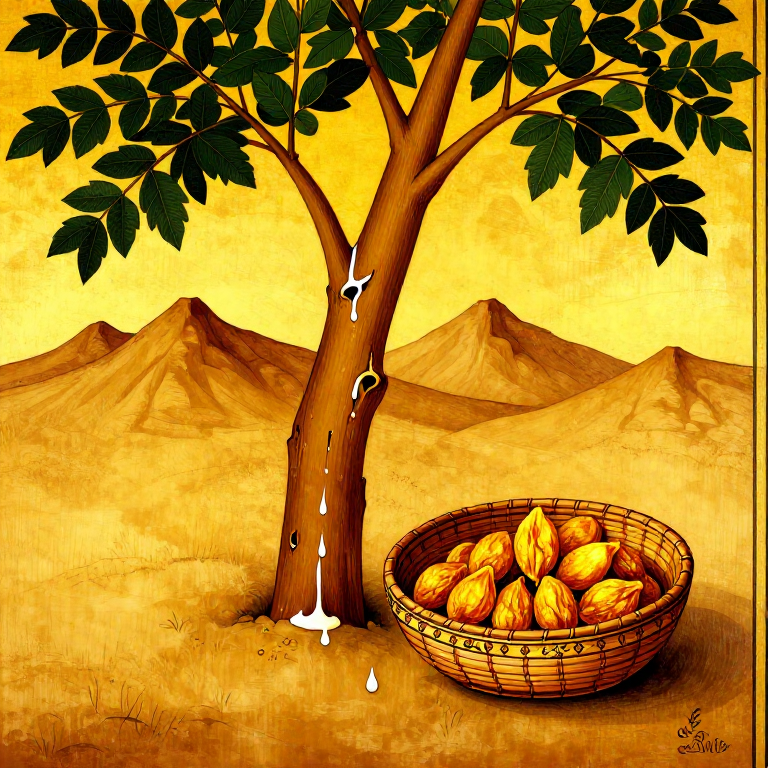
Make shallow incisions in the tree bark only 1-2 cm deep — they must penetrate the outer bark without reaching the inner wood (cambium). Each incision is 5-8 cm long. Make 8-12 incisions distributed around the trunk and main branches. Leave 10-15 cm between each incision. The tree secretes resin as a natural defensive response to heal the wounds.

Tools needed:

Tapping Knife (mingaf)Tapping Knife (mingaf)
7

Waiting for resin tears to form

After tapping, the milky white resin begins to seep from the cracks within hours. This viscous liquid gradually hardens when exposed to air. Leave the resin to harden on the tree for 10-14 days. During this period, the tears transform from a milky white color to transparent yellow or amber. Do not touch the tears while they are soft.

8

Collecting frankincense tears

After 10-14 days, gently collect the hardened tears using a flat knife or spoon. Slide the blade behind the tear and detach it from the bark with a gentle motion. Avoid scraping the bark itself. Place the tears in a cloth-lined basket to prevent breakage. A single tree produces 300-500 grams of resin per harvest.

Tools needed:

Flat Scraping KnifeFlat Scraping Knife
Lined Collection BasketLined Collection Basket
9

Removing adhering bark from resin

Some resin tears carry pieces of bark stuck to them. Gently remove these pieces using a small knife. Bark reduces the quality of frankincense and affects its purity. Be careful not to break the larger tears — bigger pieces are more commercially valuable.

Tools needed:

Small Trimming KnifeSmall Trimming Knife
10

Drying Frankincense

Spread frankincense tears in a single layer on a flat tray or mat in a dark, dry place with good ventilation. Do not expose them to direct, scorching sunlight because excessive heat melts the resin and causes it to lose its volatile oils. Leave the tears to dry for 2-3 weeks. Turn them every 2-3 days to dry evenly.

Tools needed:

Flat Drying TrayFlat Drying Tray
Woven MatWoven Mat
11

Grading frankincense by quality

Frankincense is traditionally graded by color, size, and transparency. First grade (Premium Hojari): large, transparent tears, white with a slight light green tint — the most expensive. Second grade: light yellow, transparent. Third grade: amber. Fourth grade: dark brown. Fifth grade: small broken pieces of mixed color (used for daily incense). Lighter-colored frankincense typically comes from later harvests in the season.

Tools needed:

Sorting TraysSorting Trays
12

Testing frankincense quality

Good frankincense has a mild citrus-acidic aroma and is dry. When burned on charcoal, it should produce aromatic white smoke without a plastic or pungent smell. When chewed (a common tradition in Oman and Yemen), it should be slightly bitter at first and then turn into a white gum. Adulterated or poor-quality frankincense is very brittle and does not produce aromatic smoke.

Materials for this step:

Charcoal Disc (for burn test)Charcoal Disc (for burn test)1 piece

Tools needed:

Incense Burner (mabkhara)Incense Burner (mabkhara)
13

Storing frankincense

Store the dried and graded frankincense in airtight glass containers or cotton cloth bags in a cool, dry place away from sunlight. Do not use plastic bags because the resin contains volatile oils (boswellic acid and incensole) that may react with plastic. Well-stored frankincense retains its fragrance for years. Attach a label indicating the grade, harvest date, and tree source.

Materials for this step:

Glass Storage JarsGlass Storage Jars5 pieces
Cotton Storage BagsCotton Storage Bags5 pieces

Tools needed:

Adhesive LabelsAdhesive Labels
14

Caring for the tree after harvest

After the harvest season ends, let the tree rest until the next season. Do not tap the tree more than 2-3 cycles per year. Boswellia trees are threatened by overgrazing, excessive harvesting, and climate change. In Oman, the frankincense trees in Wadi Dawkah are protected as a UNESCO World Heritage Site since 2000. Sustainable harvesting ensures the continuation of this ancient tradition.

Materials

4

Tools Required

11

CC0 Public Domain

This blueprint is released under CC0. You are free to copy, modify, distribute, and use this work for any purpose, without asking permission.

Support the Maker by purchasing products through their Blueprint where they earn a Maker Commission set by Vendors, or create a new iteration of this Blueprint and include it as a connection in your own Blueprint to share revenue.

Discussion

(0)

Log in to join the discussion

Loading comments...