
Wheat Harvesting — Traditional Wheat Cutting and Processing in Punjab
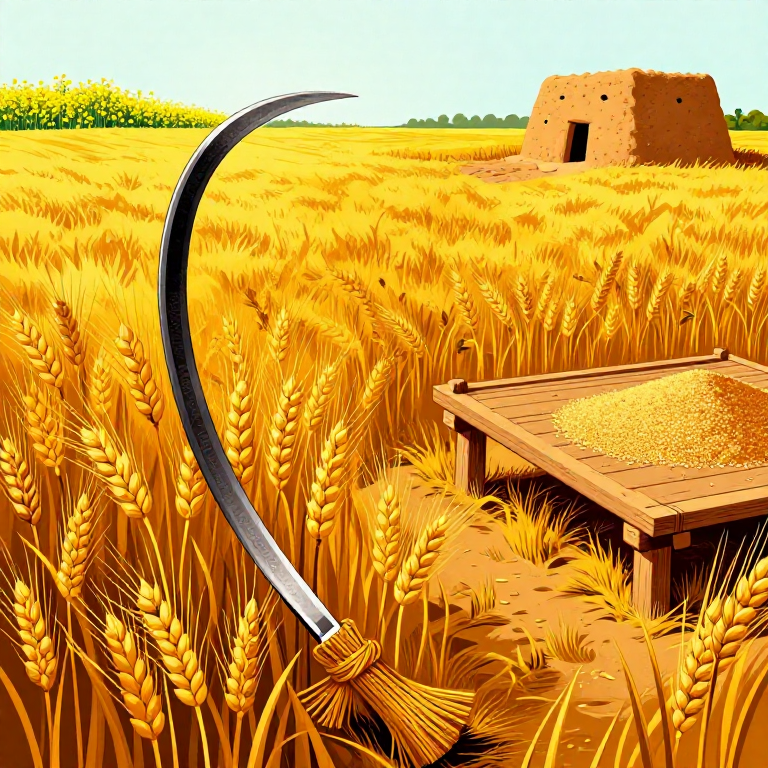
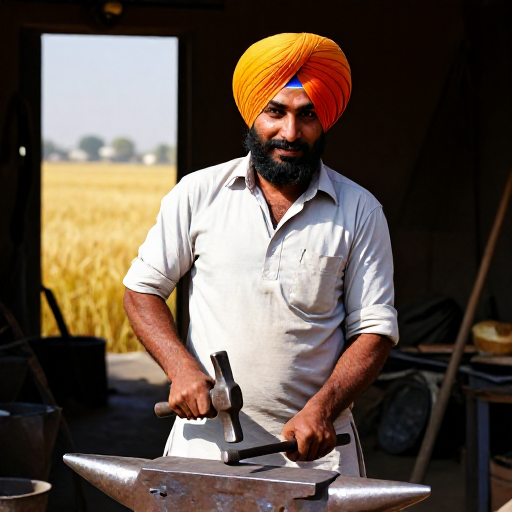
Complete process of traditional wheat (Triticum aestivum) harvesting in Punjab, India. Punjab produces approximately 35% of India's wheat and is known as India's breadbasket. Covers identifying ripeness, hand cutting with sickle, bundling sheaves, threshing on the floor, winnowing, sun-drying, and storage in earthen granaries.
Instructions
Understand the wheat plant
Understand the wheat plant
Wheat (Triticum aestivum) is a major cereal crop of the grass family (Poaceae). In Punjab, wheat is sown in October-November and harvested in April-May. The plant grows 60-120 cm tall. Each ear (spike) contains 25-50 grains. Major varieties in Punjab include HD-2967, PBW-725, and WH-1105. Punjab produces approximately 35% of India''s wheat — yielding 50-55 quintals per hectare, well above the national average of 34 quintals.
Identify ripeness
Identify ripeness
There are several signs of wheat ripeness that should be carefully checked. First: the color of the plants and ears changes from green to golden yellow — when the entire field appears golden, harvest time is near. Second: take a grain from the ear and bite it — if it breaks with a cracking sound, it is ripe; if soft, it is still unripe. Third: grain moisture should be 12-14%. The stems become dry and brittle. Harvesting too early causes grains to shrink, and harvesting too late causes grains to fall from the ear onto the ground.
Tools needed:
 Grain Moisture Meter
Prepare the sickle
Prepare the sickle
The sickle (daranti) is Punjab''s traditional wheat-cutting tool — a crescent-shaped sharp blade attached to a wooden handle. Before harvesting, sharpen the sickle blade — wet the whetstone with water and draw the blade across it at a 20-25 degree angle. Sharpen 5-10 times on both sides. Check the handle is not loose — a loose handle can cause injury. Test the edge: run it across paper, if it cuts cleanly it is ready.
Tools needed:
 Whetstone
Hand-harvest the wheat
Hand-harvest the wheat
Start cutting wheat early in the morning when the stems have slight moisture from dew — this keeps the stems flexible and reduces grain shattering. Grasp a fistful of stems with the left hand and cut with the sickle in the right hand, 10-15 cm above the ground. Pull the sickle toward you to cut — do not push. Place cut stems in a row to one side. An experienced farmer can hand-cut 0.1-0.2 acres per day. Wear cloth gloves to protect your hands.
Materials for this step:
 Cotton Work Gloves1 pair
Tools needed:
Bind sheaves
Bind sheaves
Bind the cut wheat stems into small sheaves. Each sheaf should contain as many stems as can be held with both hands — a bundle about 25-30 cm in circumference. Use a few wheat stems to tie — twist them and wrap around the middle of the bundle to bind it. Keep all the ears on one side. Stand the sheaves upright in groups of 4-6 called stooks so that air circulates and moisture decreases.
Transport sheaves to the threshing floor
Transport sheaves to the threshing floor
Transport the sheaves from the open field to the threshing floor (khalihan). In Punjab, sheaves were traditionally loaded onto bullock carts. Nowadays, tractor-trailers are used. Stack the sheaves one on top of another in the trailer and tie with rope so they do not fall en route. If the threshing floor is in the field itself, sheaves can be carried directly on the head.
Materials for this step:
 Jute Rope10 meters
Tools needed:
 Tractor Trolley
Prepare the threshing floor
Prepare the threshing floor
The threshing floor (khalihan) is the open area where threshing is done. Choose level, clean ground — a circular area approximately 10-15 meters in diameter. Sprinkle the ground with water and pound it smooth and hard with a tamper. After drying, apply a coating of cow dung slurry — this is the traditional method that makes the ground smooth so that grains do not get embedded in the soil. Let the threshing floor dry for 1-2 days.
Materials for this step:
 Cow Dung20 kg
 Water50 liters
Tools needed:
 Wooden Mallet (Mogra)
 Broom
BroomThreshing — Separating grains from stalks
Threshing — Separating grains from stalks
Threshing (threshing) is the process in which grains are separated from stalks. Traditional method: Spread the harvested crop in a 15-20 centimetre thick layer in the threshing floor. Make the bullocks move round and round on it — the grains separate from the stalks under the pressure of their hooves. This process lasts 2-3 hours. Occasionally turn the straw with a pitchfork (pitchfork) so that the grains at the bottom also separate. Nowadays small farmers also use thresher machines but the traditional method is still prevalent in small fields.
Tools needed:
 Pitchfork (Panja)
Separating the straw
Separating the straw
Tools needed:
Pitchfork (Panja)Winnowing — cleaning grain with wind
Winnowing — cleaning grain with wind
Materials for this step:
 Cotton Ground Sheet1 piece
Tools needed:
 Winnowing Tray (Chhaj)
Sun-drying the grain
Sun-drying the grain
Materials for this step:
 Tarpaulin Cover1 piece
Tools needed:
 Wooden Spreading Board
Sorting and cleaning the grain
Sorting and cleaning the grain
Tools needed:
 Coarse Wire Mesh Sieve
 Fine Wire Mesh Sieve
Storage in the kothi
Storage in the kothi
Materials for this step:
 Dried Neem Leaves2 kg
Tools needed:
 Mud Granary (Kothi)
 Weighing Scale
Monitoring and maintaining stored grain
Monitoring and maintaining stored grain
Materials for this step:
 Mud-Dung Plaster Mix5 kg
Materials
8- 1 pairPlaceholder
- 1 piecePlaceholder
- 1 piecePlaceholder
- Placeholder
- Placeholder
Tools Required
13- Placeholder
- Placeholder
- Placeholder
- Placeholder
- Placeholder
- Placeholder
- Placeholder
- Placeholder
- Placeholder
- Placeholder
- Placeholder
CC0 Public Domain
This blueprint is released under CC0. You are free to copy, modify, distribute, and use this work for any purpose, without asking permission.
Support the Maker by purchasing products through their Blueprint where they earn a Maker Commission set by Vendors, or create a new iteration of this Blueprint and include it as a connection in your own Blueprint to share revenue.