

ART
BEAUTY & WELLNESS
CRAFT
CULTURE & HISTORY
ENTERTAINMENT
ENVIRONMENT
FOOD & DRINKS
GREEN FUTURE
REVERSE ENGINEERING
SCIENCES
SPORTS
TECHNOLOGY
WEARABLES
Extracting Pink Salt from Khewra Salt Mine — Pakistan's Natural Mountain Salt
English
AmmiPeach

Created by

AmmiPeach

23. April 2026PK
0
0
0
0
0

Extracting Pink Salt from Khewra Salt Mine — Pakistan's Natural Mountain Salt

The Khewra Salt Mine located in Punjab Province, Pakistan is the world's second largest salt mine. This blueprint describes the complete method of extracting natural pink mountain salt. This salt was formed approximately 600 million years ago from the evaporation of an ancient inland sea. This guidebook includes all stages from identifying salt veins, hand-pick extraction with spades, mechanical drilling, block extraction, sorting by color, crushing, washing, grading, and storage. The Khewra mine uses the "room and pillar" method in which 50 percent of the salt remains in pillars to support the

Intermediate
Full day operation

Instructions

1

Understanding the Geology of Khewra Salt Mine

The Khewra Salt Mine is located in the Salt Range mountain chain in Jhelum District, Punjab, Pakistan. The salt deposits here were formed approximately 600 million years ago during the Precambrian/Ediacaran period when an ancient inland sea evaporated. The mine has 11 levels (6 underground) and tunnels extend approximately 730 meters into the mountain. According to tradition, the soldiers of Alexander the Great discovered it in 326 BC when their horses were licking the salt rocks.
2

Safety Preparation

Underground mining is dangerous work. Before entering the mine, it is essential to wear complete safety equipment: hard helmet (with head lamp), safety goggles, gloves, safety boots (steel toe), and a dust protection mask. Check the mine ventilation system. Inspect the structural integrity of the tunnel. Learn the emergency exits and tools. Never enter the mine alone.

Materials for this step:

Dust Protection MaskDust Protection Mask1 piece
Heavy-Duty Work Gloves1 pair

Tools needed:

Hard Hat with Head LampHard Hat with Head Lamp
Safety GogglesSafety Goggles
Steel-Toed Safety BootsSteel-Toed Safety Boots
3

Identifying Salt Veins

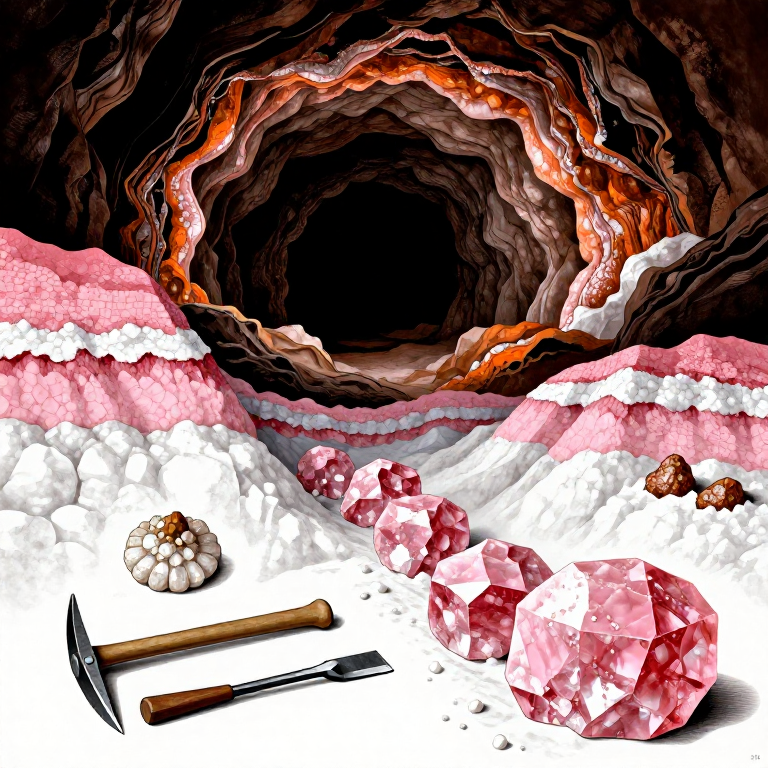
Salt in the Khewra mine is found in different colors: white, pink, red, and transparent. The pink color is due to trace amounts of iron oxide (Fe2O3). The salt contains 96-98 percent sodium chloride (NaCl), with the remainder including minerals such as calcium, magnesium, potassium, and iron. The best veins are those where the salt is clear, uniform in color, and has minimal soil or other contamination. Experienced miners assess the thickness, direction, and quality of the vein.

Tools needed:

Geological Pick HammerGeological Pick Hammer
4

Extracting Salt by Hand with a Pick

In the traditional method, miners use a heavy pick and chisel. First, find cracks and natural joints in the salt vein. Strike the salt rock with the pick to free large blocks. Strike along the natural cracks, not against them. This method yields large, unbroken blocks which are more valuable. Traditional hand mining is still used alongside modern methods today.

Tools needed:

Mining Pick (Heavy-Duty)Mining Pick (Heavy-Duty)
Steel ChiselSteel Chisel
Sledgehammer (3-5 kg)Sledgehammer (3-5 kg)
5

Mechanical Drilling

Modern extraction methods use mechanical drills. Holes are drilled in the salt wall according to a specific pattern. The drill bits are specially designed for salt rock. The depth and spacing of holes depends on the thickness of the salt vein. Sometimes limited use of explosives is made to free large sections — but this work is done only by trained blasters. In the room and pillar method, 50 percent of the salt must be left as pillars to support the ceiling.

Tools needed:

Pneumatic Rock DrillPneumatic Rock Drill
6

Extracting Salt Blocks

Salt blocks freed by drilling or picking are completely separated using lever bars and wedges. Large blocks can weigh 50-200 kilograms. They are carefully lowered to avoid breaking — intact blocks are more valuable. Smaller pieces are also collected. The blocks are placed by hand into mine carts and taken out of the tunnel.

Tools needed:

Steel Lever BarSteel Lever Bar
Steel WedgesSteel Wedges
Mine CartMine Cart
7

Initial Sorting by Color

Salt extracted from the mine is immediately sorted by color: white (purest, 98%+ NaCl), light pink (most popular), dark pink, red (highest iron content), and transparent (rare). Each color has a different value. Pink salt is in highest demand in the international market. Pieces with soil or other contamination are separated out.

Tools needed:

Sorting TableSorting Table
8

Breaking Salt

Large blocks are broken to the desired size. On an industrial scale, a jaw crusher is used. On a small scale, they are broken by hand with a hammer and chisel. Different sizes for different purposes: large pieces (for lamp making), medium pieces (for cooking), fine grains (table salt). Wear a dust protection mask during breaking.

Tools needed:

Sledgehammer (3-5 kg)Sledgehammer (3-5 kg)
Steel ChiselSteel Chisel
9

Washing

Khewra salt is washed minimally — this is its greatest virtue because unrefined salt retains its natural minerals. Only a brief wash is done to remove soil, stone particles, and other non-salt contamination. The salt is washed in brine (saturated salt water), not fresh water — fresh water would dissolve the salt. Dry immediately after washing.

Materials for this step:

Brine Solution (Saturated Salt Water)Brine Solution (Saturated Salt Water)20 liters

Tools needed:

Large Washing BasinLarge Washing Basin
10

Grading

After washing and drying, the salt is graded. Food grade salt: clean, pure color, free from soil. Industrial grade salt: less pure in color and food-grade quality. Decorative grade salt: large, beautiful pieces for lamps and decoration. The Khewra mine produces approximately 385,000 tons of salt annually, while total estimated reserves are 6.687 billion tons.

Tools needed:

Sorting TableSorting Table
Kitchen ScaleKitchen Scale
11

Packing

Prepare the graded salt for packing. Fill food-grade salt into clean, dry, food-grade bags. Wrap large blocks (for lamps or decoration) individually in soft paper so they do not break during transport. Write the weight, grade, and date on each bag. Jute sacks or large bags are used for commercial shipments.

Materials for this step:

Food-Grade Packaging BagFood-Grade Packaging Bag10 pieces
Soft Wrapping Paper (for blocks)Soft Wrapping Paper (for blocks)5 sheets
Paper LabelsPaper Labels10 pieces

Tools needed:

Kitchen ScaleKitchen Scale
12

Storage

Store salt in a dry, cool place. Salt absorbs moisture (hygroscopic), so protection from moisture is very important. Relative humidity should be below 60 percent. Place salt on pallets above the ground so that floor moisture does not reach it. Storing in airtight containers keeps salt safe for years. Salt has no expiry date — it is a mineral deposit millions of years old — but proper storage maintains its dryness and cleanliness.

Materials for this step:

Airtight Storage ContainerAirtight Storage Container1 piece
Wooden PalletWooden Pallet1 piece

Materials

8

Tools Required

14

CC0 Public Domain

This blueprint is released under CC0. You are free to copy, modify, distribute, and use this work for any purpose, without asking permission.

Support the Maker by purchasing products through their Blueprint where they earn a Maker Commission set by Vendors, or create a new iteration of this Blueprint and include it as a connection in your own Blueprint to share revenue.

Discussion

(0)

Log in to join the discussion

Loading comments...