
ART
BEAUTY & WELLNESS
CRAFT
CULTURE & HISTORY
ENTERTAINMENT
ENVIRONMENT
FOOD & DRINKS
GREEN FUTURE
REVERSE ENGINEERING
SCIENCES
SPORTS
TECHNOLOGY
WEARABLES
Rubber Tapping — Collecting Natural Latex from Rubber Trees
English
SomchaiSang

Created by

SomchaiSang

23. April 2026TH
5
0
0
0
0

Rubber Tapping — Collecting Natural Latex from Rubber Trees

Detailed guide to rubber tapping and natural latex collection. Thailand is the world's largest natural rubber producer, producing approximately 4.5–5 million tonnes per year (about 35% of global output). The rubber tree (Hevea brasiliensis) originated in the Amazon basin but is now widely cultivated in Southeast Asia.

Intermediate
2-4 hours (early morning tapping round)

Instructions

1

Understanding the Biology of the Rubber Tree

The rubber tree (Hevea brasiliensis) is a perennial tree in the family Euphorbiaceae, native to the Amazon rainforest. Rubber trees can grow up to 25-30 meters tall and have a productive latex-yielding lifespan of 25-30 years. Latex is produced in laticifer vessels located in the inner bark. Latex consists of 30-40% rubber particles (cis-1,4-polyisoprene) suspended in water, along with proteins, sugars, minerals, and lipids. Latex protects the tree from insects and pathogens. When the bark is cut, latex flows out and coagulates to seal the wound.
2

Selecting Trees Ready for Tapping

Rubber trees can begin to be tapped at 5-7 years of age, when the trunk circumference at 150 cm above ground is not less than 50 cm (approximately 16 cm diameter). Measure the circumference with a measuring tape at 150 cm from the ground. Trees with bark thick enough can withstand repeated tapping without damaging the wood. Trees that are too small will yield little latex and risk permanent damage. Rubber plantations in southern Thailand (Surat Thani, Nakhon Si Thammarat, Songkhla, Trang) are the country's main rubber-growing areas.

Tools needed:

Measuring TapeMeasuring Tape
3

Preparing the Tapping Knife

The rubber tapping knife is a specialized tool with a short curved blade designed to cut the bark shallowly and evenly. The blade must always be sharp — a dull knife creates uneven cuts, tears the bark, and damages the tree. Sharpen the knife with a sharpening stone before every tapping session. Check that the handle is secure. Thai-style tapping knives typically have a depth guard to prevent cutting too deep into the cambium.

Tools needed:

Rubber Tapping Knife (มีดกรีดยาง)Rubber Tapping Knife (มีดกรีดยาง)
Sharpening Stone (หินลับมีด)Sharpening Stone (หินลับมีด)
4

Cutting the Spiral Tapping Groove

The standard tapping cut is a half-spiral around the trunk at a 30-degree angle from horizontal, slanting from upper left to lower right (for right-handed tappers). Start tapping at 150 cm above ground. Cut the outer bark to a depth of approximately 1.5-2 mm to open the laticifer vessels. Never cut deep enough to reach the cambium, as this causes permanent damage and prevents bark regrowth. The 30-degree angle is important because the laticifer vessels are arranged at an angle from right to left — this angle cuts through the maximum number of vessels. Each tapping session shaves off a thin layer of bark to expose new laticifer vessels.

Tools needed:

Rubber Tapping Knife (มีดกรีดยาง)Rubber Tapping Knife (มีดกรีดยาง)
5

Installing the Latex Spout and Collection Cup

At the lowest end of the tapping cut (lower right), install a metal or plastic spout pressed into the bark to guide the latex flow into the cup. Hang a latex collection cup below the spout using a wire holder attached to the trunk. The cup should be clean and dry — contaminated latex will coagulate prematurely. A 300-500 ml cup is sufficient for latex from one tapping session.

Materials for this step:

Latex Collection Cup (ถ้วยรองน้ำยาง)Latex Collection Cup (ถ้วยรองน้ำยาง)1 piece
Metal Spout (รางน้ำยาง)Metal Spout (รางน้ำยาง)1 piece

Tools needed:

Wire Cup HolderWire Cup Holder
6

Adding Anti-Coagulant

Before tapping, add anti-coagulant to the collection cup. The agent used is ammonia solution or sodium sulfite solution, at 2-5 ml per cup. This prevents the latex from coagulating in the cup before collection. Without anti-coagulant, latex will begin to coagulate within 2-4 hours after flowing from the tree. Large plantations prepare ammonia solution in spray bottles for convenience.

Materials for this step:

Ammonia Solution (anti-coagulant)Ammonia Solution (anti-coagulant)5 ml per cup

Tools needed:

Dropper BottleDropper Bottle
7

Tapping in the Early Morning Hours

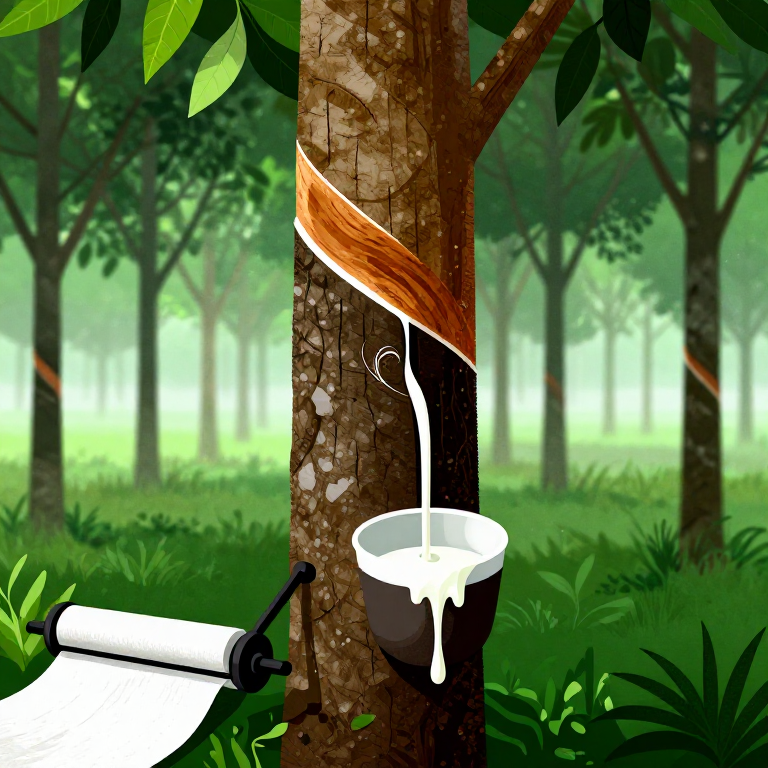
Rubber tapping is done in the early morning hours, from 2 AM to 4 AM, because turgor pressure in the rubber tree is highest during this period, causing more latex to flow than during the daytime. Use a headlamp for illumination while tapping. Tap by shaving a thin layer of bark (approximately 1.5-2 mm) along the existing tapping groove. Latex will begin to flow immediately after tapping — milky white drops flow along the groove down to the spout and cup. Skilled tappers can tap 400-600 trees per session. Tapping is done every 2-3 days (not daily) to allow the bark time to regenerate.

Tools needed:

Headlamp (ไฟฉายคาดหัว)Headlamp (ไฟฉายคาดหัว)
Rubber Tapping Knife (มีดกรีดยาง)Rubber Tapping Knife (มีดกรีดยาง)
8

Collecting the Latex

Latex flows continuously for 2-4 hours after tapping, then stops as the latex coagulates and seals the wound. Return to collect latex from the cups in the morning (6-9 AM). Pour the latex from cups into a collection bucket. One rubber tree yields approximately 30-50 ml of latex per tapping session (approximately 10-15 grams of dry rubber). Collect the cup lump (coagulated latex stuck to the cup) separately — cup lump is lower quality than fresh latex. Wash cups clean for the next session.

Tools needed:

Latex Collection Bucket (ถังรวมน้ำยาง)Latex Collection Bucket (ถังรวมน้ำยาง)
9

Filtering the Latex

Collected latex may contain contaminants such as bark fragments, leaves, insects, or dust. Filter the latex through a stainless steel strainer (40-60 mesh) or filter cloth. Pour the latex into a clean collection tank. Filtered latex should be clean, uniformly milky white, with no lumps or contaminants. Clean latex will produce high-quality rubber sheets when coagulated.

Tools needed:

Stainless Steel Strainer (40-60 mesh)Stainless Steel Strainer (40-60 mesh)
10

Coagulating the Latex with Formic Acid

Pour the filtered latex into coagulation trays — rectangular aluminum or stainless steel trays. Add formic acid at 1-2% concentration at a rate of 5-10 ml per liter of latex. Stir to mix well, then leave for 4-8 hours (or overnight). The formic acid breaks the colloidal suspension of rubber particles, causing the rubber particles to aggregate into white curds that separate from the serum. Do not use acid that is too concentrated, as it will darken the rubber and reduce quality.

Materials for this step:

Formic Acid 1-2% solutionFormic Acid 1-2% solution50 ml
Filtered LatexFiltered Latex10 liters

Tools needed:

Coagulation Tray (ถาดจับตัว)Coagulation Tray (ถาดจับตัว)
Stirring RodStirring Rod
11

Sheeting the Rubber through Rollers

The coagulated rubber (coagulum) is passed through a sheeting roller machine. The machine has 2 rollers rotating in opposite directions. The final set of rollers is ribbed to create a pattern on the rubber sheet, increasing the surface area for drying. Roll 3-5 times, gradually reducing the gap between rollers to thin the sheet (to approximately 3-4 mm). The rolled rubber sheets will be yellowish-white, elastic, with a uniform ribbed pattern. Wash the sheets with clean water to remove residual acid.

Materials for this step:

Clean Water (for washing sheets)Clean Water (for washing sheets)20 liters

Tools needed:

Sheeting Roller Machine (เครื่องรีดยาง)Sheeting Roller Machine (เครื่องรีดยาง)
12

Drying or Smoking the Rubber Sheets

Hang the rolled rubber sheets to air-dry in shade for 1-2 days first. Then transfer to a smokehouse for smoking at 40-60 degrees Celsius for 4-7 days. Smoke from wood (old rubber tree wood or other wood) kills mold and bacteria and gives the sheets an amber color. Ribbed Smoked Sheet (RSS) is the most traded form of natural rubber in the world. Alternative: sun-dry or air-dry the sheets, but air-dried sheets are lower quality than smoked sheets.

Materials for this step:

Firewood (for smokehouse)Firewood (for smokehouse)10 kg

Tools needed:

Smokehouse (โรงรมควัน)Smokehouse (โรงรมควัน)
Drying RackDrying Rack
13

Quality Grading

Smoked rubber sheets are graded according to RSS (Ribbed Smoked Sheet) standards set by the International Rubber Quality and Packing Conference, inspected visually and by transmitted light. RSS1 is the highest quality: uniform light amber color, no air bubbles, no spots, no contaminants, good elasticity. RSS2-RSS3 allow slight spots or darker color. RSS4-RSS5 are lower quality with dark spots, air bubbles, or contaminants. Rubber prices vary greatly by grade — RSS1 commands the highest price.

Tools needed:

Light Box (for visual grading)Light Box (for visual grading)
14

Storage and Preparation for Sale

Graded rubber sheets are bundled into bales of 100-113 kg each according to international standards. Wrap with sheets of the same grade to prevent contamination. Store in a dry warehouse with good air circulation, away from direct sunlight. High humidity causes mold on rubber. Natural rubber from Thailand is exported mainly to China, Japan, the United States, and Europe. It is used in the production of vehicle tires, rubber gloves, elastic bands, and other rubber products. A single rubber tree can be productive for 25-30 years, with bark regenerating for the next tapping every 2-3 days.

Tools needed:

Baling PressBaling Press
Weighing ScaleWeighing Scale

CC0 Public Domain

This blueprint is released under CC0. You are free to copy, modify, distribute, and use this work for any purpose, without asking permission.

Support the Maker by purchasing products through their Blueprint where they earn a Maker Commission set by Vendors, or create a new iteration of this Blueprint and include it as a connection in your own Blueprint to share revenue.

Discussion

(0)

Log in to join the discussion

Loading comments...