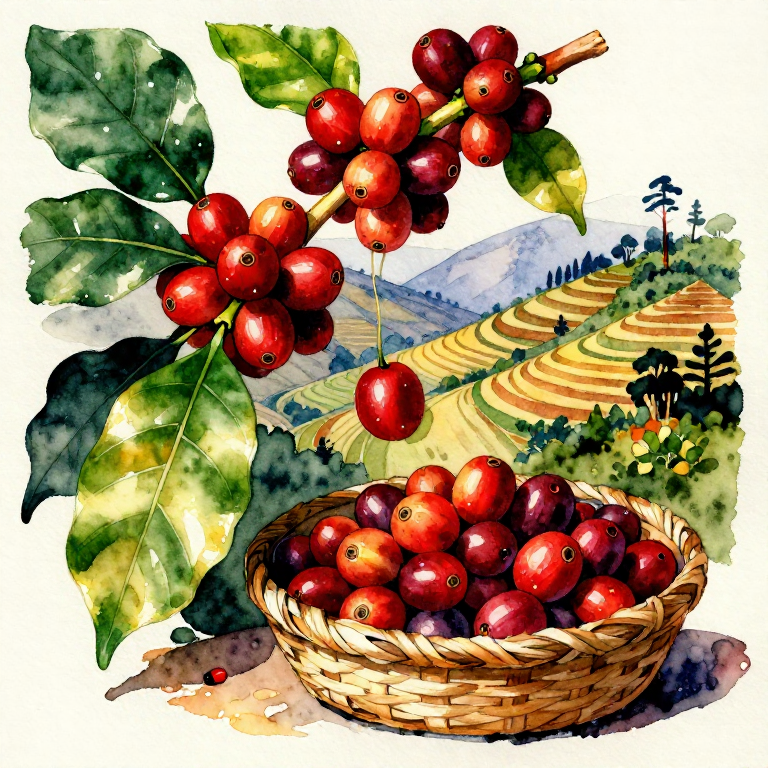


Harvesting Coffee Fruit — Selecting Ripe Cherries by Hand
Instructions
Identify ripe cherries
Identify ripe cherries
Look at the color of the cherry on the coffee tree. Ripe cherries have a deep red color or red-purple. Green or yellow cherries are not yet ripe — let them continue to ripen on the branch.
Test ripeness by touch
Test ripeness by touch
A ripe cherry should feel slightly soft when gently squeezed between your thumb and forefinger. A ripe cherry should feel slightly soft and release a little juice. If it's hard, it's not yet ripe.
Woven basket for picking
Woven basket for picking
Place a clean cloth inside the picking basket to protect cherries from bruising. The basket should easily carry 5-8 kilograms. Close the basket at the waist so both hands are free for picking.
Materials for this step:
 Clean Cotton Cloth1 piece
Tools needed:
 Woven Harvesting Basket
Start harvesting from the lower branches
Start harvesting from the lower branches
Stand near the coffee tree and start harvesting from the lower branches going upwards. This enables you to harvest all the reachable cherries before using a ladder for the upper branches.
One cherry at a time
One cherry at a time
Hold a ripe cherry between your thumb and forefinger, twist gently like a clock. The cherry will separate from the branch easily. Do not pull hard — this can damage the branch and buds for next season.
Materials for this step:
 Ripe Coffee Cherries1 tree
Pick cherries that are not yet ripe
Pick cherries that are not yet ripe
Green, yellow, and yellow-orange cherries — all remain on the branch. They will ripen after 7-14 days and be ready for harvesting in the second round. Selective picking is the secret to Kenya's best coffee.
Remove overripe cherries
Remove overripe cherries
Black or brown cherries that are rotten or dried on the branch. Remove them and set them aside in a separate bucket — do not mix them with good cherries. These cherries can spread fungal disease to others.
Tools needed:
 Sorting Bucket
Work systematically around the tree
Work systematically around the tree
Move systematically around the tree, pruning all branches on one side before moving on. A single coffee tree aged 5-8 years yields 2-5 kilograms of cherry in one harvesting round.
Five cherries in a large bag
Five cherries in a large bag
When the basket is full, carefully pour cherries into a burlap bag or sack. Do not fill more than 20 kilograms per bag — excess weight presses the bottom cherries and causes bruising.
Tools needed:
 Burlap Collection Sack
Put cherries in a sorting table
Put cherries in a sorting table
Pour cherries onto a sorting table. Remove leaves, small branches, and cherries damaged by insects. Look for small holes in cherries — this is a sign of being eaten by coffee berry borer (Hypothenemus hampei).
Tools needed:
 Sorting Table
Open a water test bucket
Open a water test bucket
Fill a 20-liter bucket with clean water. Water test (float test) is a simple method to separate good cherries from defective ones. Water should be cold, not hot.
Materials for this step:
 Distilled Water (1 Liter)20 liters
Tools needed:
 20-Liter Bucket
Soak cherry in water
Soak cherry in water
Pour cherry into a bucket of water carefully. Stir gently for 10-15 seconds so all cherries come into contact with water.
Remove floating cherries
Remove floating cherries
Cherries floating on water are bad — they have defects, are eaten by insects, or have dried inside. Remove them with a spoon or hand and set them aside. Good cherries sink to the bottom of the water.
Tools needed:
 Skimming Ladle
Rinse cherry through water
Rinse cherry through water
Pour submerged cherries through a strainer or cloth. Let water drain for 2-3 minutes. These cherries are the best — they will continue to the processing stage.
Tools needed:
 Mesh Strainer
Measure harvest weight
Measure harvest weight
Measure good cherry varieties filtered by scale. Record weight — one tree produces an average of 2-5 kg per harvest round, 2-3 times per season (October-December Kenya).
Tools needed:
 Kitchen Scale
Store cherry in the shade
Store cherry in the shade
Place cherry in a shaded area with circulating air. Do not place them in direct sunlight — heat will begin unwanted fermentation that will spoil the coffee flavor.
Process within 12 hours
Process within 12 hours
Coffee cherries must begin processing (pulping) within 12 hours after harvest. Delay causes uncontrolled fermentation, which imparts unwanted sicky or alcoholic flavors in the coffee.
Clean harvesting equipment
Clean harvesting equipment
Wash baskets, buckets, and filters with clean water after each harvest day. Cherries left on equipment can rot and spread bacteria to the next day's harvest.
Materials
3- 1 piecePlaceholder
- 1 treePlaceholder
- 20 litersPlaceholder
Tools Required
8- Placeholder
- Placeholder
- Placeholder
- Placeholder
- Placeholder
- Placeholder
- Placeholder
- Placeholder
CC0 Public Domain
This blueprint is released under CC0. You are free to copy, modify, distribute, and use this work for any purpose, without asking permission.
Support the Maker by purchasing products through their Blueprint where they earn a Maker Commission set by Vendors, or create a new iteration of this Blueprint and include it as a connection in your own Blueprint to share revenue.