Collaboration
ART
BEAUTY & WELLNESS
CRAFT
CULTURE & HISTORY
ENTERTAINMENT
ENVIRONMENT
FOOD & DRINKS
REVERSE ENGINEERING
SCIENCES
SPORTS
TECHNOLOGY
WEARABLES
English

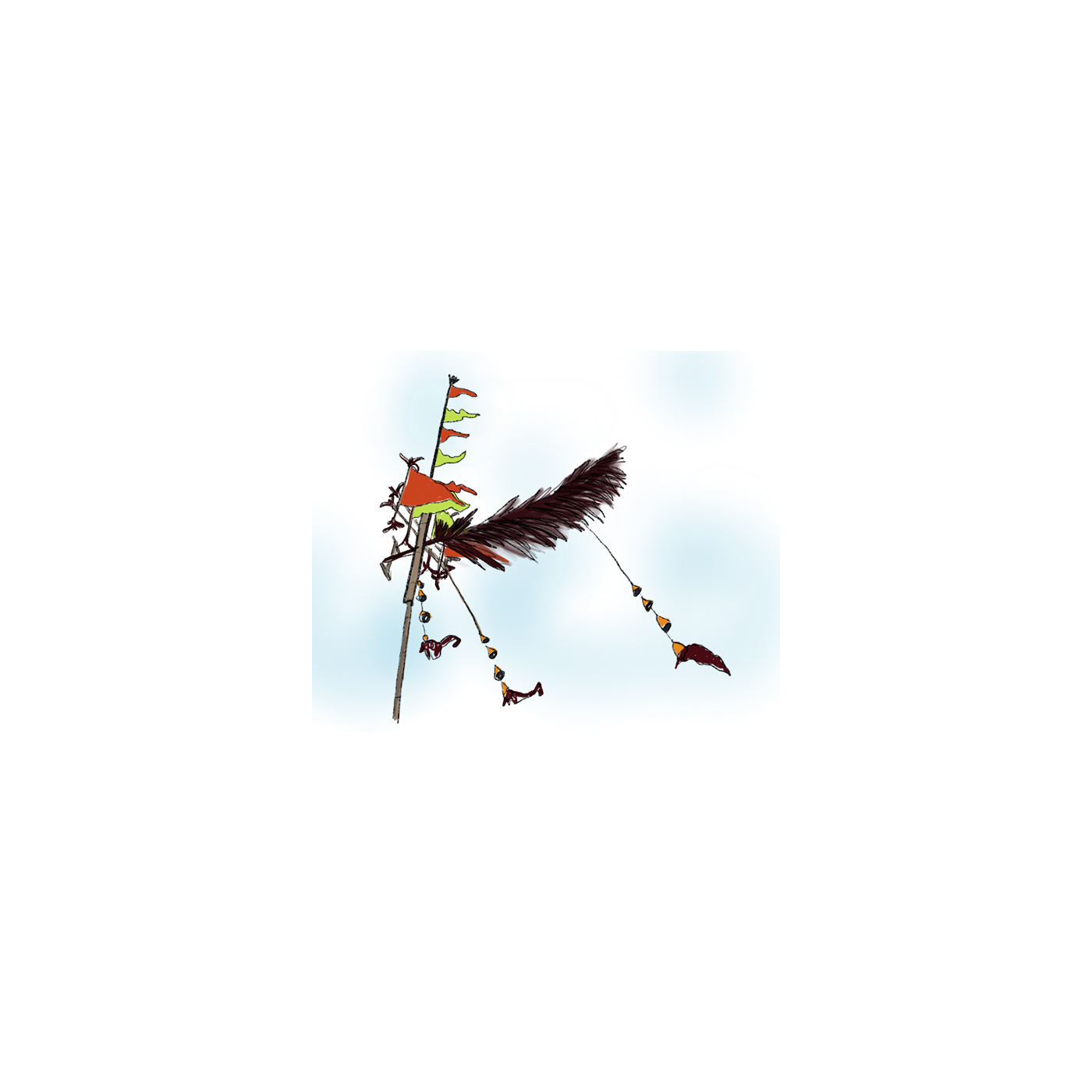
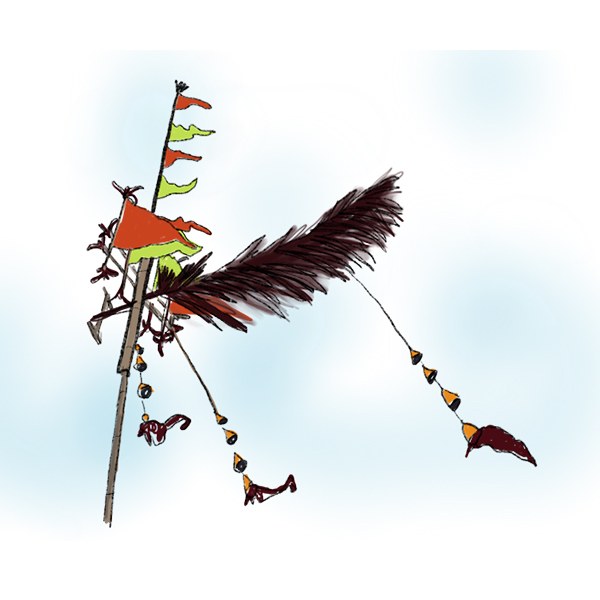
Luk Lom (Lin Lom) — two-sided wind-twisted rattle made from kha tree leaves, with bamboo cylinder, shark-mouth-shaped bamboo, and rattan tail. Makes noise to scare birds.
Luk Lom (Lin Lom, Ling Lom, Kangsa) of the southern region are both toys and bird-scarers, turned by the wind. Two-sided rattles strike the air, producing sound audible up to 3 kilometers away, and the chicken-tail indicator shows wind direction.
This blueprint builds a real luk lom following the method in the source material.
Advanced
Several days
Instructions
1
1
Size
Size
Loading Jupyter Notebook...
2
2
Previous rice field tools
Previous rice field tools
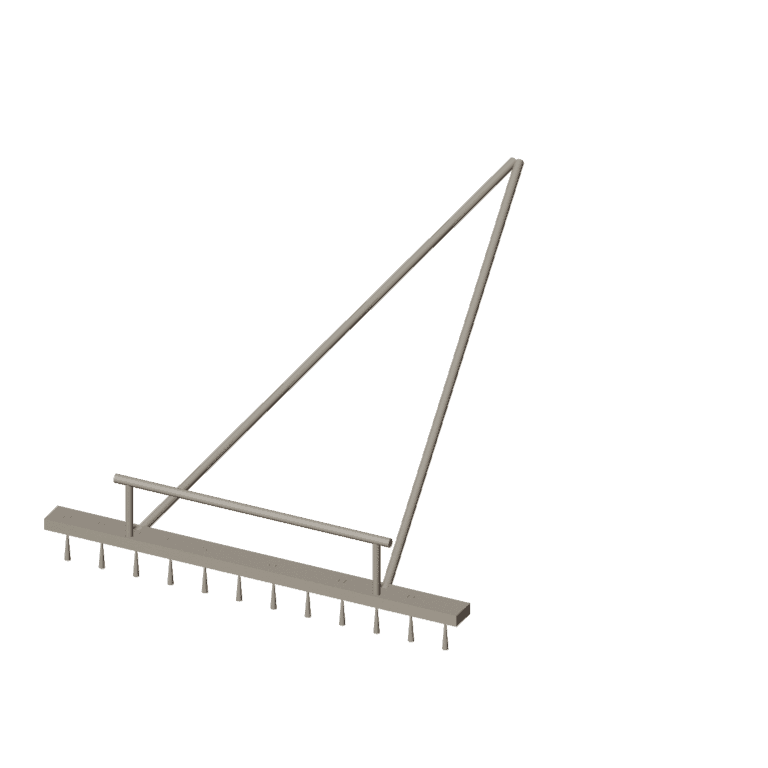
A rake used to prepare rice paddy soil. Spinning wheels are placed on it to scare birds away from the field and indicate wind direction.
3
3
Read from the source
Read from the source
"If the sound is not yet harmonious, apply shan wax (stingless bee wax) to the mouth of the ruea (the sound-producing part) and try running it again to test the sound until it is pleasing." (Sirindhorn Anthropology Centre, informant Prasert Khongmun, Ban Na Muen Si Luk Lom Conservation Group, CC BY 4.0)
4
4
Round-tail (ตัวลูกลม)
Round-tail (ตัวลูกลม)
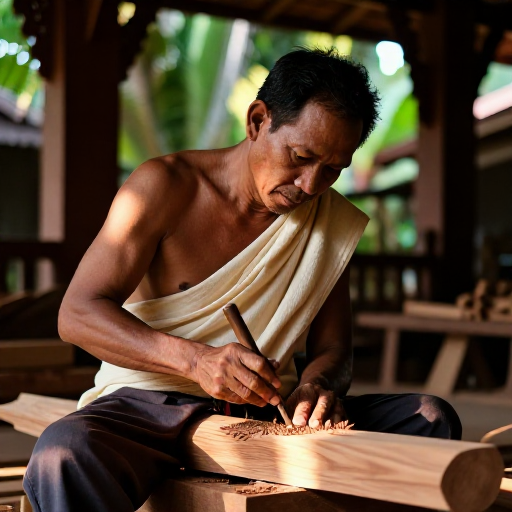
Use straight, knot-free cana bamboo, air-dry it in the sun for at least about 2 weeks, shape the rough form with an axe, then finish with a one-handed shaping adze and a knife. Divide it into three sections; the middle section is about 1 kradiep thicker than the ends. Cut a square hole to fit a rie reed tube. Both sides are shaped to be wavy, one side curving left and the other right, with uniform thickness throughout. The back is slightly curved like a propeller blade, and the two ends are notched. Drill 2 pairs of holes on each side for tying the lug-rong and lug-whei.
Tools needed:
 Axe
 Adze
 Knife
5
5
Riyan tube, roaring child, whistling child
Riyan tube, roaring child, whistling child
The riyan tube is made of ripe yellow bamboo. One end is cut into a square that fits into the center of a round piece. Wax is applied inside so it slides smoothly and does not heat up when rotated on the handle. The roaring child is made of ripe yellow bamboo (small round pieces use tube bamboo or rauk bamboo). One side is left with a node; the surface is smoothed to neither thick nor thin. The other side is cut into a shark mouth about half an inch from the tip, sealed with resin, and tied with rattan so it protrudes 2 inches past each end of the round piece, with the mouths facing opposite directions. The whistling child is made the same way but shorter and smaller, without resin, tied to the outer rim of the opposite mouth.
Materials for this step:
 Bamboo Poles1 piece
 Beeswax1 piece
Tools needed:
 Hand Saw
6
6
Sao (pole), wheel barrel, handle lever, rooster-tail
Sao (pole), wheel barrel, handle lever, rooster-tail
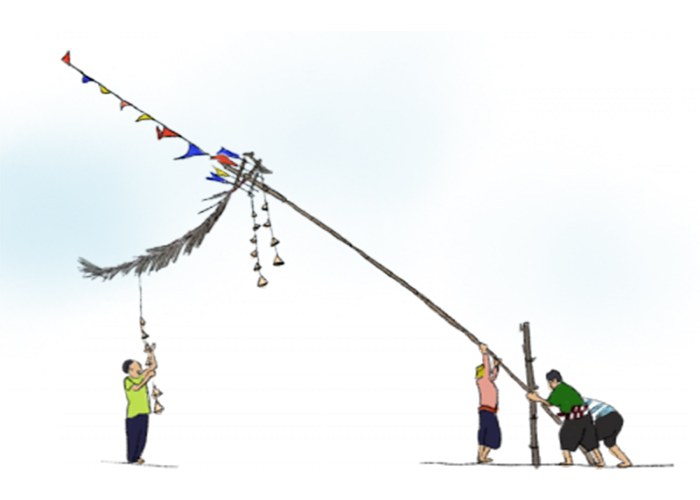
The sao is a straight, fully ripened bamboo pole with the tip cut flush at a node, inserted into the wheel barrel. A large ball is tied to it, with 3 additional bamboo pieces attached below the wheel barrel at 3 joints, splitting into 3 legs. The wheel barrel is a fully ripened bamboo with long internodes, cut at the top and bottom ends, leaving a node in the middle; it fits over the tip of the sao and is bound with rattan to prevent splitting. Above the node, a hole is bored to insert the handle lever. The handle lever is tough, hard wood; at the front it is attached to the ball, extending long to the back where it attaches to the rooster tail. The rooster tail consists of at least 3 layered water-rattan strands, with tufts tied at the ends, positioned above the wheel barrel. At least 3 pieces of cloth in alternating colors are attached.
Materials for this step:
 Cotton Cloth1 piece
7
7
Real image
Real image
Drawing of luk lom and luk lom embroidery (Sirindhorn Anthropology Centre; informant Prasert Khongmun, Ban Na Muen Si Luk Lom Conservation Group, CC BY 4.0)
8
8
Test and use
Test and use
Small wind-kite: have someone hold the handle and run to test it, listening to the sound. If it's not yet harmonious, apply a bit of ash to the mouth of the kite, then run it again. Test large kites first by mounting them on short trees, possibly for a week, before mounting them on tall trees. Used to scare birds away from rice fields and to indicate wind direction. Mounting large kites on tall trees requires several people; be careful of falling from heights.
9
9
Troubleshooting
Troubleshooting
Ball float troubleshooting
Flow
Loading...
10
10
History and Limitations
History and Limitations
Luk lom is commonly found in the south, lodged atop tall trees near rest pavilions. Raising a large luk lom is a ceremony that requires at least 5 monks to be invited. Trang Province holds an annual competition in February, judged by sound and proportions. The Ban Na Muen Si Luk Lom Conservation Group makes small versions as toys and souvenirs. Raising a large luk lom on a tall tree requires several people, and care must be taken to avoid falling from the height.
Source: Sirindhorn Anthropology Centre, Folk Tools and Utensils Database, "Luk Lom". Informant: Prasert Khongmun, chairman of the Ban Na Muen Si Luk Lom Conservation Group (licensed under CC BY 4.0)
**Limitations** The source does not give dimensions for the lhoi-ree tube, khan lao, or sao. There is no product listing for mai khae, wai, and chan-ung, so these are noted in the text.
Materials
3- 1 piecePlaceholder
- 1 piecePlaceholder
- 1 piecePlaceholder
This blueprint makes
Related Blueprints
These blueprints share knowledge with this one — techniques, materials, or principles that connect them in the learning graph.
CC0 Public Domain
This blueprint is released under CC0. You are free to copy, modify, distribute, and use this work for any purpose, without asking permission.
Support the Maker by purchasing products through their Blueprint where they earn a Maker Commission set by Vendors, or create a new iteration of this Blueprint and include it as a connection in your own Blueprint to share revenue.