
Harvesting and Preparing Abaka Fiber — The World's Strongest Natural Fiber
Instructions
Know the abaca plant
Know the abaca plant
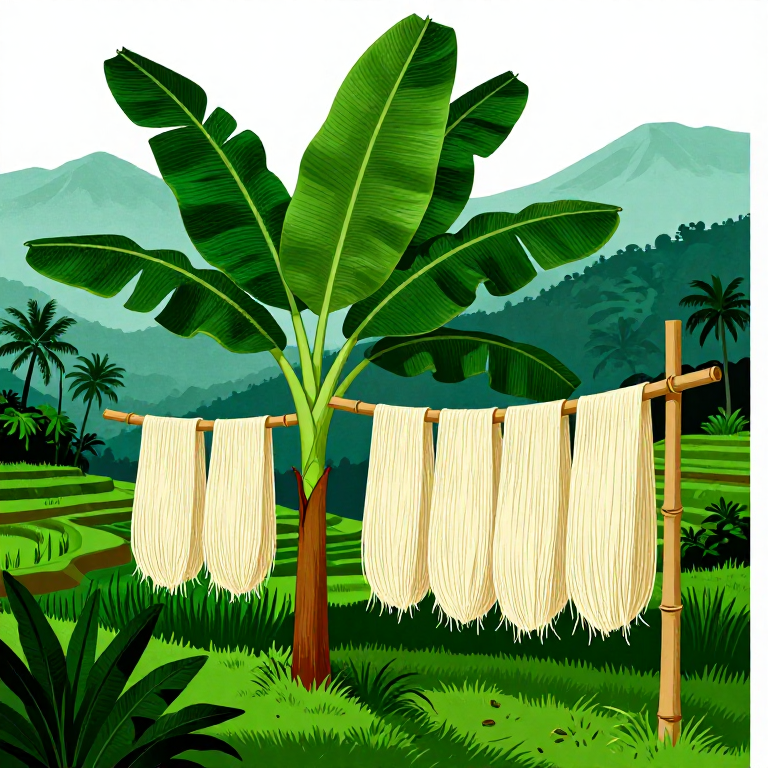
Abaca (Musa textilis) is a species of banana native to the Philippines. Unlike ordinary bananas, abaca is cultivated for its fiber, not its fruit. The plant grows 3 to 8 meters tall. The stalk (pseudostem) is composed of overlapping leaf sheaths that contain the valuable fiber. Each plant produces 12 to 25 leaf sheaths.
Determine the correct harvest time
Determine the correct harvest time
Abaca is ready to harvest after 18 to 24 months from planting. Signs of maturity: the first flower (inflorescence) has appeared, or some outer leaves have started to dry and turn yellow. Do not harvest too early — the fiber of young plants is weak and thin. Do not wait too long either — overly mature fiber becomes rough and brittle.
Prepare the tools
Prepare the tools
A sharp machete or bolo is needed for cutting the stalk and slicing the sheaths. Also prepare a stripping knife (tuxying knife) — a sharp blade attached to a wooden block used to pull the fiber from the sheath. Rope for bundling the fibers and bamboo poles or wire for the drying rack are also needed.
Tools needed:
 Sharp Bolo (large knife)
 Tuxying Knife (stripping blade)
 Tying Twine
 Bamboo Drying Poles
Cut the abaca stem
Cut the abaca stem
Cut the abaca stem at the root, about 5 to 10 cm from the ground, using a sharp bolo. The cut should be clean and horizontal. After cutting, lay the entire stem in a clean area. The cutting should be done in the morning when the plant is still full of moisture — this makes it easier to strip the fiber.
Materials for this step:
 Mature Abaca Stalk (18-24 months old)1 stalk
Tools needed:
Sharp Bolo (large knife)Slice the stalk into tuxies
Slice the stalk into tuxies
Separate each leaf sheath from the stalk, starting from the outermost. Each sheath is approximately 5 to 8 cm wide. Slice each sheath into thin strips called tuxies — about 5 to 7 cm wide and as long as the entire stalk (2 to 3 meters). The outer sheaths have coarser fiber, while the inner sheaths have the finest fiber.
Tools needed:
Sharp Bolo (large knife)Perform tuxying (hand-stripping)
Perform tuxying (hand-stripping)
Tools needed:
Tuxying Knife (stripping blade) Stripping Block (wooden)
Wash the fibers
Wash the fibers
Materials for this step:
 Distilled Water (1 Liter)20 liters
Tools needed:
 Washing Basin
Dry the fibers
Dry the fibers
Tools needed:
Bamboo Drying Poles Drying Area (direct sunlight)
Inspect drying quality
Inspect drying quality
Grade the fibers
Grade the fibers
Abaca fiber is graded in the Philippines using the Philippine Fiber Inspection Service (FIS) system. The main grades: S2 and S3 (finest — white, clean, strong) for specialty paper and banknotes. I2 and I3 (medium — dull to light tan) for rope and twine. G and H (low grade — dark brown) for packaging. Separate the fibers according to color, strength, and cleanliness.
Tools needed:
 Sorting Table
Bundle the fibers
Bundle the fibers
Materials for this step:
 Abaca Tying Twine5 meters
Proper fiber storage
Proper fiber storage
Tools needed:
 Wooden Storage Rack
 Dry Ventilated Storage Area
Understanding abaca uses
Understanding abaca uses
Record production and document
Record production and document
Tools needed:
 Field Notebook
 Weighing Scale
Materials
3- Placeholder
- 20 litersPlaceholder
- 5 metersPlaceholder
Tools Required
12- Placeholder
- Placeholder
- Placeholder
- Placeholder
- Placeholder
- Placeholder
- Placeholder
- Placeholder
- Placeholder
- Placeholder
- Placeholder
- Placeholder
CC0 Public Domain
This blueprint is released under CC0. You are free to copy, modify, distribute, and use this work for any purpose, without asking permission.
Support the Maker by purchasing products through their Blueprint where they earn a Maker Commission set by Vendors, or create a new iteration of this Blueprint and include it as a connection in your own Blueprint to share revenue.