
ART
BEAUTY & WELLNESS
CRAFT
CULTURE & HISTORY
ENTERTAINMENT
ENVIRONMENT
FOOD & DRINKS
GREEN FUTURE
REVERSE ENGINEERING
SCIENCES
SPORTS
TECHNOLOGY
WEARABLES
Clove Harvest in Maluku — Picking and Traditionally Drying Clove Flowers
English
BuMelati

Created by

BuMelati

23. April 2026ID
0
0
0
0
0

Clove Harvest in Maluku — Picking and Traditionally Drying Clove Flowers

A comprehensive guide to harvesting cloves (Syzygium aromaticum) traditionally in the Maluku Islands, Indonesia — the native homeland of the clove spice. Cloves are unopened flower buds from the clove tree, harvested when pink in color before the sepals open. Indonesia is the world's largest clove producer (approximately 75% of global production). North Maluku (Ternate, Tidore, Bacan) and Maluku (Ambon, Seram) are home to the world's oldest clove trees, some over 350 years old. This blueprint covers

Intermediate
5-7 days (including drying)

Instructions

1

Get to Know the Clove Tree (Syzygium aromaticum)

The clove tree (Syzygium aromaticum, family Myrtaceae) is an evergreen tree originating from the Maluku Islands. Mature trees reach a height of 10-15 meters, with a distinctive conical crown shape. The leaves are oblong, dark glossy green, 8-13 cm long, and contain eugenol oil that is fragrant when crushed. The bark is smooth and grey in color. Clove trees begin flowering at 5-7 years of age and reach full production at 15-20 years. A single mature tree produces 3-7 kg of dried cloves per year. The main component of clove oil is eugenol (72-90%), which gives it the characteristic aroma and antiseptic properties. In Maluku, the main harvest season falls between September and December.
2

Assess the Tree's Readiness for Harvest

Before harvesting, inspect each tree to determine flower readiness. Cloves grow in clusters called "tandan" at the tips of branches. Each cluster contains 3-20 flower buds. Watch the bud color carefully: immature buds are green, then turn pink as they approach maturity. The ideal harvest time is when the buds have turned bright pink to reddish-pink, with a bud length of approximately 1.5-2 cm. The four petals are still tightly closed, forming a round ball at the tip of the bud. Do not wait until the petals begin to open — cloves that have bloomed (called "cengkeh kembang") are of much lower quality because the eugenol content decreases and the color becomes pale after drying.

Tools needed:

Binoculars (for inspecting upper branches)Binoculars (for inspecting upper branches)
3

Prepare the Harvesting Equipment

Prepare all equipment before climbing the tree. The picking container is a small plastic bucket or cloth bag tied around the waist so both hands are free for picking. Prepare a bamboo ladder (pole ladder) long enough to reach the first branch — usually 3-5 meters. Spread a tarpaulin under the tree to catch buds that fall during picking. Check the ladder condition — make sure the rungs are strong and not cracked. Also prepare rope to tie yourself to the main branch when working at height. Wear non-slip shoes because clove tree bark can be slippery when wet with morning dew.

Materials for this step:

Canvas Waist BagCanvas Waist Bag1 piece
Nylon Rope (10mm diameter)Nylon Rope (10mm diameter)5 meters
Tarpaulin Sheet (4m x 4m)Tarpaulin Sheet (4m x 4m)1 piece

Tools needed:

Bamboo Ladder (5m)Bamboo Ladder (5m)
Rubber-Soled ShoesRubber-Soled Shoes
4

Climbing the Tree and Picking Technique

Lean the bamboo ladder against the main trunk and climb to the first branch. From the main branch, climb higher by holding onto sturdy branches. In Maluku, experienced pickers can work at heights of 10-12 meters. Picking technique: hold the bud cluster with one hand, then pick the buds one by one or in small groups (2-3 buds at a time) with the other hand. Use the thumb and index finger to snap the bud stem just below the calyx. Do not pull an entire cluster at once as this damages the branch and reduces next year's production. Place the buds in the waist bag. When the bag is full, lower it by rope to a person below. Picking should be done in the morning (6:00-11:00 AM) when the air is still cool — buds are crisper and easier to pick.

Tools needed:

Canvas Waist BagCanvas Waist Bag
Bamboo Ladder (5m)Bamboo Ladder (5m)
5

Gather the Picked Harvest

Collect all picked buds from the tarpaulin and bags into large bamboo baskets. An experienced picker can harvest 5-10 kg of fresh buds per day. Roughly inspect the harvest: remove leaves, small twigs, and already-bloomed buds. Fresh buds are pink, full of oil, and feel sticky when squeezed. Do not pile fresh buds too high (maximum 20 cm) in baskets because the pressure causes buds to burst and oil to evaporate. Bring the harvest to the processing area as quickly as possible — fresh buds piled for more than 12 hours begin to ferment and lose quality.

Materials for this step:

Large Bamboo BasketLarge Bamboo Basket2 pieces
6

Separate Buds from Stems

The picked clove buds still have a short stem (peduncle) attached. The stems must be separated because they are sold separately at a lower price (clove stems contain 5-6% eugenol, far less than the 15-20% in buds). Sit in a shaded area and take buds one by one. Snap the stem at the base of the bud using the thumb and index finger. Collect the stems separately — do not discard them as clove stems still have economic value for oil distillation. This process is time-consuming and is usually done by the entire family together. From 10 kg of buds with stems, you get approximately 7-8 kg of buds without stems and 2-3 kg of stems.

Materials for this step:

Woven Bamboo Tray (nyiru)Woven Bamboo Tray (nyiru)2 pieces
7

Sun-Drying Cloves on Bamboo Mats

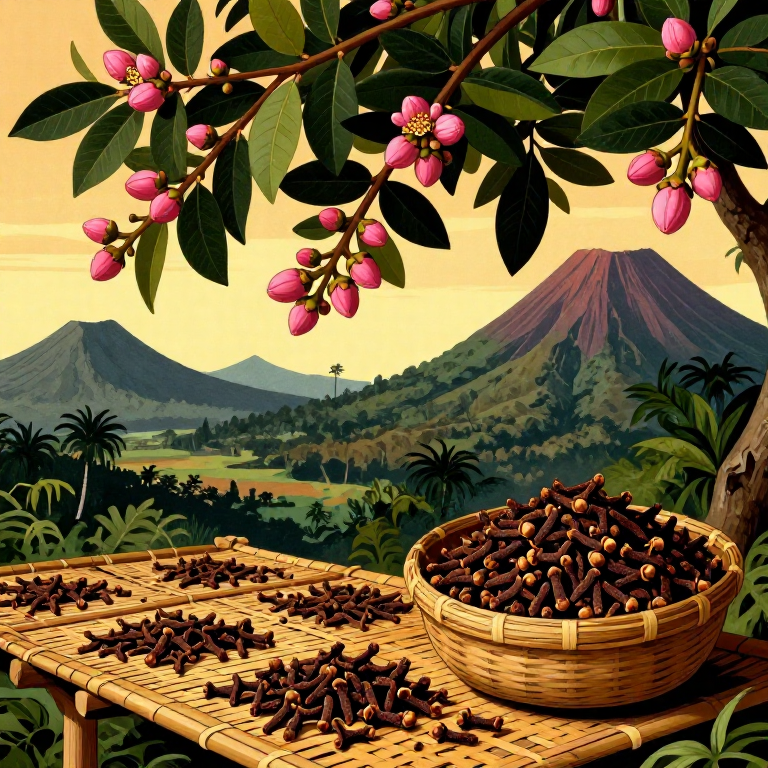
Spread bamboo mats (para-para) in a yard that receives direct sunlight throughout the day. Scatter the clove buds in a thin single layer on the mats — maximum thickness of 3-4 cm. Do not pile too thick because the bottom layer will not dry evenly and may develop mold. Stir and turn the buds 3-4 times daily for even drying. Sun-drying takes 4-5 days in clear weather. The drying buds change color from pink to dark blackish-brown. At night and during rain, cover the cloves with tarpaulin and move the mats under shelter. Avoid direct contact with the ground — ground moisture causes mold. In Maluku, the traditional drying yard is called "lantai jemur" and is usually made of smooth-plastered concrete.

Materials for this step:

Woven Bamboo Drying MatWoven Bamboo Drying Mat4 pieces
Tarpaulin Sheet (4m x 4m)Tarpaulin Sheet (4m x 4m)1 piece

Tools needed:

Wooden Rake (for spreading cloves)Wooden Rake (for spreading cloves)
8

Check the Moisture Content of Dried Cloves

Cloves are considered fully dried when their moisture content reaches 12-14%. Simple test without equipment: take one dried bud and press its stem with a fingernail — if it snaps with a sharp "click" sound, the moisture content is sufficiently low. If the stem only bends without breaking, the cloves are still too wet and need more drying. Another test: squeeze several buds in the palm of your hand — well-dried cloves feel hard, not sticky, and release a strong eugenol aroma. The weight of cloves decreases by approximately 65-70% during drying: from 10 kg of fresh buds to 3-3.5 kg of dried cloves. If available, use a moisture meter for more accurate measurement — moisture content above 14% causes mold during storage.

Tools needed:

Grain Moisture MeterGrain Moisture Meter
9

Clean the Dried Cloves

After fully drying, the cloves need to be cleaned of impurities. Pour the cloves into a bamboo winnowing tray (nyiru) and winnow with a swinging motion — dust, fine sand, and small fragments will be blown away by the wind. Separate whole buds from broken ones. Remove remaining stems, dried leaves, and any foreign objects. Clean cloves have an even dark blackish-brown color, oily on the surface, and a sharp fragrant aroma. This cleaning process is important for getting the best market price — cloves mixed with impurities are valued much lower.

Tools needed:

Woven Bamboo Winnowing Tray (nyiru)Woven Bamboo Winnowing Tray (nyiru)
10

Grading and Quality Classification

Dried cloves are sorted into several quality grades based on the SNI standard (Indonesian National Standard 01-3392-1994). Grade I: whole buds, uniform dark brown-black color, short stem still attached, maximum 12% moisture content, minimum 18% essential oil content, no mold. Grade II: whole to slightly broken buds, slightly less uniform color, maximum 14% moisture content, minimum 16% essential oil content. Grade III: mix of whole and broken buds, non-uniform color, minimum 14% essential oil content. Besides buds, clove stems and bloomed buds (mother cloves) are sold separately at lower prices. Sorting is done visually on a flat table with good lighting.

Tools needed:

Flat Sorting TableFlat Sorting Table
Weighing Scale (digital, 0-50 kg)Weighing Scale (digital, 0-50 kg)
11

Weigh and Record the Harvest

Weigh each quality grade separately. Record the weight, harvest date, source tree, and quality grade in a record book. This documentation is important for knowing the productivity of each tree and planning next year's harvest. A mature clove tree (20+ years old) produces an average of 3-7 kg of dried cloves per harvest, but production is seasonal — a high-production year (on-year) is usually followed by a low-production year (off-year). On traditional Maluku plantations, farmers own 50-200 trees and the total harvest for one season can reach 200-500 kg of dried cloves per family.

Materials for this step:

Record NotebookRecord Notebook1 piece

Tools needed:

Weighing Scale (digital, 0-50 kg)Weighing Scale (digital, 0-50 kg)
12

Storage of Dried Cloves

Place the dried cloves into clean jute sacks lined with plastic bags inside to prevent moisture absorption. Fill sacks to a maximum of 60 kg — do not pack too tightly so air circulation is maintained. Tie the sacks securely and label them with the quality grade, weight, and packaging date. Store the sacks in a warehouse that is dry, well-ventilated, and not exposed to direct sunlight. Place sacks on wooden pallets, at least 15 cm off the floor, to avoid absorbing floor moisture. Do not store near other strong-smelling materials as cloves easily absorb odors. Properly stored dried cloves can last 2-3 years without significant quality loss. Check regularly every 2-3 weeks to ensure there is no mold, insects, or increased moisture.

Materials for this step:

Jute Sack (60 kg capacity)Jute Sack (60 kg capacity)5 pieces
Polyethylene Liner BagPolyethylene Liner Bag5 pieces
Wooden Storage PalletWooden Storage Pallet2 pieces
Adhesive LabelsAdhesive Labels10 pieces

Tools needed:

Sack Sewing Needle (curved)Sack Sewing Needle (curved)
Jute TwineJute Twine
13

Clove Tree Care After Harvest

After the harvest is complete, clove trees require maintenance to ensure good production the following year. Clear the area under the tree canopy of weeds and brush. Apply organic fertilizer (compost or manure) at 15-20 kg per mature tree, spread evenly under the canopy at a radius of 1-2 meters from the trunk. Fertilizing is done after harvest when the rainy season begins (December-January in Maluku) so the fertilizer is absorbed by the wet soil. Prune dead, diseased, or overly dense branches to maintain air circulation within the canopy. Check for stem borer pest attacks (Hexamitodera semivelutina) — signs include small holes in the bark with fine sawdust below. A well-maintained clove tree can remain productive for 100-150 years.

Materials for this step:

Organic CompostOrganic Compost20 kg

Tools needed:

Pruning ShearsPruning Shears
Garden HoeGarden Hoe

Materials

12

Tools Required

13

CC0 Public Domain

This blueprint is released under CC0. You are free to copy, modify, distribute, and use this work for any purpose, without asking permission.

Support the Maker by purchasing products through their Blueprint where they earn a Maker Commission set by Vendors, or create a new iteration of this Blueprint and include it as a connection in your own Blueprint to share revenue.

Discussion

(0)

Log in to join the discussion

Loading comments...