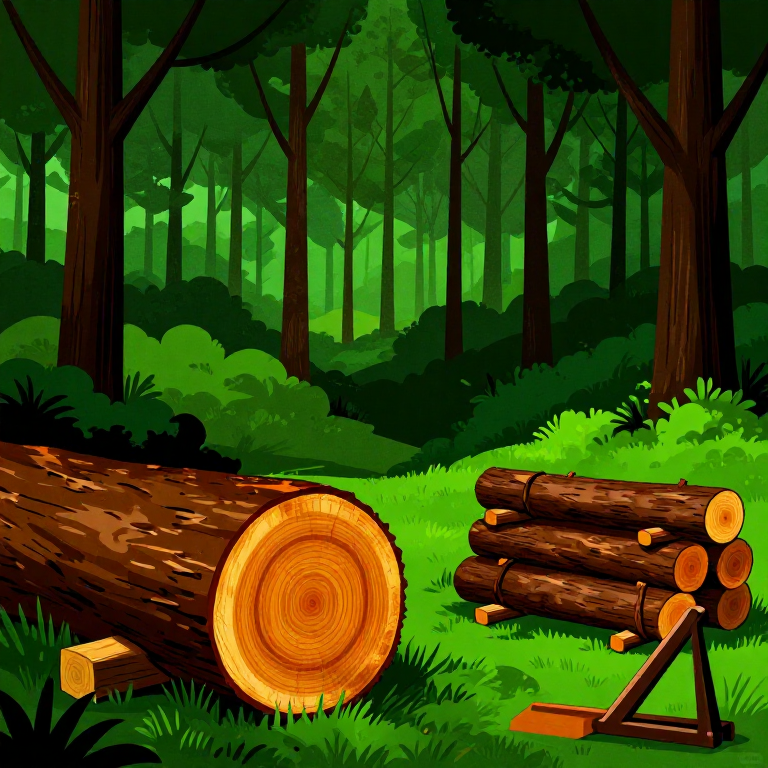


Teak Wood Harvest — How to Fell and Process Teak Wood from Java
Java Island has the oldest teak forests (Tectona grandis) in the world, managed since the Dutch colonial era around the 1600s. Currently Perhutani (Perum Perhutani) manages the state teak forests in Java. Javanese teak wood is famous throughout the world because of its excellent quality — resistant to termites, resistant to water, and durable for hundreds of years.
This blueprint explains how to fell and process teak wood from selecting mature trees to the drying and storage process. Good quality teak wood for furniture must be 40-80 years old so that the heartwood has grown perfectly. The heartwood is golden brown in color, rich in natural oils (tectoquinone) that make the wood resistant to termites and not easily rotting. This blueprint is divided into 14 sequential steps.
Instructions
Teak Wood Species (Tectona grandis)
Teak Wood Species (Tectona grandis)
Teak wood (Tectona grandis) belongs to the Lamiaceae family, originating from Southeast Asia. Teak wood can reach heights of 30-40 meters when mature. Its leaves are large (30-60 cm long), resembling tobacco leaves, and fall during the dry season (teak is a deciduous tree). The flowers are small and white, appearing during the rainy season. The bark is rough and ranges in color from gray to brown. Teak wood has two main layers: heartwood which is golden brown in color and sapwood which is lighter in color. The heartwood contains natural tectoquinone oil which makes the wood resistant to termites and water resistant.
Select Mature Trees for Felling
Select Mature Trees for Felling
Teak wood that is best for furniture must be 40-80 years old. At this age the heartwood has grown perfectly and the proportion of heartwood is greater than sapwood. Signs of trees that are ready to be felled: stem diameter at breast height (DBH, diameter at breast height) minimum 30-40 cm, tree bark is rough and cracked, and the tree is no longer growing tall (has reached maximum height). Perhutani uses a rotation cycle (rotation cycle) of 60-80 years. Younger trees can be felled for building timber, but the quality is not as good as old wood.
Tools needed:
Girdling (ring-barking) for preparation
Girdling (ring-barking) for preparation
Girdling (ring-barking) is the process of cutting the bark around the entire trunk with a width of 10-15 cm, removing the cambium layer. This process is carried out 1-2 years before felling. The purpose is for the wood to gradually lose water and sap, becoming lighter and drier when felled. Girdled wood is easier to dry and cracks less during the drying process. Girdling is done in the dry season when sap flow is at its lowest. Cut the bark carefully using an axe or machete — do not cut into the wood itself, only remove the bark and cambium.
Tools needed:
 Forestry Axe
Determine the right time to fell
Determine the right time to fell
Felling teak is best done in the dry season (June-September in Java) when the water content in the wood is at its lowest. During the dry season, teak trees have shed their leaves and sap flow has stopped. Wood felled in the dry season dries faster, cracks less, and is more resistant to termites than wood felled during the rainy season. Do not fell during heavy rain or when the ground is wet — there is danger of slipping and the wood gets dirty easily.
How to fell a teak tree
How to fell a teak tree
Materials for this step:
 Wooden Felling Wedge2 pieces
Tools needed:
 Chainsaw (professional forestry grade)Forestry Axe
 Sledgehammer
Cutting into logs (cross-cutting)
Cutting into logs (cross-cutting)
Materials for this step:
 Forestry Marking Chalk1 piece
Tools needed:
Chainsaw (professional forestry grade) Log Measuring Tape
Removing the bark (debarking)
Removing the bark (debarking)
Tools needed:
 Drawknife (bark spud)
Distinguishing heartwood and sapwood
Distinguishing heartwood and sapwood
Preparing the drying yard (stacking yard)
Preparing the drying yard (stacking yard)
Materials for this step:
 Concrete Foundation Block8 pieces
Wood Stack Arrangement for Natural Drying (Air Drying)
Wood Stack Arrangement for Natural Drying (Air Drying)
Logs or boards are arranged by inserting stickers (wooden separators) between each layer. Stickers are usually sized 2x2 cm or 3x3 cm, made from dry wood that has been treated with anti-fungal. The distance between stickers is approximately 60-90 cm. Stickers must be arranged straight vertically from bottom to top so that the weight is evenly distributed and does not bend. Natural drying (air drying) of teak wood requires 6-12 months depending on the thickness of the wood and weather conditions. The target moisture content is 12-15% for furniture. Each cubic meter of dry teak wood weighs approximately 640-720 kilograms.
Materials for this step:
 Wooden Sticker (drying spacer, 2x2 cm)30 pieces
Monitoring the drying process
Monitoring the drying process
Materials for this step:
 End Sealer (paraffin wax)1 kg
Tools needed:
 Pin-Type Wood Moisture Meter
Grading log quality
Grading log quality
Storing dried teak wood
Storing dried teak wood
Tools needed:
 Wooden Storage Platform
 Hygrometer (humidity gauge)
Understanding legal aspects and sustainability
Understanding legal aspects and sustainability
Materials
5- 2 piecesPlaceholder
- 1 piecePlaceholder
- 8 piecesPlaceholder
- Placeholder
- Placeholder
Tools Required
10- Placeholder
- Placeholder
- Placeholder
- Placeholder
- Placeholder
- Placeholder
- Placeholder
- Placeholder
CC0 Public Domain
This blueprint is released under CC0. You are free to copy, modify, distribute, and use this work for any purpose, without asking permission.
Support the Maker by purchasing products through their Blueprint where they earn a Maker Commission set by Vendors, or create a new iteration of this Blueprint and include it as a connection in your own Blueprint to share revenue.